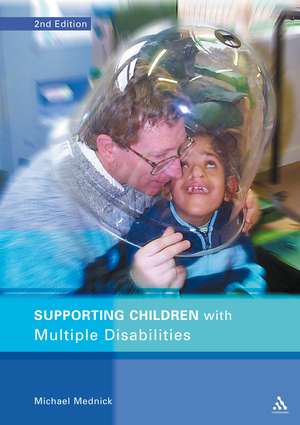
Supporting Children with Multiple Disabilities
Autor Michael Mednicken Limba Engleză Paperback – apr 2007
Supporting Children with Multiple Disabilities addresses the growing needs of professionals in a variety of educational settings, and provides a practical support framework for children, professionals and parents.
Techniques and methods are explored, leading the reader to find a range of keys that will empower them to unlock the door of learning for all multiple-disabled children.
Chapters focus on:
- Assessing children's abilities
- Possible problems of children with multiple disabilities
- Facilitating access to appropriate learning environments
- Supporting and including children with multiple disabilities in the classroom
- Developing mobility and motor skills
- Facilitating effective communication
- Developing a multi-sensory curriculum
- Facilitating access to the National Curriculum in mainstream education
This second edition has been updated throughout and now includes information on the Signalong signing system, visual timetables, personal passports, baseline assessment and P scales, learning resources and new technology.
This is an invaluable guide for all who work with multiple-disabled children.
Preț: 183.98 lei
Preț vechi: 316.26 lei
-42%
Puncte Express: 276
Carte tipărită la comandă
Livrare economică 04-18 iunie
Specificații
ISBN-13: 9780826492982
ISBN-10: 0826492983
Pagini: 205
Ilustrații: 10
Dimensiuni: 212 x 291 x 10 mm
Greutate: 0.63 kg
Ediția:2nd edition
Editura: BLOOMSBURY ACADEMIC
Locul publicării:London, United Kingdom
ISBN-10: 0826492983
Pagini: 205
Ilustrații: 10
Dimensiuni: 212 x 291 x 10 mm
Greutate: 0.63 kg
Ediția:2nd edition
Editura: BLOOMSBURY ACADEMIC
Locul publicării:London, United Kingdom
V-ar putea interesa
-
 The Last Sherlock Holmes StoryMichael DibdinPreț: 67.98 lei
 -
 -41%Preț: 78.98 lei134.84 lei
 -
 Teaching Young Learners EnglishJoan ShinPreț: 290.09 lei
 -
 Neuromotor Immaturity in Children and AdultsSally Goddard Blythe-5%Preț: 566.10 lei595.89 lei
 -
 Psychiatry of Intellectual DisabilityJulie P Gentile-5%Preț: 454.88 lei478.82 lei
 -
 -43%Preț: 81.17 lei141.49 lei
 -
 -28%Preț: 64.55 lei89.09 lei
 -
 Adapted Physical Education and SportJoseph P. Winnick-9%Preț: 716.60 lei787.48 lei
 -
 English Is Not EasyLuci GutiérrezPreț: 120.88 lei
 -
 The Teacher's Guide to SENNatalie PackerPreț: 134.34 lei
 -
 -22%Preț: 136.70 lei174.51 lei
 -
 -19%Preț: 158.53 lei196.91 lei
Cuprins
Contents
Introduction
Children with multiple disabilities
Terminology
Definitions
Meeting people with multiple disabilities
Key points
Possible problems
Disorders and delays
Problems related to medication
Eating problems
Other problems
Implications for multiple-disabled children
Common conditions
Syndromes
Specific problems for parents
Diet and behaviour
Key points
Developing effective communication skills
Role of an Intervenor or Intensive Interaction
Identifying 'Yes' and 'No'
Finding the Key
Selecting a communication mode
Communication modes
Tips for engaging in communication
Key points
Facilitating the use of sensory information and developing a multi-sensory curriculum
Function of the brain
Visual perceptual difficulties
Role of an Optometrist
The sensory system
Sensory integration
Multi-sensory curriculum
Key points
Assessment
Purposes of assessment
Types of assessment
General propositions
Evaluating assessment tools and procedures
Current approaches to assessment
Observation skills
Observation schedules
Task analysis
The ABC chart
Fixed Interval Sampling
Event sampling chart
Baselines
'P' Scales
Key points
Access to appropriate environments
The school building
A classroom environment checklist
Reactive Environments
Key points
Mobility and Motor Skills
Approaches to developing motor skills
Motor development
Stretching
Equipment
Sitting
Supporting sitting
Standing
Walking
Other equipment
Manual Handling
Handling Equipment
Risk Assessment
Key points
Support frameworks in mainstream education
Facilitating inclusive education
Support frameworks
Basic principles of working with multiple disabled children
Short-Term Planning Sheet
Weekly Planning Sheet
Weekly Record Support Sheet
Access to a Curriculum in mainstream education
Ways to guide good practice
Independence and Life Skill Training
Guidelines to facilitate subjects in the National Curriculum
Curriculum Boxes
Key points
Final Thoughts
Glossary
References
Introduction
Children with multiple disabilities
Terminology
Definitions
Meeting people with multiple disabilities
Key points
Possible problems
Disorders and delays
Problems related to medication
Eating problems
Other problems
Implications for multiple-disabled children
Common conditions
Syndromes
Specific problems for parents
Diet and behaviour
Key points
Developing effective communication skills
Role of an Intervenor or Intensive Interaction
Identifying 'Yes' and 'No'
Finding the Key
Selecting a communication mode
Communication modes
Tips for engaging in communication
Key points
Facilitating the use of sensory information and developing a multi-sensory curriculum
Function of the brain
Visual perceptual difficulties
Role of an Optometrist
The sensory system
Sensory integration
Multi-sensory curriculum
Key points
Assessment
Purposes of assessment
Types of assessment
General propositions
Evaluating assessment tools and procedures
Current approaches to assessment
Observation skills
Observation schedules
Task analysis
The ABC chart
Fixed Interval Sampling
Event sampling chart
Baselines
'P' Scales
Key points
Access to appropriate environments
The school building
A classroom environment checklist
Reactive Environments
Key points
Mobility and Motor Skills
Approaches to developing motor skills
Motor development
Stretching
Equipment
Sitting
Supporting sitting
Standing
Walking
Other equipment
Manual Handling
Handling Equipment
Risk Assessment
Key points
Support frameworks in mainstream education
Facilitating inclusive education
Support frameworks
Basic principles of working with multiple disabled children
Short-Term Planning Sheet
Weekly Planning Sheet
Weekly Record Support Sheet
Access to a Curriculum in mainstream education
Ways to guide good practice
Independence and Life Skill Training
Guidelines to facilitate subjects in the National Curriculum
Curriculum Boxes
Key points
Final Thoughts
Glossary
References