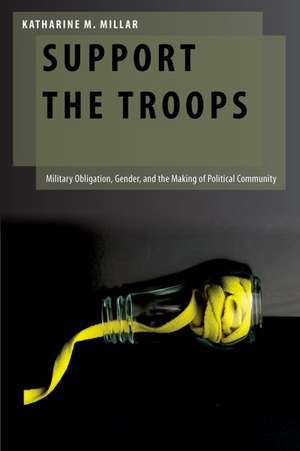
Support the Troops: Military Obligation, Gender, and the Making of Political Community: OXF STUDIES GENDER INTL RELATIONS SERIES
Autor Katharine M. Millaren Limba Engleză Hardback – 21 dec 2022
Preț: 571.84 lei
Preț vechi: 845.78 lei
-32%
Puncte Express: 858
Carte disponibilă
Livrare economică 12-18 noiembrie
Livrare prin curier în România Termenul estimat este afișat lângă disponibilitate.
Transport gratuit pentru acest produs Plată online sau ramburs, în funcție de opțiunile comenzii.
Retur gratuit în 14 zile Comandă securizată și suport în română.
Specificații
ISBN-13: 9780197642337
ISBN-10: 0197642330
Pagini: 304
Dimensiuni: 238 x 164 x 26 mm
Greutate: 0.59 kg
Editura: Oxford University Press
Colecția OUP USA
Seria OXF STUDIES GENDER INTL RELATIONS SERIES
Locul publicării:New York, United States
ISBN-10: 0197642330
Pagini: 304
Dimensiuni: 238 x 164 x 26 mm
Greutate: 0.59 kg
Editura: Oxford University Press
Colecția OUP USA
Seria OXF STUDIES GENDER INTL RELATIONS SERIES
Locul publicării:New York, United States
Recenzii
Katharine Millar's carefully researched study makes me more curious than ever about how civic 'obligation' is militarized by multi-pronged, even if fragmented, gendered public discourse. Her attention to distinct historical moments also has sharpened my awareness of the political impact of turning state soldiers first into 'our boys' and then into 'the troops.' Clearly, Millar reveals, producing a militarized citizenry takes a lot of work.
In today's liberal democracies, good citizens always 'support the troops.' Millar cleverly unpacks the layers of meaning, and the many contradictions, embedded in that simple, ubiquitous slogan. This book should be widely read not only by those troubled by contemporary expressions of militarism, but also by all students of liberalism and democratic citizenship.
This important and timely contribution gets to the heart of the contradictions associated with the now common-sense and widely embraced 'support the troops' rhetoric. Millar's brilliant and clearly written book demands a reckoning with the 'support the troops' trope and its role in legitimizing and upholding global war and political violence.
'Supporting the troops' is one of the primary ways citizens of liberal democracies participate in the wars conducted in their names. Breaking important new ground, Millar shows that this relationship of apolitical sentiment conceals a politics all its own, authorizing violence around the globe and defining belonging and value at home. Millar dares readers to imagine that a more peaceful world and a more just reckoning with war may both require leaving 'support' behind.
I would highly recommend it to both scholars and students for its empirical, theoretical and methodological contributions.
In today's liberal democracies, good citizens always 'support the troops.' Millar cleverly unpacks the layers of meaning, and the many contradictions, embedded in that simple, ubiquitous slogan. This book should be widely read not only by those troubled by contemporary expressions of militarism, but also by all students of liberalism and democratic citizenship.
This important and timely contribution gets to the heart of the contradictions associated with the now common-sense and widely embraced 'support the troops' rhetoric. Millar's brilliant and clearly written book demands a reckoning with the 'support the troops' trope and its role in legitimizing and upholding global war and political violence.
'Supporting the troops' is one of the primary ways citizens of liberal democracies participate in the wars conducted in their names. Breaking important new ground, Millar shows that this relationship of apolitical sentiment conceals a politics all its own, authorizing violence around the globe and defining belonging and value at home. Millar dares readers to imagine that a more peaceful world and a more just reckoning with war may both require leaving 'support' behind.
I would highly recommend it to both scholars and students for its empirical, theoretical and methodological contributions.
Notă biografică
Katharine M. Millar is an Assistant Professor of International Relations and a member of the Centre for Women, Peace and Security at the London School of Economics. She has participated in consultation processes regarding the UN Women, Peace and Security Agenda for the UK Foreign and Commonwealth Office, the US Marshall Center, the NATO Defense College, and the NATO Defence Education Enhancement Project (DEEP). She also works on policy engagement on gender and cybersecurity with institutions such as the UN Institute for Disarmament Research, Women in International Security, and Chatham House.