Cantitate/Preț
Produs

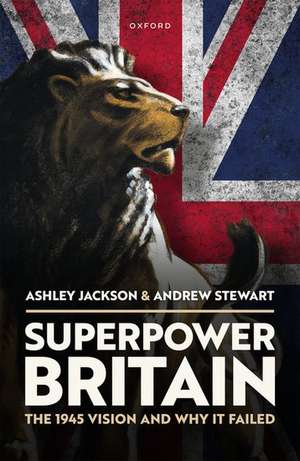
Superpower Britain: The 1945 Vision and Why it Failed

Autor Ashley Jackson, Andrew Stewart
en Limba Engleză Hardback – 13 feb 2025

Suntem de părere că Superpower Britain aduce o perspectivă proaspătă și necesară asupra istoriei postbelice, chestionând mitul conform căruia declinul Marii Britanii a fost acceptat ca inevitabil imediat după 1945. În timp ce istoriografia clasică subliniază adesea epuizarea economică și militară de după Al Doilea Război Mondial, Ashley Jackson și Andrew Stewart demonstrează că liderii britanici de la acea vreme nu anticipau un colaps, ci plănuiau o revitalizare imperială ambițioasă.

Lucrarea extinde cadrul propus de Clinging to Grandeur de Michael Blackwell cu date noi despre modul în care elitele politice și experții vremii considerau că paritatea cu noile superputeri, SUA și URSS, este un obiectiv realizabil. Dacă John Darwin în Britain and Decolonisation se concentrează pe procesul de dezintegrare, Superpower Britain analizează „viziunea care a eșuat”, explicând de ce planurile de regenerare păreau viabile în ochii contemporanilor. Ne-a atras atenția modul în care autorii integrează istoria domestică cu cea a coloniilor, arătând că zelul pentru renovarea imperială era văzut ca o condiție esențială pentru pacea mondială.

Contextualizând această apariție în opera lui Ashley Jackson, observăm o continuitate tematică față de lucrarea sa anterioară, The British Empire. Totuși, volumul de față este mult mai specific, focalizându-se pe contrastul fascinant dintre proiecțiile de mărire și realitatea geopolitică dură. Textul este structurat riguros, oferind o analiză detaliată a fundamentelor imperiale și a modului în care războiul le-a transformat, în ciuda optimismului oficial.

Citește tot Restrânge

Preț: 26452 lei

Preț vechi: 33666 lei
-21%

Puncte Express: 397

Carte disponibilă

Livrare economică 08-13 mai
Livrare express 22-28 aprilie pentru 12319 lei


Specificații

ISBN-13: 9780192863706
ISBN-10: 0192863703
Pagini: 480
Dimensiuni: 160 x 242 x 27 mm
Greutate: 0.85 kg
Editura: OUP OXFORD
Colecția OUP Oxford
Locul publicării:Oxford, United Kingdom

De ce să citești această carte

Recomandăm această carte istoricilor și pasionaților de relații internaționale care doresc să înțeleagă de ce Marea Britanie a încercat să își mențină statutul de superputere după 1945. Cititorul va câștiga o înțelegere profundă a decalajului dintre strategia politică și realitatea economică, descoperind o viziune despre lume care, deși a eșuat, a modelat decisiv structura geopolitică a secolului XX.


Despre autor

Ashley Jackson este un istoric reputat, cunoscut pentru cercetările sale aprofundate asupra Imperiului Britanic și a influenței conflictelor globale asupra acestuia. Printre lucrările sale notabile se numără The British Empire, o analiză vastă a celei mai mari entități politice din istorie, și Oxford's War, care explorează rolul strategic al universității în timpul celui de-al Doilea Război Mondial. Expertiza sa în istorie militară și imperială îi permite să abordeze subiectul puterii britanice cu o rigoare academică dublată de o capacitate remarcabilă de a sintetiza surse complexe.


Descriere

History tells us that the Second World War broke Britain as a great power, diminishing its military strength, ruining its economy, and precipitating a striking wave of decolonization. Nationalists and new superpowers dominated the post-war landscape, and the country was on the slide. But no one knew this in 1945 - the leading politicians, the top civil servants, and the most knowledgeable experts, all expected the British Empire to remain intact long into the future. There was no hint of imminent collapse, and the governing elite and key opinion-shapers weren't considering decline and decolonization, evincing instead a new zeal for imperial renovation and a belief that an empire which had just survived another global conflict was vital for the peace and security of all humankind. They were even looking to expansion, securing the spoils of victory as they had done at the end of the First World War. Fully expecting to continue leading a great empire as well as a bloc of European nations recovering from war, the British had their own vision of the new world order. Furthermore, and astonishingly given what actually happened, British leaders were convinced that parity could be gained with the Americans and the Soviets: Britain was to remain a superpower in its own right. What actually happened differed radically from these expectations. The question is, how do we account for the difference between what it was thought would happen and the actual course of events? Superpower Britain is the first book to focus in depth on this fascinating counterpoint and to fully integrate the history of Britain and the effects of the Second World War with the history of the British Empire. It explains what the British planned to do in the post-war world, why they thought their plans for regeneration and the future world order were viable, and what the war had actually done to British world power and its imperial foundations.

Recenzii

This important work deserves notice. It is certainly instructive.

Notă biografică

Ashley Jackson is Professor of Imperial and Military History at King's College London and a Visiting Fellow at Kellogg College, Oxford. He studied for postgraduate degrees at New College, Oxford, and spent eight years as a research fellow at Mansfield College, Oxford and a year as a lecturer at Oxford Brookes University.Andrew Stewart is an Honorary Professor at the Australian National University and Visiting Professor at King's College London. His previous roles have included Director of Academic Studies at the Royal College of Defence Studies and Principal at the Australian War College. A Fellow of the Royal Historical Society and the Higher Education Academy, he is also a trustee of the Liddell Hart Centre for Military Archives and the Society for Military History. His research covers conflict, diplomacy, and international relations, and his writing focuses on the Second World War. He is currently Director of Conflict Research at the Centre for Historical Analysis and Conflict Research, the British Army's think-tank.