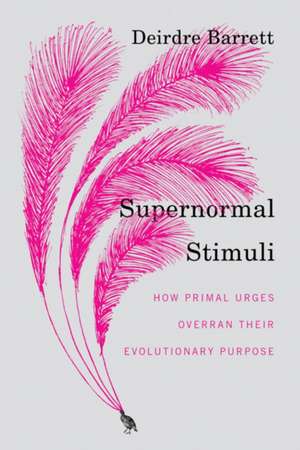
Supernormal Stimuli
Autor Deirdre Barretten Limba Engleză Hardback – feb 2010
Această monografie semnată de Deirdre Barrett, psiholog evoluționist la Harvard, reprezintă prima aplicare sistematică a conceptului de „stimuli supernormali” asupra comportamentului uman contemporan. Volumul investighează un paradox biologic alarmant: modul în care instinctele noastre de supraviețuire, perfecționate de-a lungul a milenii pentru viața în savană, au devenit vulnerabile în fața exceselor lumii moderne. De la pornografie și fast-food până la jocurile video și rețelele sociale, autoarea demonstrează cum industria modernă creează versiuni exagerate ale stimulilor naturali care ne păcălesc creierul. Structura argumentației pornește de la experimentele clasice ale lui Niko Tinbergen din anii '30 asupra păsărilor, oferind o bază solidă în biologia comportamentală. Supernormal Stimuli nu se limitează la a identifica problema, ci analizează impactul acestor stimuli asupra nutriției, relațiilor interumane și chiar a conflictelor armate. Stilul este unul riguros, ancorat în datele științifice ale psihologiei evoluționiste, dar accesibil prin cele 55 de ilustrații care facilitează înțelegerea proceselor de deturnare a instinctelor. Cititorii familiarizați cu Super Stimulated de Nicklas Brendborg vor aprecia profunzimea academică pe care o aduce Deirdre Barrett. În timp ce Brendborg se concentrează pe longevitate și sănătate, Barrett oferă o perspectivă mai largă, socio-psihologică, explicând rădăcinile evolutive ale acestor comportamente. De asemenea, lucrarea oferă un contrast modern necesar pentru textele fundamentale precum The Study of Instinct de Nikolaas Tinbergen, actualizând teoriile etologice pentru secolul XXI. Considerăm că forța cărții rezidă în mesajul său final: spre deosebire de subiecții lui Tinbergen, oamenii posedă capacitatea cognitivă de a recunoaște aceste capcane și de a-și recalibra reacțiile prin autocontrol.
Preț: 263.11 lei
Carte disponibilă
Livrare economică 09-23 noiembrie
Specificații
ISBN-10: 039306848X
Pagini: 226
Ilustrații: 55 illustrations
Dimensiuni: 156 x 217 x 25 mm
Greutate: 0.37 kg
Editura: W. W. Norton & Company
V-ar putea interesa
-
 Happiness: The Science Behind Your SmileDaniel Nettle-19%Preț: 70.27 lei86.35 lei
 -
 Consciousness Lost and Found: A Neuropsychological ExplorationLawrence Weiskrantz-28%Preț: 394.63 lei548.86 lei
 -
 The Fear of Contamination: Assessment and treatmentStanley Rachman-31%Preț: 560.56 lei815.04 lei
 -
 A User's Guide to the BrainJohn J. RateyPreț: 142.48 lei
 -
 A General Theory of LoveThomas LewisPreț: 101.14 lei
 -
 The Mindful BrainDaniel J SiegelPreț: 212.37 lei
 -
 Pocket Guide to Interpersonal NeurobiologyDaniel J. SiegelPreț: 260.34 lei
 -
 Visual ThinkingRudolf ArnheimPreț: 208.44 lei
 -
 The 3M Model of Motivation and PersonalityJohn C. Mowen-15%Preț: 668.60 lei786.59 lei
 -
 Why We LoveHelen FisherPreț: 116.08 lei
 -
 Preț: 83.27 lei
De ce să citești această carte
Recomandăm această carte oricui dorește să înțeleagă de ce obiceiurile moderne dăunătoare sunt atât de greu de combătut. Veți descoperi mecanismele biologice din spatele dependențelor digitale și alimentare, învățând cum să folosiți rațiunea pentru a prelua controlul asupra instinctelor arhaice. Este o lectură esențială pentru a naviga într-o lume configurată să ne exploateze vulnerabilitățile evolutive.