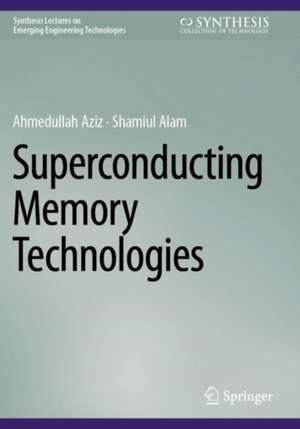
Superconducting Memory Technologies: Synthesis Lectures on Emerging Engineering Technologies
Autor Ahmedullah Aziz, Shamiul Alamen Limba Engleză Paperback – 19 mar 2025
Din seria Synthesis Lectures on Emerging Engineering Technologies
-
 Preț: 318.46 lei
 -
 Preț: 397.57 lei
 -
 Preț: 251.09 lei
 -
 Preț: 206.56 lei
 -
 Preț: 231.41 lei
 -
 Preț: 263.34 lei
 -
 Preț: 370.87 lei
 -
 Preț: 252.57 lei
 -
 Preț: 206.26 lei
 -
 Preț: 199.00 lei
 -
 Preț: 207.19 lei
 -
 Preț: 251.71 lei
 -
 Preț: 310.13 lei
 -
 Preț: 322.95 lei
 -
 Preț: 395.49 lei
 -
 Preț: 317.38 lei
 -
 Preț: 202.32 lei
 - nou
 Preț: 323.01 lei
 - nou
 Preț: 320.90 lei
Preț: 299.72 lei
Puncte Express: 450
Carte tipărită la comandă
Livrare economică 21-27 noiembrie
Livrare prin curier în România Termenul estimat este afișat lângă disponibilitate.
Transport gratuit de la 400.00 lei Plată online sau ramburs, în funcție de opțiunile comenzii.
Retur gratuit în 14 zile Comandă securizată și suport în română.
Specificații
ISBN-13: 9783031835599
ISBN-10: 303183559X
Pagini: 80
Dimensiuni: 168 x 240 x 5 mm
Greutate: 0.15 kg
Editura: Springer
Colecția Synthesis Lectures on Emerging Engineering Technologies
Seria Synthesis Lectures on Emerging Engineering Technologies
ISBN-10: 303183559X
Pagini: 80
Dimensiuni: 168 x 240 x 5 mm
Greutate: 0.15 kg
Editura: Springer
Colecția Synthesis Lectures on Emerging Engineering Technologies
Seria Synthesis Lectures on Emerging Engineering Technologies
Notă biografică
Ahmedullah Aziz is an Assistant Professor of Electrical Engineering & Computer Science at the University of Tennessee, Knoxville, USA. He earned his Ph.D. in Electrical & Computer Engineering from Purdue University in 2019, an MS degree in Electrical Engineering from Pennsylvania State University in 2016, and a BS degree in Electrical & Electronic Engineering from Bangladesh University of Engineering & Technology in 2013.
Dr. Aziz is an expert in device-circuit co-design and electronic design automation (EDA). His research laid the foundation for physics-based and semi-physical compact modeling of multiple emerging device technologies, including - Mott switches, oxide memristors, ferroelectric transistors, Josephson Junctions, cryotrons, topological memory/switches, and so on. His research portfolio comprises multiple avenues of exploratory nanoelectronics, spanning from device modeling to circuit/array design. In addition, Dr. Aziz has been a trailblazer in cryogenic memory technologies, facilitating critical advancements in quantum computing systems and space electronics. His works on memristive (room-temperature) and superconducting (cryogenic) neuromorphic systems have paved the way for dense, reconfigurable, and bio-plausible computing hardware.
He received several awards and accolades for his research, including the 'Translational Research Award' & 'Chancellor's Innovation Award' from UT Knoxville (2024), 'New Faculty Researcher Award' from American Society of Engineering Educators (2024), 'ACM SIGDA Outstanding Ph.D. Dissertation Award (2021)' from the Association of Computing Machinery, 'Outstanding Graduate Student Research Award (2019)' from Purdue University, and 'Icon' award from Samsung (2013). He is a technical program committee (TPC) member for multiple flagship conferences (including DAC and ISCAS), and a reviewer for several reputed journals (including Nature, Advanced Materials). He serves as an editorial board member for multiple journals including - 'Scientific Reports', and 'Frontiers in Nanotechnology'. He also served as a review panelist for the US Department of Energy and the National Science Foundation.
Shamiul Alam is a Ph.D. candidate in Electrical Engineering at the University of Tennessee, Knoxville, where he also completed his M.S. degree. He earned his B.S. in Electrical and Electronic Engineering from the Bangladesh University of Engineering and Technology in 2017. Prior to beginning his graduate studies in 2020, he served as a Lecturer in Electrical Engineering at the Military Institute of Science and Technology in Dhaka, Bangladesh.
Mr. Alam's research specializes in device modeling and circuit design, with a focus on developing logic, memory, and in-memory computing systems for room-temperature and cryogenic applications. He has authored over 40 research articles in prestigious journals and conferences. His work has been recognized as an "Editor's Pick" in Applied Physics Letters and featured in the "Top 100 in Physics" and "Top 100 in Materials Science" collections of Scientific Reports.
Descriere
It covers four main types of superconducting memories: Josephson junction-based, magnetic Josephson junction-based, superconducting memristor-based, and ferroelectric superconducting quantum interference device-based memories.