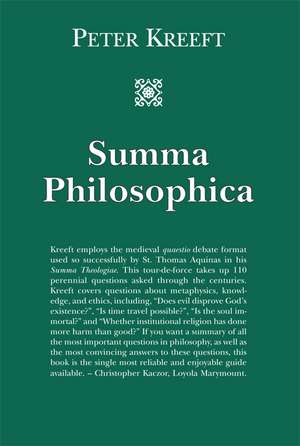
Summa Philosophica
Autor Peter Kreeften Limba Engleză Hardback – 9 iun 2012
Prin lucrarea de față, Peter Kreeft propune un demers marcat de o profundă interdisciplinaritate, situat la intersecția dintre filozofia clasică, teologia naturală și antropologia filozofică. Volumul nu este doar o expunere teoretică, ci o aplicare practică a riguroasei metode tomiste — faimoasa „quaestio” — asupra marilor dileme ale gândirii contemporane și perene. Reținem efortul autorului de a structura dialogul intelectual după modelul lăsat de Thomas Aquinas, oferind cititorului un instrument de analiză logică rar întâlnit în manualele moderne. Remarcăm organizarea sistematică a celor zece diviziuni ale filozofiei, care ghidează progresia lecturii de la bazele metodologice și logice către ramuri complexe precum metafizica, cosmologia și estetica. Această structură oglindește arhitectura gândirii medievale, dar este aplicată aici unor teme care vizează etica aplicată și filozofia politică, domenii esențiale pentru înțelegerea contextului social actual. Comparabil cu A Summary of Philosophy de Thomas Aquinas în ceea ce privește rigoarea dialectică, volumul lui Kreeft se distinge prin faptul că este actualizat pentru un public care caută claritate în terminologia modernă, fără a sacrifica densitatea argumentației. Fiecare dintre cele 110 întrebări abordate urmează un parcurs logic fix: prezentarea unei teze, sumarizarea obiecțiilor principale, invocarea unei autorități istorice și, în final, o demonstrație proprie urmată de demontarea punctuală a contraargumentelor. Acest ritm de expunere oferă o experiență de lectură disciplinată, transformând textul într-un exercițiu de gimnastică mentală. Putem afirma că Summa Philosophica reușește să recupereze autoritatea tradiției scolastice, oferind o sinteză coerentă a întregului spectru filozofic într-un format accesibil, dar necompromis academic.
Preț: 208.91 lei
Carte disponibilă
Livrare economică 16-30 mai
Specificații
ISBN-10: 1587318253
Pagini: 296
Dimensiuni: 161 x 241 x 28 mm
Greutate: 0.55 kg
Ediția:New
Editura: St. Augustine's Press
V-ar putea interesa
-
 Preț: 97.26 lei
 -
 Between Allah & JesusPeter KreeftPreț: 133.49 lei
 -
 Summa of the SummaPeter KreeftPreț: 169.31 lei
 -
 Prayer for BeginnersPeter KreeftPreț: 79.33 lei
 -
 Catholic ChristianityPeter KreeftPreț: 126.46 lei
 -
 The God Who Loves YouPeter KreeftPreț: 94.48 lei
 -
 Because God Is RealPeter KreeftPreț: 95.55 lei
 -
 Jacob's LadderPeter KreeftPreț: 77.77 lei
 -
 Practical TheologyPeter KreeftPreț: 139.53 lei
 -
 Acedia and Its DiscontentsR. J. SnellPreț: 104.25 lei
 -
 How to Be HolyPeter KreeftPreț: 86.11 lei
De ce să citești această carte
Această carte se adresează studenților la filozofie și teologie, precum și cititorilor care doresc să își disciplineze gândirea critică. Prin utilizarea metodei lui Thomas Aquinas, Summa Philosophica oferă un sistem complet de navigare prin istoria ideilor. Câștigul major al cititorului este deprinderea tehnicii de a demonta logic orice argument potrivnic, parcurgând o sinteză clară a zece discipline fundamentale.
Despre autor
Peter Kreeft este profesor de filozofie la Boston College și unul dintre cei mai prolifici autori contemporani de apologetică și filozofie creștină. Autor a peste 80 de cărți, Kreeft este recunoscut pentru capacitatea sa de a traduce concepte complexe din opera lui Thomas Aquinas sau C.S. Lewis pe înțelesul publicului larg. Opera sa se concentrează pe dialogul dintre credință și rațiune, fiind un punct de referință pentru studiile de filozofie și teologie practică în spațiul anglo-saxon.
Notă biografică
Cuprins
Textul de pe ultima copertă
First, Peter Kreeft imitated the Socratic dialogue form to put Socrates in conversation with Jesus, Hume, Descartes, Kant, and Machiavelli. Now, in Summa Philosophica, Kreeft employs the medieval quaestio debate format used so successfully by St. Thomas Aquinas in his Summa Theologiae. This tour-de-force takes up 110 perennial questions asked through the centuries. Kreeft covers questions about metaphysics, knowledge, and ethics, including, “Does evil disprove God’s existence?”, “Is time travel possible?”, “Is the soul immortal?” and “Whether institutional religion has done more harm than good?” If you want a summary of all the most important questions in philosophy, as well as the most convincing answers to these questions, this book is the single most reliable and enjoyable guide available. – Christopher Kaczor, Loyola Marymount, is author of How to Stay Catholic in College and The Ethics of Abortion.