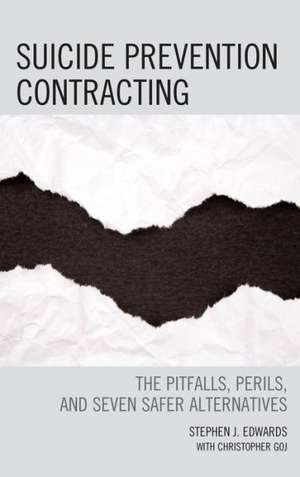
Suicide Prevention Contracting: The Pitfalls, Perils, and Seven Safer Alternatives
Autor Stephen J. Edwardsen Limba Engleză Hardback – 11 dec 2013
Preț: 525.14 lei
Preț vechi: 736.82 lei
-29%
Puncte Express: 788
Carte tipărită la comandă
Livrare economică 30 noiembrie-14 decembrie
Livrare prin curier în România Termenul estimat este afișat lângă disponibilitate.
Transport gratuit pentru acest produs Plată online sau ramburs, în funcție de opțiunile comenzii.
Retur gratuit în 14 zile Comandă securizată și suport în română.
Specificații
ISBN-13: 9780765709967
ISBN-10: 0765709961
Pagini: 221
Ilustrații: 12 BW Illustrations, 16 Tables
Dimensiuni: 154 x 230 x 20 mm
Greutate: 0.52 kg
Editura: Bloomsbury Publishing
Colecția Jason Aronson Inc
Locul publicării:New York, United States
ISBN-10: 0765709961
Pagini: 221
Ilustrații: 12 BW Illustrations, 16 Tables
Dimensiuni: 154 x 230 x 20 mm
Greutate: 0.52 kg
Editura: Bloomsbury Publishing
Colecția Jason Aronson Inc
Locul publicării:New York, United States
Cuprins
Preface
Acknowledgments
Symbols and Abbreviations
Introduction: Evidence Base behind this Book
Part 1: Current Understanding of Suicide Prevention Contracting
Chapter 1: A personal journey with SPC
Chapter 2: Historical review
Chapter 3: Definitions
Chapter 4: Causes of current concern
Part 2: A New Understanding of Suicide Prevention Contracting
Chapter 5: Profile of contemporary SPC
Chapter 6: The anatomy of contemporary SPC
Part 3: The Potential-to-Cause-Harm Profile of Suicide Prevention Contracting
Chapter 7: How SPC can compromise treatment
Chapter 8: The role of no suicide assurances in clinical practice
Chapter 9: Contraindications for SPC
Part 4: Alternatives to Suicide Prevention Contracting
Chapter 10: Seven alternatives to SPC
Conclusion
Frequently Asked Questions
Appendices: Teaching Tools
Useful links
Index
About the Author
Acknowledgments
Symbols and Abbreviations
Introduction: Evidence Base behind this Book
Part 1: Current Understanding of Suicide Prevention Contracting
Chapter 1: A personal journey with SPC
Chapter 2: Historical review
Chapter 3: Definitions
Chapter 4: Causes of current concern
Part 2: A New Understanding of Suicide Prevention Contracting
Chapter 5: Profile of contemporary SPC
Chapter 6: The anatomy of contemporary SPC
Part 3: The Potential-to-Cause-Harm Profile of Suicide Prevention Contracting
Chapter 7: How SPC can compromise treatment
Chapter 8: The role of no suicide assurances in clinical practice
Chapter 9: Contraindications for SPC
Part 4: Alternatives to Suicide Prevention Contracting
Chapter 10: Seven alternatives to SPC
Conclusion
Frequently Asked Questions
Appendices: Teaching Tools
Useful links
Index
About the Author
Recenzii
The aim of Suicide Prevention Contracting: The Pitfalls, Perils, and Seven Safer Alternatives is commendable: to caution mental health professionals against unthinkingly using nosuicide contracts. Authors Stephen J. Edwards and Christopher Goj firmly believe that nosuicide contracts are unhelpful, actually compromising treatment because, rather than reinforcing the clinician-client relationship, they erode the empathy and compassion that clinicians offer clients. Thus, this book not only condemns no suicide contracts as unhelpful but also warns that such contracts may go so far as to cause harm. . . .Edwards and Goj provide valid points and pull data from an impressively large sample. . . .[T]his book . . . [would] be . . . useful as a reference for clinicians.
Edwards and Goj offer a comprehensive review of the research and problems related to 'no suicide contracts.' They offer a variety of clinically viable alternatives to help mental health professionals work with suicidal patients.
As Edwards and Goj show with both clinical and scholarly acumen, 'no-suicide' contracts are both ill-advised and distressingly common. We need alternatives-clinically useful and research supported alternatives-and these authors provide several.
In this era of evidence-based suicide prevention it is surprising that the 'no-suicide' contract has endured. This new book-the first devoted solely to the 'no-suicide' contract-discusses why it should not be used and suggests seven safer substitutes. The book is a must for all those who work with suicidal clients, for those who supervise them, and for those in training.
Edwards and Goj offer a comprehensive review of the research and problems related to 'no suicide contracts.' They offer a variety of clinically viable alternatives to help mental health professionals work with suicidal patients.
As Edwards and Goj show with both clinical and scholarly acumen, 'no-suicide' contracts are both ill-advised and distressingly common. We need alternatives-clinically useful and research supported alternatives-and these authors provide several.
In this era of evidence-based suicide prevention it is surprising that the 'no-suicide' contract has endured. This new book-the first devoted solely to the 'no-suicide' contract-discusses why it should not be used and suggests seven safer substitutes. The book is a must for all those who work with suicidal clients, for those who supervise them, and for those in training.