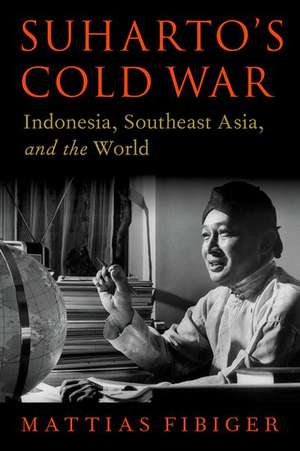
Suharto's Cold War: Indonesia, Southeast Asia, and the World: OXFORD STUDIES IN INTL HISTORY SERIES
Autor Mattias Fibigeren Limba Engleză Hardback – 21 aug 2023
Preț: 256.59 lei
Preț vechi: 319.69 lei
-20%
Puncte Express: 385
Carte tipărită la comandă
Livrare economică 04-15 decembrie
Livrare prin curier în România Termenul estimat este afișat lângă disponibilitate.
Transport gratuit de la 400.00 lei Plată online sau ramburs, în funcție de opțiunile comenzii.
Retur gratuit în 14 zile Comandă securizată și suport în română.
Specificații
ISBN-13: 9780197667224
ISBN-10: 0197667228
Pagini: 380
Ilustrații: 14 black and white halftones
Dimensiuni: 279 x 229 x 19 mm
Greutate: 0.64 kg
Editura: Oxford University Press
Colecția OUP USA
Seria OXFORD STUDIES IN INTL HISTORY SERIES
Locul publicării:New York, United States
ISBN-10: 0197667228
Pagini: 380
Ilustrații: 14 black and white halftones
Dimensiuni: 279 x 229 x 19 mm
Greutate: 0.64 kg
Editura: Oxford University Press
Colecția OUP USA
Seria OXFORD STUDIES IN INTL HISTORY SERIES
Locul publicării:New York, United States
Recenzii
In Suharto's Cold War, Mattias Fibiger not only situates the consolidation of the Suharto regime in Indonesia in the late 1960s and 1970s within the global Cold War context but also shows the consequences of the anti-communist turn in Indonesia under Suharto for the direction of the Cold War across Southeast Asia during this period. The book thus offers a major contribution to our understanding of the history of modern Indonesia and Southeast Asia, and of the Cold War.
Fibiger's well-researched book provides an incomparably detailed account of an all-important moment in the story of the Cold War in the Third World: the violent ending in the mid-1960s of President Sukarno's project of non-alignment and the founding of President Suharto's US-allied dictatorship. By revealing what the Cold War looked like from Jakarta, Fibiger re-orients our understanding of international relations history.
The book contributes to a greater understanding of how a post-colonial country navigates its domestic interest amidst immense global ideological tensions...Mattias Fibiger's Suharto's Cold War presents a highly original study to help make sense of the actions of Indonesia under Suharto in its interaction with other countries both in the region and beyond. The book reaffirms the importance of understanding the domestic context and political situation in explaining a country's foreign policy behaviour.
Suharto's Cold War is a major achievement and promises to be a key reference in years to come for the study of Indonesia, the Global Cold War,Third World counterrevolution, and the IR of Southeast Asia.
Mattias Fibiger compellingly illustrates Suharto's various domestic, regional, and global strategies, highlighting his central role in the clash between the Western and Eastern blocs. He depicts Suharto as an agent of the West, committed to eradicating leftist forces not only in Indonesia but throughout Southeast Asia. His book is recommended for readers looking to understand the evolution of Indonesia within the context of the Cold War, particularly how Suharto navigated the West's agenda.
Fibiger's well-researched book provides an incomparably detailed account of an all-important moment in the story of the Cold War in the Third World: the violent ending in the mid-1960s of President Sukarno's project of non-alignment and the founding of President Suharto's US-allied dictatorship. By revealing what the Cold War looked like from Jakarta, Fibiger re-orients our understanding of international relations history.
The book contributes to a greater understanding of how a post-colonial country navigates its domestic interest amidst immense global ideological tensions...Mattias Fibiger's Suharto's Cold War presents a highly original study to help make sense of the actions of Indonesia under Suharto in its interaction with other countries both in the region and beyond. The book reaffirms the importance of understanding the domestic context and political situation in explaining a country's foreign policy behaviour.
Suharto's Cold War is a major achievement and promises to be a key reference in years to come for the study of Indonesia, the Global Cold War,Third World counterrevolution, and the IR of Southeast Asia.
Mattias Fibiger compellingly illustrates Suharto's various domestic, regional, and global strategies, highlighting his central role in the clash between the Western and Eastern blocs. He depicts Suharto as an agent of the West, committed to eradicating leftist forces not only in Indonesia but throughout Southeast Asia. His book is recommended for readers looking to understand the evolution of Indonesia within the context of the Cold War, particularly how Suharto navigated the West's agenda.
Notă biografică
Mattias Fibiger is an Assistant Professor in the Business, Government, and International Economy Unit at Harvard Business School. He is a historian of Asia's twentieth century specializing in political economy and international relations in Southeast Asia.