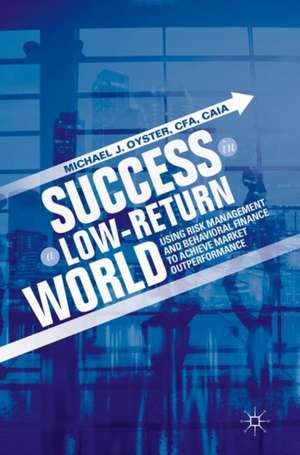
Success in a Low-Return World: Using Risk Management and Behavioral Finance to Achieve Market Outperformance
Autor Michael J. Oysteren Limba Engleză Paperback – 10 dec 2019
Most investment portfolios hold a greater allocation to stocks than any other class of investment asset. Massive amounts of wealth were created from the bull market since early 2009 providing institutions and individuals with a rising tide that lifted their portfolios above their goals without much effort. The environment of the future stands to be far less accommodating, so finding suitable investments (other than U.S. stocks) that can achieve the necessary returns (or make up the shortfall) will be a critical component of achieving goals in years to come. This book will explore those solutions.
Preț: 209.97 lei
Precomandă
Puncte Express: 315
Carte nepublicată încă
Livrare prin curier în România Precomanda se expediază când titlul devine disponibil.
Transport gratuit de la 400.00 lei Plată online sau ramburs, în funcție de opțiunile comenzii.
Retur gratuit în 14 zile Comandă securizată și suport în română.
Doresc să fiu notificat când acest titlu va fi disponibil:
Se trimite...
Specificații
ISBN-13: 9783030404697
ISBN-10: 3030404692
Pagini: 269
Dimensiuni: 155 x 235 mm
Ediția:1st ed. 2018
Editura: Springer
Colecția Palgrave Macmillan
Locul publicării:Cham, Switzerland
ISBN-10: 3030404692
Pagini: 269
Dimensiuni: 155 x 235 mm
Ediția:1st ed. 2018
Editura: Springer
Colecția Palgrave Macmillan
Locul publicării:Cham, Switzerland
Cuprins
Table
of
Contents
PART ONE: CHALLENGES IN INVESTING
Chapter 1: The Future Isn’t What it Used to Be
Chapter 2: An Obsolete Fundamental Philosophy
Chapter 3: As a Group, Professional Investors Are the Market
Chapter 4: The Specifics of Market Efficiency
Chapter 5: Fund Manager Fees
Chapter 6: To Err Is To Be Human. To Make a Behavioral Error Is To Be a Human Investor
Chapter 7: How Regulations Impact Investment Managers
Chapter 8: Performance Doesn’t Tell the Whole Story
PART TWO: SOLUTIONS
Chapter 9: Intuition
Chapter 10: Focus on Asset Allocation
Chapter 11: Indexing
Chapter 12: Active Share and Private Equity
Chapter 13: Momentum
Chapter 14: Smart Beta
Chapter 15: Risk Management
Chapter 16: Buy-Write
Chapter 17: Put Selling
Chapter 18: The Options Income Index
Chapter 19: Portable Alpha
Chapter 20: Epilogue
PART ONE: CHALLENGES IN INVESTING
Chapter 1: The Future Isn’t What it Used to Be
Chapter 2: An Obsolete Fundamental Philosophy
Chapter 3: As a Group, Professional Investors Are the Market
Chapter 4: The Specifics of Market Efficiency
Chapter 5: Fund Manager Fees
Chapter 6: To Err Is To Be Human. To Make a Behavioral Error Is To Be a Human Investor
Chapter 7: How Regulations Impact Investment Managers
Chapter 8: Performance Doesn’t Tell the Whole Story
PART TWO: SOLUTIONS
Chapter 9: Intuition
Chapter 10: Focus on Asset Allocation
Chapter 11: Indexing
Chapter 12: Active Share and Private Equity
Chapter 13: Momentum
Chapter 14: Smart Beta
Chapter 15: Risk Management
Chapter 16: Buy-Write
Chapter 17: Put Selling
Chapter 18: The Options Income Index
Chapter 19: Portable Alpha
Chapter 20: Epilogue
Notă biografică
Michael
J.
Oyster,
CFA,
CAIA
is
an
investment
strategist,
researcher
and
creator
of
theOptions
Income
Index.
He
began
his
professional
investment
career
in
1994
with
options
advisory
firm
Schaeffer’s
Investment
Research.
As
Schaeffer’s
senior
quantitative
analyst,
he
conducted
detailed
analysis
of
options
and
volatility
metrics
while
managing
product
offerings
including
an
S&P
500
Index
options
spread
strategy.
Upon joining Fund Evaluation Group, LLC (FEG) in 1999, Michael began researching traditional, hedge fund and options-based investment strategies as well as conducting and publishing independent research. As FEG’s Chief Investment Strategist, he served as a thought leader and frequent presenter on markets and the economy. His first book,Mission Possible, was published in 2005, and he was twice commissioned by the Chicago Board Options Exchange (Cboe) to conduct research on and provide summary analysis regarding suites of their proprietary options indexes. He serves as a board member on the Freestore Foodbank Foundation and on the Lincoln W. Pavey Educational Foundation.
Upon joining Fund Evaluation Group, LLC (FEG) in 1999, Michael began researching traditional, hedge fund and options-based investment strategies as well as conducting and publishing independent research. As FEG’s Chief Investment Strategist, he served as a thought leader and frequent presenter on markets and the economy. His first book,Mission Possible, was published in 2005, and he was twice commissioned by the Chicago Board Options Exchange (Cboe) to conduct research on and provide summary analysis regarding suites of their proprietary options indexes. He serves as a board member on the Freestore Foodbank Foundation and on the Lincoln W. Pavey Educational Foundation.
Textul de pe ultima copertă
Following
the
Great
Financial
Crisis,
the
S&P
500
advanced
more
than
17
percent
annualized
from
February
2009
through
June
2018.
At
this
pace,
a
buy-and-hold
investor
in
the
stock
market
would
see
their
money
double
in
5
years
and
more
than
triple
in
7
years.
This
performance
has
lulled
many
investors
into
thinking
that
such
above-average
returns
will
be
with
us
into
perpetuity.
Unfortunately,
this
may
not
be
the
case.
Far
more
likely,
the
return
an
investor
may
receive
from
the
stock
market
will
be
slightly
better
than
half
the
long-term
average,
about
5%
to
7%.
Most investment portfolios hold a greater allocation to stocks than any other class of investment asset. Massive amounts of wealth were created from the bull market since early 2009 providing institutions and individuals with a rising tide that lifted their portfolios above their goals without much effort. The environment of the future stands to be far less accommodating, so finding suitable investments (other than U.S. stocks) that can achieve the necessary returns (or make up the shortfall) will be a critical component of achieving goals in years to come. This book will explore those solutions.
Most investment portfolios hold a greater allocation to stocks than any other class of investment asset. Massive amounts of wealth were created from the bull market since early 2009 providing institutions and individuals with a rising tide that lifted their portfolios above their goals without much effort. The environment of the future stands to be far less accommodating, so finding suitable investments (other than U.S. stocks) that can achieve the necessary returns (or make up the shortfall) will be a critical component of achieving goals in years to come. This book will explore those solutions.
Caracteristici
Illustrates
some
reasons
why
active
managers
have
underperformed
Showcases how spreading assets among a variety of different, uncorrelated asset classes can lower risk portfolio wide
Shines a light on passive investing and smart beta to provide for outperformance
Explains how and why the volatility risk premium (VRP) is perhaps the most significant, untapped resource available to investors today
Showcases how spreading assets among a variety of different, uncorrelated asset classes can lower risk portfolio wide
Shines a light on passive investing and smart beta to provide for outperformance
Explains how and why the volatility risk premium (VRP) is perhaps the most significant, untapped resource available to investors today