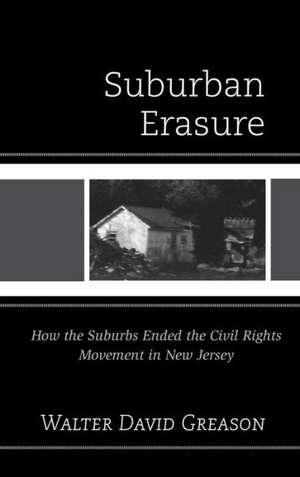
Suburban Erasure: How the Suburbs Ended the Civil Rights Movement in New Jersey
Autor Walter David Greasonen Limba Engleză Paperback – 30 iul 2014
| Toate formatele și edițiile | Preț | Express |
|---|---|---|
| Paperback (1) | 334.02 lei 6-8 săpt. | |
| Bloomsbury Publishing – 30 iul 2014 | 334.02 lei 6-8 săpt. | |
| Hardback (1) | 536.59 lei 6-8 săpt. | |
| Bloomsbury Publishing – 13 dec 2012 | 536.59 lei 6-8 săpt. |
Preț: 334.02 lei
Preț vechi: 467.88 lei
-29%
Puncte Express: 501
Preț estimativ în valută:
59.05€ • 70.55$ • 51.15£
59.05€ • 70.55$ • 51.15£
Carte tipărită la comandă
Livrare economică 14-28 martie
Specificații
ISBN-13: 9781611477290
ISBN-10: 1611477298
Pagini: 224
Ilustrații: 10 b/w photos;
Dimensiuni: 152 x 226 x 15 mm
Greutate: 0.31 kg
Editura: Bloomsbury Publishing
Colecția Fairleigh Dickinson University Press
Locul publicării:New York, United States
ISBN-10: 1611477298
Pagini: 224
Ilustrații: 10 b/w photos;
Dimensiuni: 152 x 226 x 15 mm
Greutate: 0.31 kg
Editura: Bloomsbury Publishing
Colecția Fairleigh Dickinson University Press
Locul publicării:New York, United States
Cuprins
Acknowledgments
Introduction
Chapter 1 - Family Life
Chapter 2 - Women's Historiography
Chapter 3 - Leadership
Chapter 4 - Churches and Schools
Chapter 5 - Civil Rights, Beginnings
Chapter 6 - Civil Rights, Endings
Chapter 7 - Resistance and Denial
Chapter 8 - Suburban Regions
Chapter 9 - Consumption
Chapter 10 - Metropolitan Poverty
Chapter 11 - Metropolitan Growth
Conclusion
Bibliography
About the Author
Introduction
Chapter 1 - Family Life
Chapter 2 - Women's Historiography
Chapter 3 - Leadership
Chapter 4 - Churches and Schools
Chapter 5 - Civil Rights, Beginnings
Chapter 6 - Civil Rights, Endings
Chapter 7 - Resistance and Denial
Chapter 8 - Suburban Regions
Chapter 9 - Consumption
Chapter 10 - Metropolitan Poverty
Chapter 11 - Metropolitan Growth
Conclusion
Bibliography
About the Author
Recenzii
Suburban Erasure is an impressive work of cultural history. Greason compliments his obviously extensive knowledge about American history and the Civil Rights movement with statistics from local sources and oral histories. The book's greatest strength is that the author illustrates the daily struggles and small victories of individuals with detailed stories, and then references those stories throughout the book as evidence to support his larger point.... Walter Greason's book will no doubt make a significant impact in the fields of American history and African-American studies. I am equally convinced of its importance for urban historians, such as myself, who may have been teaching an over-simplified version of the urban-suburban/black-white narrative to students. The truth is complicated, but the extraordinary commitment of Black rural communities in the flight towards racial equality is a story that begs to be told.
In Suburban Erasure Walter David Greason 'examines the roles of African Americans in transforming the culture, politics, and economics of rural New Jersey in the twentieth century (p. 2). He uses the first half of the book to explore the history of women, churches, and schools. . . .[T]he second half of the book picks up as Greason analyzes larger social trends such as suburbanization and the culture of consumption and their impact on African Americans. . . .[T]the second half brings together newer historio-graphical insights about suburbanization and consumption and makes more nuanced arguments about them. Historians of the African American experience, especially in New Jersey, will find these chapters to be of greater value.
Greason's argument resonates with the best recent scholarly literature. . . .Having unearthed sources that are often obscure or fragmentary, Greason's account of black resilience and persistence is impressive.
This is an ambitious, admirably researched and analyzed history of African American communities, their development, consolidation, and subsequent centrifugal diminution. Greason writes objectively, but one can sense the passion motivating it.
In Suburban Erasure Walter David Greason 'examines the roles of African Americans in transforming the culture, politics, and economics of rural New Jersey in the twentieth century (p. 2). He uses the first half of the book to explore the history of women, churches, and schools. . . .[T]he second half of the book picks up as Greason analyzes larger social trends such as suburbanization and the culture of consumption and their impact on African Americans. . . .[T]the second half brings together newer historio-graphical insights about suburbanization and consumption and makes more nuanced arguments about them. Historians of the African American experience, especially in New Jersey, will find these chapters to be of greater value.
Greason's argument resonates with the best recent scholarly literature. . . .Having unearthed sources that are often obscure or fragmentary, Greason's account of black resilience and persistence is impressive.
This is an ambitious, admirably researched and analyzed history of African American communities, their development, consolidation, and subsequent centrifugal diminution. Greason writes objectively, but one can sense the passion motivating it.