Cantitate/Preț
Produs

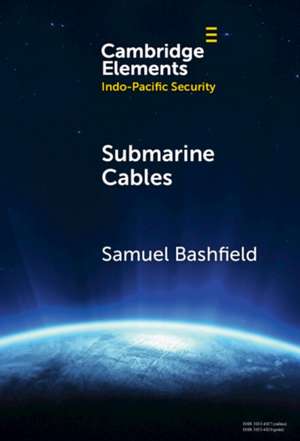
Submarine Cables

Autor Samuel Bashfield
en Limba Engleză Hardback – 6 aug 2026
How and why are key Indo-Pacific states adapting respective foreign and defence policies to secure submarine cable networks amid heightened Sino-US network-based competition? States are driven to control submarine cable networks as these infrastructures transmit information between continents and islands, traverse vulnerable maritime zones, and constrict data through limited chokepoints. China's Digital Silk Road has challenged Western submarine cable dominance, prompting a suite of countermeasures by Western states individually and in coalition. This Element posits a nodes-flows-production typology to illustrate how states are attempting to control connectivity nodes, secure transmission flows and dominate production. The analysis highlights how states are pursuing central network positions to mitigate vulnerability - but this structural competition risks enabling weaponisation. This microcosm of network-based competition reveals how the contest to control submarine cable infrastructure is defining contemporary great power rivalry and re-wiring the Indo-Pacific's arteries. This title is also available as Open Access on Cambridge Core.
Citește tot Restrânge

Preț: 47129 lei

Preț vechi: 58184 lei
-19%

Puncte Express: 707

Carte tipărită la comandă

Livrare economică 21 decembrie 26 - 04 ianuarie 27

Livrare prin curier în România Termenul estimat este afișat lângă disponibilitate.
Transport gratuit pentru acest produs Plată online sau ramburs, în funcție de opțiunile comenzii.
Retur gratuit în 14 zile Comandă securizată și suport în română.

Specificații

ISBN-13: 9781009651127
ISBN-10: 1009651129
Pagini: 94
Dimensiuni: 152 x 229 x 6 mm
Greutate: 0.3 kg
Editura: Cambridge University Press

Cuprins

1. Introduction: seabed lines of communication; 2. Submarine cable competition in context; 3. Cable breaks abound: accidental, negligent or malicious?; 4. The Indo-Pacific adapts; 5. The nodes-flows-production contest; 6. Conclusion: the seabed and Indo-Pacific security.