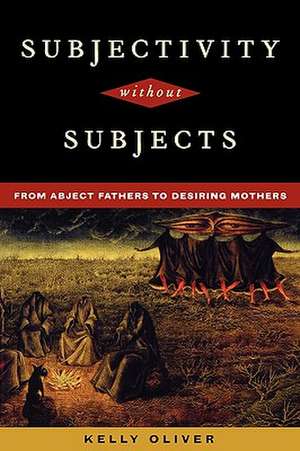
Subjectivity Without Subjects: From Abject Fathers to Desiring Mothers
Autor Kelly Oliveren Limba Engleză Paperback – 24 noi 1998
Oliver studies the roles of paternal responsibility, virility and race in such events as the Million Man March and the growth of the Promise Keeper's movement and suggests alternative ways to conceive of self-other relations and the subjective identity at stake in them. In addition she offers a detailed analysis of particular works by such well-known film-makers as Polanski, Bergman and Varda in developing a theory of identity that opens the subject to otherness or difference.
Preț: 145.23 lei
Preț vechi: 190.50 lei
-24%
Puncte Express: 218
Carte tipărită la comandă
Livrare economică 27 noiembrie-11 decembrie
Livrare prin curier în România Termenul estimat este afișat lângă disponibilitate.
Transport gratuit de la 400.00 lei Plată online sau ramburs, în funcție de opțiunile comenzii.
Retur gratuit în 14 zile Comandă securizată și suport în română.
Specificații
ISBN-13: 9780847692538
ISBN-10: 0847692531
Pagini: 224
Dimensiuni: 150 x 228 x 18 mm
Greutate: 0.3 kg
Editura: Bloomsbury Publishing
Colecția Rowman & Littlefield
Locul publicării:New York, United States
ISBN-10: 0847692531
Pagini: 224
Dimensiuni: 150 x 228 x 18 mm
Greutate: 0.3 kg
Editura: Bloomsbury Publishing
Colecția Rowman & Littlefield
Locul publicării:New York, United States
V-ar putea interesa
-
 Sex Rights: The Oxford Amnesty Lectures 2002Nicholas Bamforth-21%Preț: 262.42 lei332.43 lei
 -
 Contemporary French FeminismKelly Oliver-29%Preț: 397.46 lei555.94 lei
 -
 -20%Preț: 80.33 lei99.88 lei
 -
 Sexuality, Equality and DiversityDiane RichardsonPreț: 297.58 lei
 -
 Angela Carter and DecadenceM. TonkinPreț: 389.06 lei
 -
 SexualitiesSally HinesPreț: 396.85 lei
 -
 Preț: 402.67 lei
 -
 Transnational Feminism in Film and MediaK. MarciniakPreț: 420.07 lei
 -
 Preț: 391.06 lei
 -
 Women in British Politics, c.1689-1979Krista Cowman-24%Preț: 247.73 lei324.81 lei
 -
 Ambiguity and SexualityW. WilkersonPreț: 396.69 lei
 -
 The Portable Kristeva 2eJulia KristevaPreț: 297.31 lei
 -
 The Tattooed LadyAmelia Klem OsterudPreț: 128.56 lei
 -
 Dangerous Brown Men: Exploiting Sex, Violence and Feminism in the 'War on Terror'Professor Gargi Bhattacharyya-22%Preț: 211.53 lei272.54 lei
 -
 Development with a Body: Sexuality, Human Rights and DevelopmentAndrea Cornwall-17%Preț: 165.20 lei199.74 lei
 -
 -18%Preț: 164.29 lei199.22 lei
 -
 Intersex (For lack of a Better Word)Thea HillmanPreț: 91.66 lei
Cuprins
Chapter 1 Introduction
Part 2 Part I: Abject Fathers
Chapter 3 The Morality of American Manhood, Responsibility and Virility
Chapter 4 Fatherhood and the Promise of Ethics
Chapter 5 Abjection in Fassbinder's Dispair and Polanski's The Tenant
Part 6 Part II: Desiring Mother
Chapter 7 Kristeva's Imaginary Father as a Screen for the Desiring Mother
Chapter 8 Recognition, Witnessing, and Identity: Drucilla Cornell on Family Law
Chapter 9 Face to Face With the Mother: Alterity in Bergman's Persona
Part 10 Part III: Subjectivity Without Subjects
Chapter 11 Fractal Politics: How to Use the Subject
Chapter 12 Between Soma and Psyche: Kristeva and the Crisis in Meaning
Chapter 13 Subjectivity Without Subjects: Circulation from Vision to Visions
Chapter 14 Beyond Recognition: Witnessing the Other Otherwise in Varda's Vagabond
Chapter 15 Notes
Chapter 16 Bibliography
Chapter 17 Index
Part 2 Part I: Abject Fathers
Chapter 3 The Morality of American Manhood, Responsibility and Virility
Chapter 4 Fatherhood and the Promise of Ethics
Chapter 5 Abjection in Fassbinder's Dispair and Polanski's The Tenant
Part 6 Part II: Desiring Mother
Chapter 7 Kristeva's Imaginary Father as a Screen for the Desiring Mother
Chapter 8 Recognition, Witnessing, and Identity: Drucilla Cornell on Family Law
Chapter 9 Face to Face With the Mother: Alterity in Bergman's Persona
Part 10 Part III: Subjectivity Without Subjects
Chapter 11 Fractal Politics: How to Use the Subject
Chapter 12 Between Soma and Psyche: Kristeva and the Crisis in Meaning
Chapter 13 Subjectivity Without Subjects: Circulation from Vision to Visions
Chapter 14 Beyond Recognition: Witnessing the Other Otherwise in Varda's Vagabond
Chapter 15 Notes
Chapter 16 Bibliography
Chapter 17 Index
Recenzii
Subjectivity without Subjects takes on the much-needed project of theorizing identity and subjectivity as loving openness to difference. Oliver argues that theories of witnessing can overcome the limitations of a Hegelian notion of recognition by acknowledging when recognition is impossible. Her account of a subject as an open system provides a response to contemporary debates about responsibility and agency that avoids the trap of conceiving subjects as either completely active or passive. Oliver's reading of such events as the Million Man March and various films provide practical applications of the theoretical points she makes, rendering this book wonderfully accessible to the student and layperson as well as refreshingly concrete.
Oliver reaches beyond the limits of professional philosophy without impairing her ability to be theoretically sophisticated.
In her brilliant new book, Kelly Oliver shows us why feminists were so right to insist that the personal is political. Oliver provides us with a convincing argument that our basic ideas of mothers and fathers have left us in a world of subjectivity without subjects. Only by confronting the heart of the matter of personal life can we develop an approach to a feminist politics of liberation that might lead all of us to be significantly less discontented.
Oliver reaches beyond the limits of professional philosophy without impairing her ability to be theoretically sophisticated.
In her brilliant new book, Kelly Oliver shows us why feminists were so right to insist that the personal is political. Oliver provides us with a convincing argument that our basic ideas of mothers and fathers have left us in a world of subjectivity without subjects. Only by confronting the heart of the matter of personal life can we develop an approach to a feminist politics of liberation that might lead all of us to be significantly less discontented.