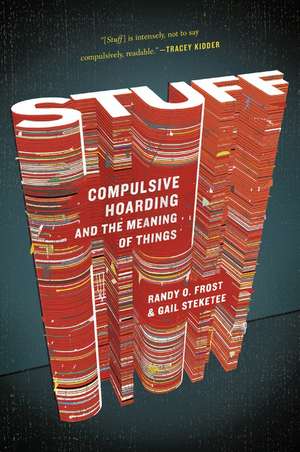
Stuff
Autor Gail Steketee, Randy Frosten Limba Engleză Paperback – 4 ian 2011
Recomandăm Stuff cercetătorilor, psihologilor clinicieni și studenților la facultățile de psihologie care doresc să înțeleagă fundamentele clinice ale tezaurizării compulsive. Această lucrare, devenită bestseller New York Times, reprezintă o sinteză între rigoarea academică și narativul uman, oferind o perspectivă clară asupra motivului pentru care obiectele ajung să pună stăpânire pe viața individului. Descoperim aici o structură bazată pe portrete vii — de la gemeni bogați care își umplu apartamentele de lux cu artă până la persoane care își pierd casele din cauza acumulării de resturi inutile.
Putem afirma că stilul autorilor Randy Frost și Gail Steketee amintește de abordarea lui Oliver Sacks, transformând datele clinice în povești de viață profunde. Cartea extinde cadrul teoretic propus de The Hoarding Impulse de Renee Winters prin adăugarea unei componente empirice solide, bazată pe sute de pacienți tratați și mii de apeluri de la familii disperate. Spre deosebire de abordarea psihologiei abisale a lui Winters, lucrarea de față se ancorează în datele observaționale și în mecanismele cognitive ale atașamentului față de obiecte.
În contextul operei lui Gail Steketee, Stuff servește drept punte între cercetarea academică pură, regăsită în The Oxford Handbook of Hoarding and Acquiring, și ghidurile de tratament precum Treatment for Hoarding Disorder sau Group Treatment for Hoarding Disorder. Dacă lucrările anterioare se concentrau pe protocoale de intervenție CBT (terapie cognitiv-comportamentală), acest volum explorează rădăcinile comportamentale și impactul social al epidemiei de acumulare, oferind o lectură esențială pentru înțelegerea unei patologii recent recunoscute ca entitate distinctă în DSM-5.
Preț: 108.34 lei
Carte disponibilă
Livrare economică 17 iunie-01 iulie
Specificații
ISBN-10: 0547422555
Pagini: 304
Dimensiuni: 133 x 203 x 19 mm
Greutate: 0.39 kg
Ediția:First Edition
Editura: HarperOne
Locul publicării:United States
V-ar putea interesa
-
 Against DepressionPeter D. KramerPreț: 137.25 lei
 -
 Treatment for Hoarding Disorder: WorkbookGail Steketee-5%Preț: 358.16 lei378.35 lei
 -
 The Oxford Handbook of Hoarding and AcquiringRandy O. Frost-31%Preț: 1142.78 lei1651.27 lei
 -
 The Neurotic Personality of Our TimeKaren HorneyPreț: 122.82 lei
 -
 MessBarry YourgrauPreț: 82.27 lei
 -
 The Mind of a MnemonistA. R. Luria-5%Preț: 216.61 lei228.01 lei
 -
 Handbook of Posttraumatic Growth: Research and PracticeLawrence G. Calhoun-5%Preț: 730.40 lei768.84 lei
 -
 Cognitive-Behavioral Treatment of Borderline Personality DisorderMarsha M. Linehan-15%Preț: 525.00 lei617.65 lei
 -
 Preț: 95.68 lei
 -
 From Isolation to Intimacy: Making Friends without WordsPhoebe Caldwell-21%Preț: 128.79 lei163.48 lei
De ce să citești această carte
Pentru practicieni, volumul oferă indicii vizuale și comportamentale clare pentru identificarea tezaurizării, dincolo de simpla dezordine. Cititorul câștigă o înțelegere empatică a unei tulburări care afectează milioane de oameni, învățând să facă distincția între colecționarea pasionată și acumularea patologică. Este un instrument valoros pentru cei care lucrează în asistență socială sau sănătate mintală, oferind contextul necesar pentru aplicarea protocoalelor de tratament.
Despre autor
Dr. Gail Steketee este profesor și decan interimar la Boston University, în cadrul School of Social Work. Este recunoscută la nivel internațional pentru cercetările sale de pionierat în domeniul tulburărilor de spectru obsesiv-compulsiv. Alături de Randy Frost, a pus bazele studiului modern al tezaurizării compulsive (hoarding), contribuind decisiv la includerea acesteia ca diagnostic distinct în manualele de specialitate. Expertiza sa acoperă atât dezvoltarea de protocoale pentru terapia cognitiv-comportamentală, cât și coordonarea grupurilor de suport, fiind autoarea unor manuale de referință pentru terapeuți și pacienți deopotrivă.
Descriere scurtă
Acclaimed psychologists Randy Frost and Gail Sketetee's groundbreaking study on the compulsion of hoarding, "Stuff invites readers to reevaluate their desire for things” (Boston Globe).
What possesses someone to save every scrap of paper that’s ever come into his home? What compulsions drive a woman like Irene, whose hoarding cost her her marriage? Or Ralph, whose imagined uses for castoff items like leaky old buckets almost lost him his house? Or Jerry and Alvin, wealthy twin bachelors who filled up matching luxury apartments with countless pieces of fine art, not even leaving themselves room to sleep?
When Frost and Steketee became the first scientists to study hoarding, they expected to find a few sufferers. Instead, they uncovered an epidemic, treating hundreds of patients and fielding thousands of calls from the families of others, exploring the compulsion through a series of compelling case studies in the vein of Oliver Sacks.
With vivid portraits that show us the traits by which you can identify a hoarder—piles on sofas and beds that make the furniture useless, houses that can be navigated only by following small paths called goat trails, vast piles of paper that the hoarders “churn” but never discard, even collections of animals and garbage—Frost and Steketee explain the causes and outline the often ineffective treatments for the disorder.They also illuminate the pull that possessions exert on all of us.
Whether we’re savers, collectors, or compulsive cleaners, none of us is free of the impulses that drive hoarders to the extremes in which they live. For the six million sufferers, their relatives and friends, and all the rest of us with complicated relationships to our things, Stuff answers the question of what happens when our stuff starts to own us.
Recenzii
"Eye-opening... Frost and Steketee write with real sympathy and appreciation for hoarders...This succinct, illuminating book will prove helpful to hoarders, their families, and mental health professionals who work with them." -- Publishers Weekly
"An excellent starting point for family, friends, and neighbors of hoarders, but the vivid writing will attract readers who enjoy fiction or memoirs about extreme behavior." -- Library Journal, starred review
"Very intriguing. . . Most readers will recognize some aspects of themselves in the people the authors discuss. We may not be hoarders exactly, but the authors make us take a closer look at our own lives, wondering (for example) about that very fine line that divides a collector from a hoarder. Fascinating stuff." -- Booklist
"Fascinating." -- People
"[The authors] invite us graciously into territory that might otherwise make us squirm . . .To those who need to understand hoarders, perhaps in their own family, Stuff offers perspective. For general readers, it is likely to provide useful stimulus for examining how we form and justify our own attachments to objects.” -- New York Times Book Review
"Stuff is worth reading not only because of the authors’ authority on the subject, but also because of its elegant prose, and its nuanced and well-researched take on the subject.” -- Salon.com
"[The authors'] examples are rich in storytelling and dialogue, and they admirably balance a fascination with the psychological profiles of their subject with a deep sympathy for their plights . . . The book is a valuable study of a poorly understood condition." -- Minneapolis Star Tribune
"Amazing... Utterly engrossing." -- Washington Post
"Gripping . . . A highly readable account of this perplexing impulse . . . The book succeeds beyond mere voyeurism, because Stuff’ invites readers to reevaluate their desire for things." -- Boston Globe —