Cantitate/Preț
Produs

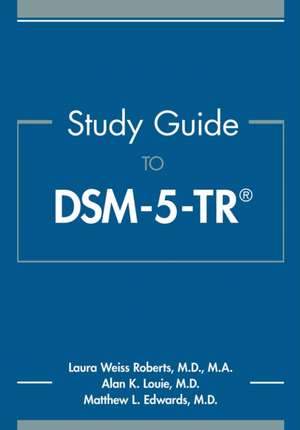
Study Guide to Dsm-5-Tr(r)

Editat de Laura Weiss Roberts, Alan K Louie, Matthew L Edwards
en Limba Engleză Paperback – 12 dec 2024

Destinat studenților la medicină, rezidenților în psihiatrie și specialiștilor din domeniul sănătății mintale, Study Guide to Dsm-5-Tr(r) reprezintă instrumentul pedagogic esențial pentru stăpânirea celei mai recente revizuiri a manualului diagnostic de referință. Sub redacția lui Laura Weiss Roberts, acest volum transformă criteriile rigide în scenarii clinice aplicabile, facilitând tranziția de la teorie la practica de cabinet. Ne-a atras atenția în mod deosebit modul în care autorii au ales să detalieze tulburările cu prevalență ridicată, oferind „perle diagnostice” care nu se regăsesc în textul standard DSM-5-TR. Apreciem structura duală a lucrării: prima parte ancorează diagnosticul în contextul cultural și structural actual, în timp ce a doua parte explorează clasele diagnostice prin viniete ce surprind nuanțele unice ale fiecărui pacient. Această ediție în limba engleză reflectă schimbările aduse pentru peste 70 de afecțiuni și introduce diagnostice noi, precum tulburarea de doliu prelungit, oferind totodată corespondențele necesare cu sistemul de codare ICD-10-CM. Putem afirma că volumul reușește să „dea viață” conceptelor abstracte prin exerciții de autoevaluare și întrebări de discuție concepute pentru mentorat. În arsenalul bibliografic al oricărui clinician, acest ghid completează DSM-5-TR Clinical Cases prin adăugarea unei componente solide de testare și fundamentare teoretică. În timp ce DSM-5-TR Handbook of Differential Diagnosis se concentrează strict pe ramificațiile decizionale ale diagnosticului diferențial, Study Guide to Dsm-5-Tr(r) oferă o viziune panoramică asupra procesului de evaluare, incluzând strategii de interviu și considerații despre capacitatea de adaptare a individului.

Citește tot Restrânge

Preț: 55006 lei

Preț vechi: 57901 lei
-5%

Puncte Express: 825

Carte disponibilă

Livrare economică 05-19 iunie


Specificații

ISBN-13: 9781615375554
ISBN-10: 1615375554
Pagini: 600
Dimensiuni: 178 x 254 x 23 mm
Greutate: 0.86 kg
Ediția:1
Editura: American Psychiatric Association Publishing

De ce să citești această carte

Această resursă este vitală pentru oricine dorește să utilizeze corect standardele DSM-5-TR în practica clinică. Cititorul câștigă precizie în diagnosticare prin analiza celor peste 100 de cazuri și întrebări de autoevaluare. Este mai mult decât un manual; este un partener de studiu care clarifică noile modificări de terminologie și criterii, asigurând o înțelegere profundă a factorilor culturali care influențează prezentarea bolii.


Descriere

"The Diagnostic and Statistical Manual of Mental Disorders (DSM) is the most widely used manual for assisting in the diagnosis of mental disorders. As such, it has tremendous influence over research, clinical care, education, and public policy relating to these disorders and to clinicians' patients', families', and the public's understanding of these disorders. Knowledge of and facility with DSM is a necessity for professionals who work with people living with or affected by mental disorders. DSM-5-TR, the text revision of the fifth full edition of this manual, is an essential resource for those training in all fields of physical and mental health. Of note, it is a valued clinical tool when applied in the context of whole people, keeping in mind an individual's ability to adapt, thrive, and engage, and in relation to genetic, biological, psychological, environmental, familial, and cultural considerations. Revisions included changes in the writing, references, and codes (ICD-10-CM codes are now listed), as well as changes to diagnostic entities, diagnostic criteria, specifiers, and terminology. Changes in diagnostic criteria or specifiers occurred for over 70 disorders, although major changes are not involved. Three new disorders were added: prolonged grief disorder, unspecified mood disorder, and stimulant-induced-mild neurocognitive disorder. The Study Guide to DSM-5-TR should be used side-by-side with the full text of DSM-5-TR. We take a patient-centered approach, complementing the more disorder-centered organization of DSM-5-TR. A new chapter focusing on structural and cultural considerations in the diagnostic process has been added to Part I of the Study Guide to DSM-5-TR. We also introduce consistent features in the diagnostic chapters to help make the concepts of DSM-5-TR come to life. For example, each of the chapters in Part II offers case vignettes that illustrate patterns of illness, including expected and, at times, unexpected elements, and demonstrate how age, gender, and several other cultural factors influence the cases. Other vignettes highlight patient-clinician interactions in the process of an interview and provide sample questions asked by the clinician to better appreciate the patient's unique experience of a disorder. The diagnosis-oriented chapters in Part II provide "diagnostic pearls" and points of importance to daily clinical practice. Furthermore, the chapters in Part II include "elements to consider in the cultural formulation" and "changes between DSM-5 and DSM-5-TR," bringing attention to the revisions that have been made in this edition of the DSM. The Study Guide provides a context for all of the diagnoses in DSM-5-TR, but instead of covering every diagnosis superficially, we chose to dive into greater detail ("in depth") for certain very interesting or very prevalent diagnoses that illustrate each diagnostic class. Because this book is a study guide, we have tried to make it learner friendly to facilitate the processes of registering new information from DSM-5-TR, recalling it, and then considering how it will apply in the reader's work. Part I puts DSM-5-TR in context, in terms of explaining diagnostic frameworks and indicating how these might shape work with patients. Part II focuses on the diagnostic classes in DSM-5-TR. To stimulate learning about the disorders, each of these chapters has a self-assessment section, including key concepts, questions to discuss with colleagues and mentors, complicated cases, and short-answer questions and answers (the answers are generally based on information in either the Study Guide or DSM-5-TR). Part III ("Test Yourself") is replete with more than 100 questions, including brief vignettes covering a wide range of diagnoses and patient circumstances to aid the application of DSM-5-TR to clinical work and training. Because this Study Guide is a companion book to DSM-5-TR, its content intentionally parallels that of DSM-5-TR"-- Provided by publisher.