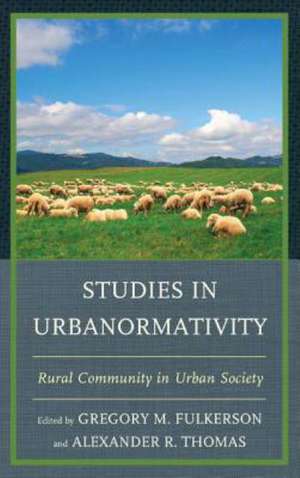
Studies in Urbanormativity: Rural Community in Urban Society
Editat de Gregory M. Fulkerson, Alexander R. Thomas Contribuţii de Elizabeth Seale, Karen E. Hayden, Stephanie Bennett, Aimee Vieira, Barbara Ching, Gerald Creed, Brian Lowe, Chris Stapel, Polly Smith, Gretchen Thompson, Karl A. Jicha, R. V. Rikard, Robert Moxley, Thomas Gray, Curtis Stofferahn, Laura McKinneyen Limba Engleză Hardback – 19 dec 2013
Edited by Gregory M. Fulkerson and Alexander R. Thomas, Studies in Urbanormativity engages a topic on which scholars have been surprisingly silent. Designed for advancing theory and practice, the chapters provide new theoretical tools for understanding the complex relationship between the urban and rural. While primarily intended for scholars and practitioners interested in rural life, rural policy, and community development, the insights of this book will also be of interest to scholars studying various forms of cultural and social domination, as well as identity politics.
Preț: 710.76 lei
Preț vechi: 1054.17 lei
-33%
Puncte Express: 1066
Carte tipărită la comandă
Livrare economică 20 noiembrie-04 decembrie
Livrare prin curier în România Termenul estimat este afișat lângă disponibilitate.
Transport gratuit pentru acest produs Plată online sau ramburs, în funcție de opțiunile comenzii.
Retur gratuit în 14 zile Comandă securizată și suport în română.
Specificații
ISBN-13: 9780739178768
ISBN-10: 0739178768
Pagini: 308
Ilustrații: 1 b/w illustration
Dimensiuni: 159 x 237 x 27 mm
Greutate: 0.59 kg
Editura: Bloomsbury Publishing
Colecția Lexington Books
Locul publicării:New York, United States
ISBN-10: 0739178768
Pagini: 308
Ilustrații: 1 b/w illustration
Dimensiuni: 159 x 237 x 27 mm
Greutate: 0.59 kg
Editura: Bloomsbury Publishing
Colecția Lexington Books
Locul publicării:New York, United States
Cuprins
Introduction
Chapter 1: Urbanization, Urbanormativity, and Place-Structuration
Chapter 2: Critical Concepts for Studying Communities and their Built Environments
Chapter 3: Historic Hartwick: Reading Civic Character in a Living Landscape
Chapter 4: Stigma, Reputation, and Place Structuration
Chapter 5: 'Taking the Cure:' The Rural as a Place of health and Wellbeing in New York State during the Late 1800's and early 1900's
Chapter 6: Minority Groups and the Informal Economy: English Speakers in Quebec's Eastern Townships
Chapter 7: Eaten Up: Urban Foraging and Rural Identity
Chapter 8: Fracture Lines
Chapter 9: "Fagging" the Countryside? (De)"Queering" Rural Queer Studies
Chapter 10: Return to Ridgefield Corners: Cultural Continuity and Change in a Rural Village
Chapter 11: Inbred Horror: Degeneracy, Revulsion, and Fear of the Rural Community
Chapter 12: Matrixed Inequality, Rurality, and Access to Substance Abuse Treatment: A Community Structure Analysis of North Carolina Communities
Chapter 13: Eliminating Organization Tensions, Dis-embedding Farmers: A Ten Year Retrospective on the (Organizational) Political-Economic Losses of Dakota Growers Pasta Cooperative
Chapter 14: A Study of Sustainability: Entropy and the Urban/Rural Transition
Chapter 15: Conclusion
Chapter 16: About the Contributors
Chapter 1: Urbanization, Urbanormativity, and Place-Structuration
Chapter 2: Critical Concepts for Studying Communities and their Built Environments
Chapter 3: Historic Hartwick: Reading Civic Character in a Living Landscape
Chapter 4: Stigma, Reputation, and Place Structuration
Chapter 5: 'Taking the Cure:' The Rural as a Place of health and Wellbeing in New York State during the Late 1800's and early 1900's
Chapter 6: Minority Groups and the Informal Economy: English Speakers in Quebec's Eastern Townships
Chapter 7: Eaten Up: Urban Foraging and Rural Identity
Chapter 8: Fracture Lines
Chapter 9: "Fagging" the Countryside? (De)"Queering" Rural Queer Studies
Chapter 10: Return to Ridgefield Corners: Cultural Continuity and Change in a Rural Village
Chapter 11: Inbred Horror: Degeneracy, Revulsion, and Fear of the Rural Community
Chapter 12: Matrixed Inequality, Rurality, and Access to Substance Abuse Treatment: A Community Structure Analysis of North Carolina Communities
Chapter 13: Eliminating Organization Tensions, Dis-embedding Farmers: A Ten Year Retrospective on the (Organizational) Political-Economic Losses of Dakota Growers Pasta Cooperative
Chapter 14: A Study of Sustainability: Entropy and the Urban/Rural Transition
Chapter 15: Conclusion
Chapter 16: About the Contributors
Recenzii
The chapters [in this book] are interesting, insightful, and thought provoking.
Studies in Urbanormativity is a wide-ranging collection that moves beyond the boundaries of traditional rural sociology in significant, productive, and critical ways. It is an important book that comes at a crucial time. As the world becomes more urban than rural and as the economic and cultural import of rural people and places is seen as waning, these authors reveal the phenomenon of urbanormativity as a key step to challenging its inevitability.
Studies in Urbanormativity is an essential and exciting contribution to the field of rural studies. Fulkerson and Thomas have masterfully assembled a volume that not only marshals provocative argumentation regarding the importance and relevance of rurality in an increasingly urban world, but more importantly the ways in which 'the rural' has been naturalized as a spatial, as well as social, political and cultural periphery. The chapters within this book use a variety of disciplinary and theoretical perspectives to unpack and challenge prevailing social imaginations, while appealing not only to rural scholars but more broadly to those with interests in urban studies, identity and cultural politics, community theory and critical geography.
Studies in Urbanormativity is a wide-ranging collection that moves beyond the boundaries of traditional rural sociology in significant, productive, and critical ways. It is an important book that comes at a crucial time. As the world becomes more urban than rural and as the economic and cultural import of rural people and places is seen as waning, these authors reveal the phenomenon of urbanormativity as a key step to challenging its inevitability.
Studies in Urbanormativity is an essential and exciting contribution to the field of rural studies. Fulkerson and Thomas have masterfully assembled a volume that not only marshals provocative argumentation regarding the importance and relevance of rurality in an increasingly urban world, but more importantly the ways in which 'the rural' has been naturalized as a spatial, as well as social, political and cultural periphery. The chapters within this book use a variety of disciplinary and theoretical perspectives to unpack and challenge prevailing social imaginations, while appealing not only to rural scholars but more broadly to those with interests in urban studies, identity and cultural politics, community theory and critical geography.