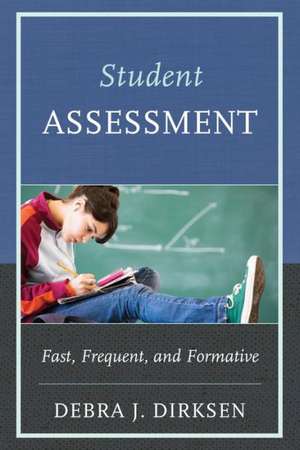
Student Assessment: Fast, Frequent, and Formative: R&L Education
Autor Debra J. Dirksenen Limba Engleză Paperback – noi 2013
Din seria R&L Education
- 25%
 Preț: 220.37 lei
 - 19%
 Preț: 338.17 lei
 - 23%
 Preț: 270.37 lei
 - 22%
 Preț: 127.67 lei
 - 28%
 Preț: 364.85 lei
 - 25%
 Preț: 221.03 lei
 - 26%
 Preț: 175.66 lei
 - 17%
 Preț: 180.76 lei
 - 25%
 Preț: 380.37 lei
 - 19%
 Preț: 324.21 lei
 - 25%
 Preț: 142.54 lei
 - 24%
 Preț: 255.31 lei
 - 21%
 Preț: 140.97 lei
 - 24%
 Preț: 255.02 lei
 - 23%
 Preț: 274.24 lei
 - 28%
 Preț: 363.95 lei
 - 25%
 Preț: 216.37 lei
 - 26%
 Preț: 174.98 lei
 - 21%
 Preț: 109.80 lei
 - 25%
 Preț: 218.37 lei
 - 19%
 Preț: 314.30 lei
 - 27%
 Preț: 55.87 lei
 - 23%
 Preț: 276.18 lei
 - 19%
 Preț: 322.16 lei
 - 26%
 Preț: 175.46 lei
 - 26%
 Preț: 342.22 lei
 - 19%
 Preț: 312.02 lei
 - 25%
 Preț: 217.87 lei
 - 26%
 Preț: 176.05 lei
 - 26%
 Preț: 176.79 lei
 - 23%
 Preț: 276.29 lei
 - 25%
 Preț: 179.49 lei
 - 24%
 Preț: 274.49 lei
 - 35%
 Preț: 656.39 lei
 - 24%
 Preț: 222.16 lei
 - 25%
 Preț: 177.38 lei
 - 27%
 Preț: 278.14 lei
 - 25%
 Preț: 217.36 lei
 - 25%
 Preț: 343.77 lei
 - 26%
 Preț: 176.78 lei
 - 24%
 Preț: 274.39 lei
Preț: 279.24 lei
Preț vechi: 362.71 lei
-23%
Puncte Express: 419
Carte tipărită la comandă
Livrare economică 01-15 decembrie
Livrare prin curier în România Termenul estimat este afișat lângă disponibilitate.
Transport gratuit de la 400.00 lei Plată online sau ramburs, în funcție de opțiunile comenzii.
Retur gratuit în 14 zile Comandă securizată și suport în română.
Specificații
ISBN-13: 9781475801200
ISBN-10: 1475801203
Pagini: 168
Ilustrații: 2 Tables
Dimensiuni: 156 x 229 x 13 mm
Greutate: 0.41 kg
Editura: Bloomsbury Publishing
Colecția R&L Education
Seria R&L Education
Locul publicării:New York, United States
ISBN-10: 1475801203
Pagini: 168
Ilustrații: 2 Tables
Dimensiuni: 156 x 229 x 13 mm
Greutate: 0.41 kg
Editura: Bloomsbury Publishing
Colecția R&L Education
Seria R&L Education
Locul publicării:New York, United States
Descriere
When playing video games, players are able to press the reset button when something goes wrong and realize they are missing an essential skill needed to win the game. In education, we can use formative assessment as a means for the student to press the virtual reset button. Educators can ensure that students gain the skills needed to be successful learners in their classroom.
In this book, the author provides strategies and techniques, such as the use of graphic organizers, quick writes, and journaling, to be used as formative assessments. Specific information about each tool and recommendations for data analysis and implementation are provided, helping teachers to implement formative assessment effectively and efficiently and allow their students to "preset the reset button" and master the skills they need to be successful in the classroom.
In this book, the author provides strategies and techniques, such as the use of graphic organizers, quick writes, and journaling, to be used as formative assessments. Specific information about each tool and recommendations for data analysis and implementation are provided, helping teachers to implement formative assessment effectively and efficiently and allow their students to "preset the reset button" and master the skills they need to be successful in the classroom.
Cuprins
Preface
Chapter 1: Introduction: Press the Reset Button
Chapter 2: Formative Assessment: Purpose
Chapter 3: Formative Assessment: Reliability and Validity
Chapter 4: Pre Assessments
Chapter 5: Commercial Short-Cycle Assessments
Chapter 6: Assignments and Assessments
Chapter 7: Collaborative Learning
Chapter 8: Writing
Chapter 9: Graphic Organizers
Chapter 10: Games
Chapter 11: Discussions
Chapter 12: Technology
Chapter 13: Efficiency in Data Collection and Analysis
Chapter 14: Instructional Interventions
Chapter 15: Bringing it all together
Bibliography
Index
Chapter 1: Introduction: Press the Reset Button
Chapter 2: Formative Assessment: Purpose
Chapter 3: Formative Assessment: Reliability and Validity
Chapter 4: Pre Assessments
Chapter 5: Commercial Short-Cycle Assessments
Chapter 6: Assignments and Assessments
Chapter 7: Collaborative Learning
Chapter 8: Writing
Chapter 9: Graphic Organizers
Chapter 10: Games
Chapter 11: Discussions
Chapter 12: Technology
Chapter 13: Efficiency in Data Collection and Analysis
Chapter 14: Instructional Interventions
Chapter 15: Bringing it all together
Bibliography
Index
Recenzii
Dirksen, a former middle school math teacher, has authored a helpful text for pre-service and first-year teachers. The focus is primarily on formative assessments, with two chapters addressing the purpose of formative assessments and how to ensure that they are reliable and valid. The author states that she tries to never assume that just because she is teaching students are learning, which supports the need for formative assessments. Dirksen makes connections to backward design, response to intervention, common core, and pre-assessments. Six chapters (e.g., games, graphic organizers, and writing) address specific strategies for formative assessments. In addition, Dirksen includes an excellent chapter on data collection and analysis, which is critical for understanding student learning. . . .Summing Up: Recommended. Upper-division undergraduate and professional collections.
Debra Dirksen states that her purpose in writing Student Assessment is to give teachers specific tools they can use to support student learning. She ably accomplishes this goal. The book starts with a very understandable description of what formative assessment is and why it is important to be used in unit planning. The book is loaded with many ideas for using formative assessment not only in the unit introduction but throughout the unit to learn what knowledge the students already have. Time is a crucial factor that teachers face with every lesson. Using the strategies presented in this book, teachers can teach what the students need and not repeat the knowledge that they already have. This is vitally important when curriculum is packed and time is limited. This book should be required reading for pre-service teachers and those in the field as well.
The book flows very nicely. The tendency for many books on assessment is focusing on theory and little on how a teacher could implement formative assessment in the classroom to assist their students to become better learners. This book doesn't do that. Debra Dirksen has provided a current metaphor for faculty and teachers alike to grab and hang on to regarding a somewhat hard to understand process.
How about a 'reset' for the classroom: Instead of avoiding or even instilling the fear of failure, we embrace and teach students how to learn from failure? Assessment serves as the 'reset button' for any learner. Dr. Dirksen outlines specific, practical, and proven methods of a variety of assessments and tools that can be utilized to analyze and chart the best learning route for a student. In her easy-to-read style, she comprehensively covers all aspects and types of learner assessments, strategies, interventions, activities, and technologies. Student Assessment is a complete 'go-to' reference guide for every educator.
Debra Dirksen states that her purpose in writing Student Assessment is to give teachers specific tools they can use to support student learning. She ably accomplishes this goal. The book starts with a very understandable description of what formative assessment is and why it is important to be used in unit planning. The book is loaded with many ideas for using formative assessment not only in the unit introduction but throughout the unit to learn what knowledge the students already have. Time is a crucial factor that teachers face with every lesson. Using the strategies presented in this book, teachers can teach what the students need and not repeat the knowledge that they already have. This is vitally important when curriculum is packed and time is limited. This book should be required reading for pre-service teachers and those in the field as well.
The book flows very nicely. The tendency for many books on assessment is focusing on theory and little on how a teacher could implement formative assessment in the classroom to assist their students to become better learners. This book doesn't do that. Debra Dirksen has provided a current metaphor for faculty and teachers alike to grab and hang on to regarding a somewhat hard to understand process.
How about a 'reset' for the classroom: Instead of avoiding or even instilling the fear of failure, we embrace and teach students how to learn from failure? Assessment serves as the 'reset button' for any learner. Dr. Dirksen outlines specific, practical, and proven methods of a variety of assessments and tools that can be utilized to analyze and chart the best learning route for a student. In her easy-to-read style, she comprehensively covers all aspects and types of learner assessments, strategies, interventions, activities, and technologies. Student Assessment is a complete 'go-to' reference guide for every educator.