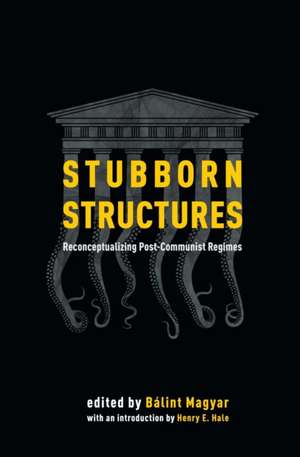
Stubborn Structures: Reconceptualizing Post-Communist Regimes
Autor Bálint Magyaren Limba Engleză Paperback – 10 apr 2019
În cadrul studiilor politice contemporane, analiza tranziției în Europa de Est și Eurasia a suferit adesea de o aplicare rigidă a teoriilor democratice occidentale. Notăm cu interes faptul că Stubborn Structures, volum editat de Bálint Magyar, propune o schimbare de paradigmă necesară: trecerea de la examinarea structurilor nominale de suprafață către mecanismele informale și adesea ilicite care definesc „politica reală” în regiune. Lucrarea se încadrează în nucleul cercetării academice despre natura regimurilor hibride, fiind un instrument esențial pentru înțelegerea modului în care rețelele de putere capturează instituțiile statului.
Volumul este organizat riguros în trei părți distincte. Prima secțiune stabilește cadrele conceptuale, unde autori precum János Kornai și Henry E. Hale reevaluează paradigma sistemelor și neopatrimonialismul. A doua parte analizează actorii puterii, oferind radiografii ale sistemului neo-nomenklaturist al lui Putin sau ale sistemului patronal de corupție din România, analizat de László Nándor Magyari. Ultima secțiune explorează tehnicile de control, de la cenzura iliberală la utilizarea sistemelor de partid ca accesorii ale „statului mafiot”.
Reținem că Stubborn Structures acoperă aceeași arie tematică precum Informal Politics in Post-Communist Europe de Michal Klíma, dar cu o abordare mult mai vastă din punct de vedere terminologic, oferind un lexicon complex pentru fenomene care scapă observatorilor externi. Față de lucrările anterioare ale autorului, precum Russia's Imperial Endeavor and Its Geopolitical Consequences, acest volum se concentrează mai puțin pe evenimente geopolitice punctuale și mai mult pe persistența structurilor sociologice profunde care fac aceste regimuri atât de rezistente la schimbare.
Preț: 645.31 lei
Preț vechi: 701.42 lei
-8%
Carte disponibilă
Livrare economică 17 noiembrie-01 decembrie
Specificații
ISBN-10: 9633862140
Pagini: 712
Dimensiuni: 152 x 229 x 38 mm
Greutate: 1.32 kg
Ediția:1
Editura: Amsterdam University Press
Colecția Central European University Press
Locul publicării:Oxford, United Kingdom
V-ar putea interesa
-
 The Road to OxianaRobert Byron-30%Preț: 66.44 lei94.26 lei
 -
 The Road to Wigan PierGeorge Orwell-19%Preț: 51.77 lei64.20 lei
 -
 Liberal City, Conservative State: Moscow and Russia's Urban Crisis 1906-1914Robert William Thurston-30%Preț: 882.29 lei1261.71 lei
 -
 -24%Preț: 573.93 lei759.07 lei
 -
 -18%Preț: 980.21 lei1195.37 lei
 -
 -15%Preț: 665.99 lei783.52 lei
 -
 -15%Preț: 665.80 lei783.29 lei
 -
 Democracy and ApartheidA. Butler-15%Preț: 664.79 lei782.11 lei
 -
 Peacemaking Strategies in Northern IrelandD. Bloomfield-15%Preț: 666.48 lei784.09 lei
 -
 European Union Development PolicyMarjorie Lister-15%Preț: 664.14 lei781.33 lei
 -
 Drugs in South AsiaM. Haq-15%Preț: 670.07 lei788.32 lei
 -
 The Institutional Effects of Executive ScandalsBrandon Rottinghaus-14%Preț: 732.00 lei851.16 lei
 -
 Is Bipartisanship Dead?Laurel HarbridgePreț: 282.26 lei
 -
 -32%Preț: 174.46 lei255.80 lei
 -
 Discourse Theory in European PoliticsD. Howarth-15%Preț: 601.95 lei708.18 lei
 -
 Europe and Asia: Perceptions From AfarMartin Holland-32%Preț: 625.95 lei926.79 lei
 -
 The End of ImaginationArundhati RoyPreț: 144.82 lei
 -
 Preț: 340.88 lei
 -
 Postkommunistische RegimeBálint Magyar-15%Preț: 471.08 lei554.21 lei
 -
 Preț: 185.38 lei
 -
 Preț: 226.43 lei
 -
 Preț: 261.80 lei
 -
 -18%Preț: 922.77 lei1125.33 lei
Public țintă
AcademicDe ce să citești această carte
Recomandăm această lucrare cercetătorilor și studenților la științe politice care doresc să depășească definițiile de manual ale democrației. Cititorul câștigă o înțelegere profundă a modului în care corupția sistemică și rețelele informale din țări precum România sau Ucraina nu sunt anomalii, ci elemente constitutive ale regimului. Este un ghid terminologic esențial pentru a descifra mecanismele de putere din spațiul ex-comunist prin intermediul unor studii de caz riguroase.
Despre autor
Bálint Magyar este un sociolog și politician maghiar, cunoscut pentru analizele sale pătrunzătoare asupra conceptului de „stat mafiot post-comunist”. Lucrările sale sunt fundamentale pentru înțelegerea evoluției politice a Europei Centrale și de Est. În volume precum The Anatomy of Post-Communist Regimes sau Ukraine's Patronal Democracy and the Russian Invasion, el a dezvoltat un cadru analitic original care îmbină sociologia politică cu economia, oferind instrumente conceptuale pentru a descrie regimurile care nu se încadrează nici în democrația liberală, nici în dictatura clasică. Expertiza sa se concentrează pe mecanismele informale de exercitare a puterii și pe capturarea statului de către grupuri de interese.
Notă biografică
He was a member of the Hungarian Parliament (1990-2010). As a Minister of Education (1996-1998; 2002-2006) he initiated and carried out reforms in public and higher education.
Henry E. Hale is Professor of Political Science and International Affairs at the Elliott School of International Affairs, George Washington University.
Descriere scurtă
Cuprins
List of Figures
List of Tables
Editor’s Preface
I. CONCEPTUAL FRAMEWORKS
Henry E. Hale: Freeing Post-Soviet Regimes from the Procrustean Bed of Democracy Theory
János Kornai: The System Paradigm Revisited: Clarification and Additions in the Light Of Experiences in the Post-Communist Region
Oleksandr Fisun: Neopatrimonialism in Post-Soviet Eurasia
Bálint Magyar: Towards a Terminology for Post-communist Regimes
II. ACTORS OF POWER
Nikolay Petrov: Putin’s Neo-Nomenklatura System and its Evolution
Mikhail Minakov: Republic of Clans: The Evolution of the Ukrainian Political System
Uladzimir Rouda: Is Belarus a Classic Post-Communist Mafia State?
László Nándor Magyari: The Romanian Patronal System of Public Corruption
III. TECHNIQUES AND TOOLS
Zoltán Sz. Bíró: The Russian Party System
Andrei Kazakevich: The Belarusian Non-Party Political System: Government, Trust and Institutions, 1990–2015
Miklós Haraszti: Illiberal State Censorship: A Must-have Accessory for Any Mafia State
Dumitru Minzarari: Disarming Public Protests in Russia: Transforming Public Goods into Private Goods
IV. WEALTH AND OWNERSHIP
Andrey Ryabov: The Institution of Power and Ownership in the Former U.S.S.R: Origin, Diversity of Forms, and Influence on Transformation Processes
Ilja Viktorov: Russia’s Network State and Reiderstvo Practices: The Roots to Weak Property Rights Protection after the post-Communist Transition
Bálint Magyar: From Free Market Corruption Risk to the Certainty of a State-Run Criminal Organization (using Hungary as an example)
V. CONTRASTS AND CONNECTIONS
Alexei Pikulik: Belarus, Russia, and Ukraine as Post-Soviet Rent-Seeking Regimes
Sarah Chayes: The Structure of Corruption: A Systemic Analysis
Kálmán Mizsei: The New East European Patronal States and the Rule-of-Law
Bálint Magyar: Parallel System Narratives—Polish and Hungarian Regime Formations Compared
List of Contributors
Index
Appendix
Descriere
The editor of this book has brought together contributions designed to capture the essence of post-communist politics in East-Central Europe and Eurasia. Rather than on the surface structures of nominal democracies, the nineteen essays focus on the informal, often intentionally hidden, disguised and illicit understandings and arrangements that penetrate formal institutions. These phenomena often escape even the best-trained outside observers, familiar with the concepts of established democracies. Contributors to this book share the view that understanding post-communist politics is best served by a framework that builds from the ground up, proceeding from a fundamental social context.
The book aims at facilitating a lexical convergence; in the absence of a robust vocabulary for describing and discussing these often highly complex informal phenomena, the authors wish to advance a new terminology of post-communist regimes. Instead of a finite dictionary, a kind of conceptual cornucopia is offered. The resulting variety reflects a larger harmony of purpose that can significantly expand the understanding the “real politics” of post-communist regimes.
Countries analyzed from a variety of aspects, comparatively or as single case studies, include Azerbaijan, Belarus, Georgia, Hungary, Kyrgyzstan, Moldova, Poland, Romania, Russia, and Ukraine.