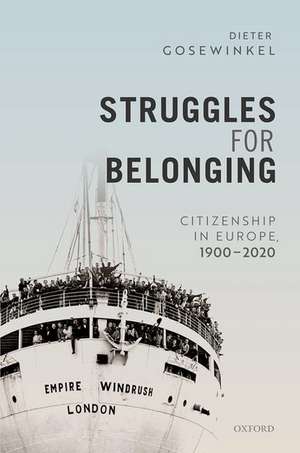
Struggles for Belonging: Citizenship in Europe, 1900-2020
Autor Dieter Gosewinkelen Limba Engleză Hardback – 4 noi 2021
Preț: 945.91 lei
Preț vechi: 1390.63 lei
-32%
Puncte Express: 1419
Carte disponibilă
Livrare economică 19-25 noiembrie
Livrare prin curier în România Termenul estimat este afișat lângă disponibilitate.
Transport gratuit pentru acest produs Plată online sau ramburs, în funcție de opțiunile comenzii.
Retur gratuit în 14 zile Comandă securizată și suport în română.
Specificații
ISBN-13: 9780198846161
ISBN-10: 0198846169
Pagini: 544
Dimensiuni: 167 x 241 x 36 mm
Greutate: 0.96 kg
Editura: OUP OXFORD
Colecția OUP Oxford
Locul publicării:Oxford, United Kingdom
ISBN-10: 0198846169
Pagini: 544
Dimensiuni: 167 x 241 x 36 mm
Greutate: 0.96 kg
Editura: OUP OXFORD
Colecția OUP Oxford
Locul publicării:Oxford, United Kingdom
V-ar putea interesa
-
 National Identity in EU LawElke Cloots-30%Preț: 1015.31 lei1451.67 lei
 -
 -30%Preț: 997.29 lei1427.06 lei
 -
 Living SpeechJames Boyd WhitePreț: 375.52 lei
 -
 Cash, Color, and ColonialismRenee Ann CramerPreț: 186.78 lei
 -
 The Extraterritorial Application of the Human Right to Water in AfricaTakele Soboka Bulto-14%Preț: 729.98 lei848.82 lei
 -
 Preț: 301.24 lei
 -
 The Demographic Transformations of CitizenshipHeli AskolaPreț: 314.43 lei
 -
 The Adoption of the Fourteenth AmendmentHorace Edgar FlackPreț: 145.35 lei
 -
 Wissenschaft, Politik, VerfassungsgerichtErnst-Wolfgang BöckenfördePreț: 170.31 lei
 -
 Der AusstellungsvertragGabor MuesPreț: 415.41 lei
 -
 -19%Preț: 503.66 lei621.81 lei
 -
 Das InformationsfreiheitsgesetzAnja Rössner-19%Preț: 405.64 lei500.79 lei
 -
 -23%Preț: 623.11 lei809.23 lei
 -
 Die Leistungsfähigkeit der Wissenschaft des Öffentlichen RechtsChristian Hillgruber-23%Preț: 1523.95 lei1979.16 lei
 -
 Preț: 116.94 lei
Recenzii
Gosewinkel takes us through this difficult terrain with admirable objectivity.
Starting around 1900, Chapter 1 portrays the Russian, German, French, and British Empires as waning empires but strengthening states...In the double process of empire- and nation-building, "a distinction between a national majority as state or titular nation and minorities within the nation-state or empire was often drawn and sharpened."...Though not articulated this way explicitly, Gosewinkel's choice of women and Jews as case studies throughout the book encapsulates a process that began long before 1900. "Dependent" people â women, children, domestic servants, apprentices, and journeymen, among others â struggled to receive the "internal" rights of citizenship in nineteenth-century Europe.
Struggles for Belonging rightfully garnered acclaim and praise.
Gosewinkel's book covers so much ground that it is hard to do it all justice in one review.
Starting around 1900, Chapter 1 portrays the Russian, German, French, and British Empires as waning empires but strengthening states...In the double process of empire- and nation-building, "a distinction between a national majority as state or titular nation and minorities within the nation-state or empire was often drawn and sharpened."...Though not articulated this way explicitly, Gosewinkel's choice of women and Jews as case studies throughout the book encapsulates a process that began long before 1900. "Dependent" people â women, children, domestic servants, apprentices, and journeymen, among others â struggled to receive the "internal" rights of citizenship in nineteenth-century Europe.
Struggles for Belonging rightfully garnered acclaim and praise.
Gosewinkel's book covers so much ground that it is hard to do it all justice in one review.
Notă biografică
Dieter Gosewinkel is Director of the Center for Global Constitutionalism at the WZB Social Science Center Berlin, and Professor in the Department of History at the Freie Universität Berlin. He was the Alfred-Grosser guest professor at Sciences Po, Paris, from 2018-2019, and has been a Member of the Academia Europaea since 2019. He received his PhD in History from the University of Freiburg in 1990.