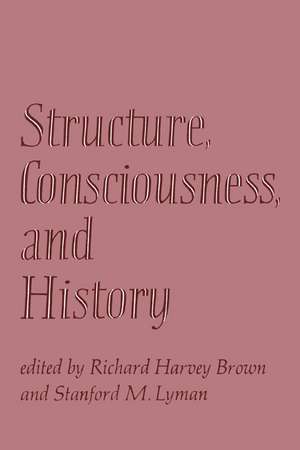
Structure, Consciousness and History
Autor Richard Harvey Brown Editat de Robert Hanbury Brown, S. M. Lymanen Limba Engleză Paperback – mar 2010
Preț: 303.20 lei
Puncte Express: 455
Carte tipărită la comandă
Livrare economică 07-21 decembrie
Livrare prin curier în România Termenul estimat este afișat lângă disponibilitate.
Transport gratuit de la 400.00 lei Plată online sau ramburs, în funcție de opțiunile comenzii.
Retur gratuit în 14 zile Comandă securizată și suport în română.
Specificații
ISBN-13: 9780521293402
ISBN-10: 0521293405
Pagini: 300
Dimensiuni: 152 x 229 x 18 mm
Greutate: 0.49 kg
Editura: Cambridge University Press
Locul publicării:Cambridge, United Kingdom
ISBN-10: 0521293405
Pagini: 300
Dimensiuni: 152 x 229 x 18 mm
Greutate: 0.49 kg
Editura: Cambridge University Press
Locul publicării:Cambridge, United Kingdom
V-ar putea interesa
-
 McCoubrey & White's Textbook on JurisprudenceJames Penner-21%Preț: 399.93 lei507.71 lei
 -
 Social Economies of Fear and DesireV. NicolPreț: 404.31 lei
 -
 -18%Preț: 1151.03 lei1403.69 lei
 -
 Capitalism and Modern Social TheoryAnthony GiddensPreț: 168.63 lei
 -
 Real Social ScienceBent FlyvbjergPreț: 283.85 lei
 -
 Outline of a Theory of PracticePierre BourdieuPreț: 202.73 lei
 -
 Social TheoryHans JoasPreț: 448.61 lei
 -
 Dissecting the SocialPeter HedstromPreț: 207.51 lei
 -
 Preț: 280.19 lei
 -
 Networks in Social Policy ProblemsBal Zs Vedres-11%Preț: 681.51 lei765.73 lei
 -
 The Reflexive Imperative in Late ModernityMargaret S. ArcherPreț: 334.96 lei
 -
 The Sources of Social PowerMichael MannPreț: 354.09 lei
 -
 -18%Preț: 1248.98 lei1523.15 lei
 -
 Postmodern GeographiesEdward W SojaPreț: 91.85 lei
 -
 ViolenceSlavoj Zizek-19%Preț: 69.00 lei85.36 lei
 -
 Social theory for beginnersPaul RansomePreț: 263.15 lei
Cuprins
Preface; Introduction: symbolic realism and cognitive aesthetics: an invitation Richard Harvey Brown and Stanford M. Lyman; Part I. Structure, Consciousness and History: 1. Symbolic realism and sociological thought:beyond the positivist romantic debate Richard Harvey Brown; 2. History and hermeneutics: Wilhelm Dilthey and the dialectics of interpretative method Richard Harvey Brown; 3. The acceptance, rejection, and reconstruction of histories: on some controversies in the study of social and cultural change Stanford M. Lyman; 4. The histories of 'mentalités': recent writings on revolution, criminality and death in France Robert Darnton; Part II. Structure, Self, and Evil: 5. Architectonic man: on the structuring of lived experience Rom Harré; 6. Social theory as confession: Parsonian sociology and the symbolism of evil Paul G. Creelan; 7. Dignity versus survival? Reflections on the moral philosophy of social order Manfred Stanley; Part III. Praxis and Utopia: 8. Dramaturgical and political enactments: toward an artistic foundation for political space Tracy B. Strong; Toward a semiotic of utopia: Thomas More's Utopia Louis Marin.
Descriere
These essays adopt the approach of 'symbolic realism' or 'cognitive aesthetics' to overcome the crisis of dualism in conventional sociological theory.