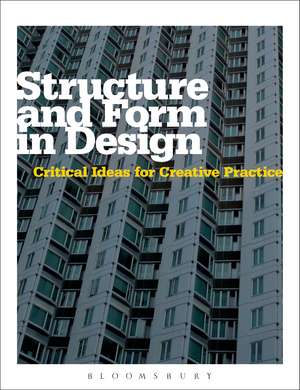
Structure and Form in Design: Critical Ideas for Creative Practice
Autor Michael Hannen Limba Engleză Paperback – sep 2012
In the context of the decorative arts and design, structure is the underlying framework, and form the resultant, visible, two- or three-dimensional outcome of the creative process. Whether hidden or visually detectable in the final design, structure invariably determines whether or not a design is successful in terms of both its aesthetics and its practical performance.
Hann successfully identifies various geometric concepts, and presents and discusses a number of simple guidelines to assist the creative endeavours of both accomplished and student practitioners, teachers and researchers.
Preț: 269.22 lei
Preț vechi: 353.00 lei
-24%
Puncte Express: 404
Carte disponibilă
Livrare economică 03-17 noiembrie
Livrare prin curier în România Termenul estimat este afișat lângă disponibilitate.
Transport gratuit de la 400.00 lei Plată online sau ramburs, în funcție de opțiunile comenzii.
Retur gratuit în 14 zile Comandă securizată și suport în română.
Specificații
ISBN-13: 9781847887429
ISBN-10: 1847887422
Pagini: 200
Ilustrații: 228 bw & 19 colour illus
Dimensiuni: 188 x 244 x 12 mm
Greutate: 0.5 kg
Ediția:New.
Editura: Bloomsbury Publishing
Colecția Berg Publishers
Locul publicării:London, United Kingdom
ISBN-10: 1847887422
Pagini: 200
Ilustrații: 228 bw & 19 colour illus
Dimensiuni: 188 x 244 x 12 mm
Greutate: 0.5 kg
Ediția:New.
Editura: Bloomsbury Publishing
Colecția Berg Publishers
Locul publicării:London, United Kingdom
V-ar putea interesa
-
 BlueprintsMarcus Du SautoyPreț: 123.84 lei
 -
 Form and ForcesEdward Allen-11%Preț: 700.10 lei786.62 lei
 -
 Principles of Two-Dimensional DesignWucius WongPreț: 364.45 lei
 -
 Tilings and PatternsBranko Grunbaum-18%Preț: 292.19 lei356.57 lei
 -
 Notes on the Synthesis of FormChristopher AlexanderPreț: 235.55 lei
 -
 The Pocket Universal Principles of Interior DesignKelly Harris Smith-19%Preț: 81.02 lei100.20 lei
 -
 Funicular Structures: The Art of Building EfficientlyDamon BolhassaniPreț: 384.80 leiRecomandat
 -
 Designing with Algorithms: A Mathematical GuideArash Soleimani-20%Preț: 329.03 lei411.29 lei
 -
 The Structural Basis of ArchitectureBjørn N. SandakerPreț: 364.46 lei
 -
 Ornamental Origami: Exploring 3D Geometric DesignsMeenakshi MukerjiPreț: 298.28 lei
 -
 Visual GrammarChristian Leborg-14%Preț: 102.91 lei119.26 lei
 -
 Geometry of DesignKimberly Elam-13%Preț: 118.31 lei135.29 lei
 -
 -27%Preț: 104.51 lei142.35 lei
 -
 Preț: 44.96 lei
 -
 DesignaAdam TetlowPreț: 157.10 lei
 -
 Islamic DesignDaud SuttonPreț: 48.16 lei
 -
 Sacred GeometryMiranda LundyPreț: 48.06 lei
 -
 Structuring DesignUlysses Voelker-24%Preț: 171.79 lei226.28 lei
 -
 Shaping Visual Structures: The Art of Composition, Movement, and Space in Graphic DesignCarla Viviana Cordova-15%Preț: 120.66 lei142.06 lei
Cuprins
Part One: Introduction
Part Two: The Fundamentals and Their Role in Design
Introduction; Point - a Sound of Silence; Line and What Follows; Planes, Shapes and Forms; Various Polygons; Grids and Guidelines; Use to the Creative Practitioner; Summary
Part Three: Underneath It All
Introduction; Various Useful Constructions; Static and Dynamic Rectangles; Root Rectangles; The Brunes Star; Compositional Rectangles; Grids from Dynamic Rectangles; Summary
Part Four: Tiling the Plane Without Gap or Overlap
Introduction; Regular and Semi-regular Tilings; Demi-regular Tilings; Aperiodic Tilings; Islamic Tilings and Their Construction; Tiling on a Curved Surface; Developing Original Tiling Designs; Summary
Part Five: Symmetry, Patterns and Fractals
Introduction; Symmetry Operations; Motifs, Figures or Repeating Units; Friezes, Strips or Borders; Lattices and all-over Patterns; Counter-change Designs; Fractals and Self-similarity - Another Type of Symmetry; Summary
Part Six: The Stepping Stones of Fibonacci and the Harmony of a Line Divided
Introduction; The Fibonacci Series; The Golden Section; The Golden Rectangle; The Golden Spiral
Uses in Art, Design and Architecture - a Summary of the Debate; The Potential for the Creative Practitioner; Summary
Part Seven: Polyhedra, Spheres and Domes
Introduction; Spheres; Platonic Solids; Archimedean Solids; Radiolarians, Soccer Balls and Super Molecules; Polyhedra in Art and Design; Domes; Summary
Part Eight: Structure and Form in Three Dimensions
Introduction; Elements of Three-dimensional Form; Representations of Three-dimensional Form; Cubes, Prisms and Cylinders; Cones and Pyramids; Three-dimensional Lattices; Transformations; Summary
Part Nine: Variations on a Theme: Modularity, Closest Packing and Partitioning
Introduction; The Nature of Modularity; Modularity in the Fine and Decorative Arts; Modularity in Design and Architecture; Closest Packing; Efficient Partitioning; Towards a Theory of Emergence in the Decorative Arts and Design; Summary
Part Ten: Structural Analysis in the Decorative Arts, Design and Architecture
Introduction; Symmetry Analysis - Steps Towards a Consistent Method; Geometric Analysis in the Decorative Arts, Design and Architecture; Frequently Used Constructions and Measures; Questions Relating to Method and Data Collection; Steps Towards a Systematic Analytical Framework; Questions of Accuracy; Summary
Part Eleven: A Designer's Framework
Appendices
References
Part Two: The Fundamentals and Their Role in Design
Introduction; Point - a Sound of Silence; Line and What Follows; Planes, Shapes and Forms; Various Polygons; Grids and Guidelines; Use to the Creative Practitioner; Summary
Part Three: Underneath It All
Introduction; Various Useful Constructions; Static and Dynamic Rectangles; Root Rectangles; The Brunes Star; Compositional Rectangles; Grids from Dynamic Rectangles; Summary
Part Four: Tiling the Plane Without Gap or Overlap
Introduction; Regular and Semi-regular Tilings; Demi-regular Tilings; Aperiodic Tilings; Islamic Tilings and Their Construction; Tiling on a Curved Surface; Developing Original Tiling Designs; Summary
Part Five: Symmetry, Patterns and Fractals
Introduction; Symmetry Operations; Motifs, Figures or Repeating Units; Friezes, Strips or Borders; Lattices and all-over Patterns; Counter-change Designs; Fractals and Self-similarity - Another Type of Symmetry; Summary
Part Six: The Stepping Stones of Fibonacci and the Harmony of a Line Divided
Introduction; The Fibonacci Series; The Golden Section; The Golden Rectangle; The Golden Spiral
Uses in Art, Design and Architecture - a Summary of the Debate; The Potential for the Creative Practitioner; Summary
Part Seven: Polyhedra, Spheres and Domes
Introduction; Spheres; Platonic Solids; Archimedean Solids; Radiolarians, Soccer Balls and Super Molecules; Polyhedra in Art and Design; Domes; Summary
Part Eight: Structure and Form in Three Dimensions
Introduction; Elements of Three-dimensional Form; Representations of Three-dimensional Form; Cubes, Prisms and Cylinders; Cones and Pyramids; Three-dimensional Lattices; Transformations; Summary
Part Nine: Variations on a Theme: Modularity, Closest Packing and Partitioning
Introduction; The Nature of Modularity; Modularity in the Fine and Decorative Arts; Modularity in Design and Architecture; Closest Packing; Efficient Partitioning; Towards a Theory of Emergence in the Decorative Arts and Design; Summary
Part Ten: Structural Analysis in the Decorative Arts, Design and Architecture
Introduction; Symmetry Analysis - Steps Towards a Consistent Method; Geometric Analysis in the Decorative Arts, Design and Architecture; Frequently Used Constructions and Measures; Questions Relating to Method and Data Collection; Steps Towards a Systematic Analytical Framework; Questions of Accuracy; Summary
Part Eleven: A Designer's Framework
Appendices
References
Recenzii
This book is a unique contribution to the theory of structural design in two and three dimensional form, and should be of interest to surface designers, architects, and interior designers.