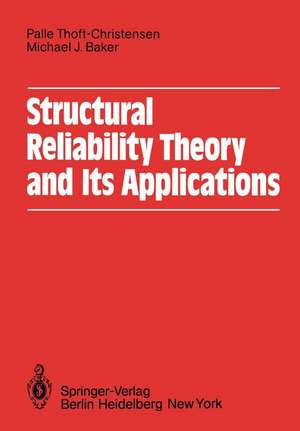
Structural Reliability Theory and Its Applications
Autor P. Thoft-Cristensen, M. J. Bakeren Limba Engleză Paperback – 10 dec 2011
Găsim în această carte un exercițiu riguros de modelare a rezistenței materialelor prin utilizarea teoriei statistice a extremelor, o abordare care transformă parametrii de proiectare din valori deterministe în variabile aleatorii. Considerăm că forța acestui volum rezidă în capacitatea de a extrage rigoarea academică și de a o transpune în metodologii de calcul pentru siguranța și mentenanța structurilor civile. Structural Reliability Theory and Its Applications nu se limitează la teorie pură, ci ghidează cititorul prin procesul complex de selecție a modelelor probabilistice pentru încărcări și rezistențe, oferind o bază solidă pentru decizii de proiectare raționale. Ca și Milík Tichý în Applied Methods of Structural Reliability, autorii P. Thoft-Cristensen și M. J. Baker distilează experiență reală în principii acționabile, făcând tranziția de la cercetarea fundamentală la aplicații practice în ingineria structurală. În timp ce alte lucrări se concentrează pe elemente singulare, acest manual explorează profunzimea incertitudinilor statistice și modul în care acestea influențează codurile de practică. Organizarea volumului urmărește o progresie logică: începe cu fundamentele teoriei probabilităților și axiomele necesare, avansează către vectori aleatorii și distribuții condiționate, culminând cu metodele de Nivel 2. Această structură permite o acoperire exhaustivă a analizei de fiabilitate, de la definirea spațiului de eșantionare până la calibrarea indicilor de siguranță. Este un instrument esențial pentru înțelegerea modului în care combinațiile de încărcări pot fi formulate doar prin raționament probabilistic, depășind limitele abordărilor deterministe convenționale.
Preț: 566.31 lei
Preț vechi: 666.24 lei
-15%
Carte tipărită la comandă
Livrare economică 08-22 decembrie
Specificații
ISBN-10: 3642686990
Pagini: 284
Ilustrații: XIV, 268 p.
Dimensiuni: 170 x 244 x 16 mm
Greutate: 0.5 kg
Ediția:Softcover reprint of the original 1st ed. 1982
Editura: Springer
Locul publicării:Berlin, Heidelberg, Germany
V-ar putea interesa
-
 Structural Engineer's Pocket Book: EurocodesFiona CobbPreț: 388.86 lei
 -
 Introduction to Optimum DesignJasbir Singh Arora-31%Preț: 729.19 lei1059.00 lei
 -
 Williams, D: Structural MechanicsD. Williams-11%Preț: 652.66 lei733.32 lei
 -
 Structural Engineering: A Very Short IntroductionDavid Blockley-28%Preț: 50.96 lei70.82 lei
 -
 The Art of UncertaintyDavid SpiegelhalterPreț: 160.59 lei
 -
 Probability Theory for Quantitative ScientistsLuca Leuzzi-8%Preț: 450.33 lei489.49 lei
 -
 Structural and System ReliabilityArmen der Kiureghian-9%Preț: 662.04 lei727.52 lei
 -
 Practical Reliability EngineeringAndre V. Kleyner-23%Preț: 815.99 lei1059.74 lei
 -
 Topics in Model Validation and Uncertainty Quantification, Volume 5Todd Simmermacher-18%Preț: 1277.43 lei1557.84 lei
 -
 Structural EngineeringAdnan Ibrahimbegovic-19%Preț: 456.85 lei564.01 lei
 -
 Probability, Statistics and Life Cycle AssessmentReinout Heijungs-18%Preț: 1490.63 lei1817.84 lei
 -
 Statistics for ScientistsUmberto Michelucci-20%Preț: 279.62 lei349.53 lei
 -
 Stochastic Models, Statistics and Their ApplicationsAnsgar Steland-20%Preț: 1190.22 lei1487.78 lei
 -
 In-Service Fatigue Reliability of StructuresSergei V. Petinov-15%Preț: 666.92 lei784.61 lei
 -
 Stochastic DynamicsSoren R K NielsenPreț: 178.50 lei
 -
 Geotechnical Reliability AnalysisJie Zhang-15%Preț: 673.58 lei792.45 lei
 -
 Advances in Reliability and Safety Assessment for Critical SystemsC. Senthil Kumar-18%Preț: 954.82 lei1164.41 lei
Public țintă
ResearchDe ce să citești această carte
Această lucrare se adresează cercetătorilor și inginerilor structuriști care doresc să stăpânească metodele probabilistice de evaluare a siguranței. Cititorul câștigă o înțelegere profundă a modului în care incertitudinile pot fi cuantificate și integrate în designul structural, oferind un avantaj tehnic în interpretarea și aplicarea codurilor moderne de proiectare bazate pe fiabilitate.