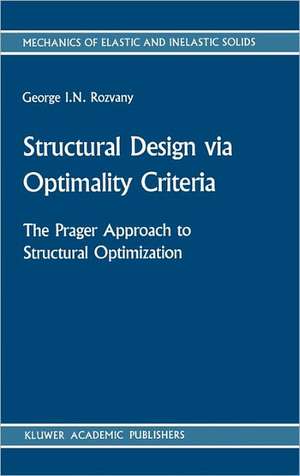
Structural Design Via Optimality Criteria
Autor George I N Rozvanyen Limba Engleză Hardback – 31 mar 1989
Preț: 1277.98 lei
Preț vechi: 1558.51 lei
-18%
Puncte Express: 1917
Carte tipărită la comandă
Livrare economică 03-17 decembrie
Livrare prin curier în România Termenul estimat este afișat lângă disponibilitate.
Transport gratuit pentru acest produs Plată online sau ramburs, în funcție de opțiunile comenzii.
Retur gratuit în 14 zile Comandă securizată și suport în română.
Specificații
ISBN-13: 9789024736133
ISBN-10: 9024736137
Pagini: 490
Ilustrații: 490 p.
Dimensiuni: 156 x 234 x 27 mm
Greutate: 0.87 kg
Ediția:1989 edition
Editura: Springer
Locul publicării:Dordrecht, Netherlands
ISBN-10: 9024736137
Pagini: 490
Ilustrații: 490 p.
Dimensiuni: 156 x 234 x 27 mm
Greutate: 0.87 kg
Ediția:1989 edition
Editura: Springer
Locul publicării:Dordrecht, Netherlands
V-ar putea interesa
-
 -12%Preț: 377.59 lei427.68 lei
 -
 Matrix Analysis Of Framed StructuresWilliam Weaver-18%Preț: 2173.84 lei2651.01 lei
 -
 The Seismic Design HandbookFarzad Naeim-18%Preț: 1287.61 lei1570.26 lei
 -
 -18%Preț: 987.63 lei1204.43 lei
 -
 Design of Steel StructuresElias G. Abu-Saba-18%Preț: 1435.49 lei1750.59 lei
 -
 Applied Methods of Structural ReliabilityMilík Tichý-18%Preț: 1275.55 lei1555.54 lei
 -
 The Paramount Role of Joints into the Reliable Response of StructuresC. C. BaniotopoulosPreț: 388.13 lei
 -
 -18%Preț: 986.17 lei1202.64 lei
 -
 Structural Steel Design to Eurocode 3 and Aisc SpecificationsClaudio Bernuzzi-9%Preț: 942.87 lei1036.12 lei
 -
 Preț: 457.32 lei
 -
 -19%Preț: 536.35 lei662.16 lei
 -
 Back Analysis in Rock EngineeringShunsuke Sakurai-18%Preț: 1308.72 lei1596.00 lei
 -
 Estimating and Tendering for Construction WorkMartin Brook-15%Preț: 428.25 lei503.82 lei
 -
 Building Measurement: New Rules of MeasurementAndrew Packer-8%Preț: 447.41 lei486.31 lei
 -
 Foundation Systems for High-Rise StructuresRolf Katzenbach-18%Preț: 1008.82 lei1230.27 lei
 -
 -27%Preț: 1522.45 lei2075.34 lei
 -
 Bifurcations, Instabilities, Degradation in GeomechanicsGeorge Exadaktylos-18%Preț: 1277.43 lei1557.84 lei
 -
 Topology Optimization in Structural and Continuum MechanicsGeorge I. N. Rozvany-18%Preț: 1449.83 lei1768.07 lei
 -
 -15%Preț: 658.77 lei775.02 lei
 -
 Preț: 380.46 lei
 -
 Optimization of Large Structural SystemsGeorge I. N. RozvanyPreț: 508.06 lei
 -
 -15%Preț: 646.04 lei760.05 lei
Public țintă
ResearchCuprins
I.1 Why Optimality Criteria?.- I.2 Classes of Problems in Structural Optimization.- I.3 Case Studies Involving Simple Structures.- I.4 Case Studies Involving More Complex Structures.- I.5 Broader Implications of Optimality Criteria Methods.- 1. Static-Kinematic Optimality Criteria.- 1.1 Aims.- 1.2 An Introductory Example: What This Book Is All About.- 1.3 Plastic Design on the Basis of the Lower Bound Theorem.- 1.4 Basic Variables in Structural Mechanics.- 1.5 Fundamental Relations of Structural Mechanics.- 1.6 The Role of Static-Kinematic Optimality Criteria.- 1.7 The Prager-Shield Theory of Optimal Plastic Design.- 1.8 The G-Gradient Operator.- 1.9 Extensions of the Prager-Shield Theory in Plastic Design.- 1.10 Optimal Elastic Design — Static Problems.- 1.11 Optimal Elastic Design — Buckling and Natural Frequency Constraints.- 1.12 Superposition Principles.- 1.13 Duality Principles in Elastic Design.- 1.14 Concluding Remarks.- 2. Optimal Plastic Design of Beams with Freely Variable Cross-Sectional Dimensions.- 2.1 General Concepts.- 2.2 Optimal Plastic Design of Beams Having a Moment-Dependent Specific Cost Function — Continuously Variable Cross-Section.- 2.3 Optimal Plastic Design of Beams Having a Moment and Shear Dependent Specific Cost Function — Continuously Variable Cross-Section.- 2.4 Dual Formulation for Plastically Designed Beams — Continuously Varying Cross-Section.- 2.5 Concluding Remarks.- 3. Optimal Plastic Design of Beams with Unspecified Actions or Reactions.- 3.1 Preliminary Remarks.- 3.2 External Actions (Reactions) at Prescribed Locations.- 3.3 External Actions or Reactions of Unspecified Location.- 3.4 Concluding Remarks.- 4. Optimal Plastic Design of Beams with Segmentation.- 4.1 Segmentation in Beam Design.- 4.2 Optimality Conditions forSegmented Beams with Prescribed Segment Boundaries.- 4.3 Optimization of Segmentation.- 4.4 Segmented Beams with Multiple Load Conditions.- 4.5 Concluding Remarks.- 5. Optimal Plastic Design of Beams: Allowance for Selfweight, Bounded Spatial Gradients (Niordson-Constraints) and Linear Segments.- 5.1 Introductory Remarks.- 5.2 Allowance for the Effect of Selfweight — Continuously Variable Cross-Section.- 5.3 Bounded Spatial Gradients of the Specific Cost (Niordson-Constraints).- 5.4 Beams with Segmentation and Selfweight.- 5.5 Beams with Linear Segmentation.- 5.6 Concluding Remarks.- 6. Optimal Elastic Design of Beams — Stress and Deflection Constraints.- 6.1 Optimal Elastic versus Optimal Plastic Design.- 6.2 Linearly Elastic Beams with Stress and Displacement Constraints — Freely Variable Cross-Sectional Dimensions.- 6.3 Prescribed Distribution of the Cross-Sectional Parameters over Given Beam Segments.- 6.4 Concluding Remarks.- 7. Optimal Elastic Design of Beams — Optimization of Segmentation, Constraints on Spatial Gradients (Niordson-Constraints) and Multicriteria Design.- 7.1 Introductory Remarks.- 7.2 Optimization of Beam Segmentation and Location of Hinges and Supports.- 7.3 Optimization of Elastic Beams with Stress, Deflection and Niordson-Constraints.- 7.4 Multicriteria Optimization of Elastic Beams.- 7.5 Concluding Remarks.- 8. The Theory of Optimal Layouts and a Brief Review of Its Applications.- 8.1 Introductory Remarks.- 8.2 The Concept of Structural Universe.- 8.3 Introductory Examples.- 8.4 Classical and Advanced Layout Theories.- 8.5 Applications of the Classical Layout Theory.- 8.6 Applications of the Advanced Layout Theory.- 9. A Short History of Optimality Criteria Methods.- 9.1 The Origins of Optimality Criteria in Structural Mechanics.-9.2 Later Developments.- 9.3 Historical Notes on Optimal Layout Theory.- Closing Remarks.- Appendix. A Brief Review of Variational Methods.- A.1 Aims.- A.2 Necessary Conditions (Euler Equations) for the Minimum of a Functional — Given Boundary Conditions and No Constraints.- Problems and Solutions.- A.3 Variational Problems with Equality Constraints.- Problems and Solutions.- A.4 Transversality Conditions (Variational Problems with Variable Boundary Conditions).- Problems and Solutions.- A.5 Inequality Constraints.- Problems and Solutions.- A.6 Mixed Variational Problems.- Problems and Solutions.- A.7 Discontinuous Extremals.- Problems and Solutions.- A.8 The Rocket Problem (Variational Solution).- Selected Bibliography.- R.1 Books.- R.2 Review Papers.- R.3 Research Papers.- Name Index.
Recenzii
`This book can definitely be recommended to all those who are willing to immerse themselves in one of the most important areas of structural optimization,`
H. Eschenauer, ZFW Köln, 1990
`Das Buch kann in jedem Fall all denen empfohlen werden, die bereit sind, sich eines der wichtigen Gebiete der Strukturoptimierung einzuarbeiten.'
Zeitschrift für Flug und Weltraumforschung, 14:1/2, 1990
H. Eschenauer, ZFW Köln, 1990
`Das Buch kann in jedem Fall all denen empfohlen werden, die bereit sind, sich eines der wichtigen Gebiete der Strukturoptimierung einzuarbeiten.'
Zeitschrift für Flug und Weltraumforschung, 14:1/2, 1990