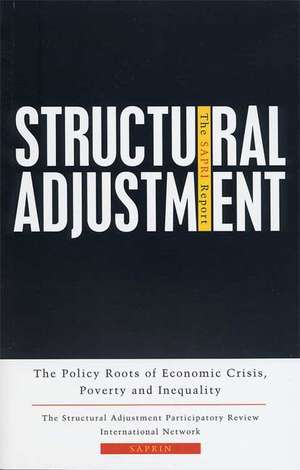
Structural Adjustment: The SAPRI Report: The Policy Roots of Economic Crisis, Poverty and Inequality
en Limba Engleză Paperback – feb 2004
Preț: 260.43 lei
Preț vechi: 308.92 lei
-16%
Puncte Express: 391
Carte tipărită la comandă
Livrare economică 02-16 decembrie
Livrare prin curier în România Termenul estimat este afișat lângă disponibilitate.
Transport gratuit de la 400.00 lei Plată online sau ramburs, în funcție de opțiunile comenzii.
Retur gratuit în 14 zile Comandă securizată și suport în română.
Specificații
ISBN-13: 9781842773895
ISBN-10: 1842773895
Pagini: 256
Dimensiuni: 145 x 205 x 16 mm
Greutate: 0.34 kg
Editura: Bloomsbury Publishing
Colecția Zed Books
Locul publicării:London, United Kingdom
ISBN-10: 1842773895
Pagini: 256
Dimensiuni: 145 x 205 x 16 mm
Greutate: 0.34 kg
Editura: Bloomsbury Publishing
Colecția Zed Books
Locul publicării:London, United Kingdom
V-ar putea interesa
-
 Development as FreedomAmartya Sen-19%Preț: 93.38 lei114.70 lei
 -
 -27%Preț: 373.02 lei514.49 lei
 -
 Fighting Poverty TogetherA. Karnani-8%Preț: 454.60 lei494.13 lei
 -
 Demanding the LandPaul DoshPreț: 294.46 lei
 -
 Life in Poverty Neighbourhoods: European and American PerspectivesJurgen Friedrichs-18%Preț: 1112.03 lei1356.13 lei
 -
 Poverty and MoralityWilliam A. GalstonPreț: 250.33 lei
 -
 Random FamilyAdrian Nicole LeblancPreț: 121.51 lei
 -
 Collateral DamageZygmunt BaumanPreț: 135.39 lei
 -
 GhostbreadSonja LivingstonPreț: 133.19 lei
 -
 Slumming It: The Tourist Valorization of Urban PovertyFabian Frenzel-15%Preț: 145.65 lei170.78 lei
 -
 London Labour and the London PoorHenry MayhewPreț: 47.21 lei
 -
 Making Poverty: A HistoryThomas Lines-12%Preț: 172.93 lei195.45 lei
 -
 -23%Preț: 260.96 lei340.37 lei
 -
 Health and Poverty: Global Health Problems and SolutionsGijs WalravenPreț: 387.91 lei
Cuprins
1. SAPRI/CASA Experience
2. Trade Liberalization Policies and Their Impact on the Manufacturing Sector - Bangladesh, Ecuador, Ghana, Hungary, Mexico, the Philippines and Zimbabwe
3. Financial Sector Liberalization, Effects on Production and the Small Enterprise Sector - Bangladesh, Ecuador, El Salvador and Zimbabwe
4. Employment under Adjustment and the Effects of Labor Market Reform on Working People - Ecuador, El Salvador, Mexico and Zimbabwe
5. The Economic and Social Impact of Privatization Programs - Bangladesh, El Salvador, Hungary and Uganda
6. The Impact of Agricultural Sector Adjustment Policies on Small Farmers and Food Security - Bangladesh, Mexico, the Philippines, Uganda and Zimbabwe
7. The Socioeconomic and Environmental Impact of Mining Sector Reform - Ghana and the Philippines
8. The Effects of Public Expenditure Policies on Education and Health Care under Structural Adjustment - Ecuador, Ghana, Hungary, Mexico, the Philippines, Uganda and Zimbabwe
9. Structural Adjustment, Poverty and Inequality
2. Trade Liberalization Policies and Their Impact on the Manufacturing Sector - Bangladesh, Ecuador, Ghana, Hungary, Mexico, the Philippines and Zimbabwe
3. Financial Sector Liberalization, Effects on Production and the Small Enterprise Sector - Bangladesh, Ecuador, El Salvador and Zimbabwe
4. Employment under Adjustment and the Effects of Labor Market Reform on Working People - Ecuador, El Salvador, Mexico and Zimbabwe
5. The Economic and Social Impact of Privatization Programs - Bangladesh, El Salvador, Hungary and Uganda
6. The Impact of Agricultural Sector Adjustment Policies on Small Farmers and Food Security - Bangladesh, Mexico, the Philippines, Uganda and Zimbabwe
7. The Socioeconomic and Environmental Impact of Mining Sector Reform - Ghana and the Philippines
8. The Effects of Public Expenditure Policies on Education and Health Care under Structural Adjustment - Ecuador, Ghana, Hungary, Mexico, the Philippines, Uganda and Zimbabwe
9. Structural Adjustment, Poverty and Inequality
Recenzii
Structural Adjustment: The SAPRI Report illustrates the devastating impact that structural adjustment policies, undemocratically imposed by the international financial institutions, have had on national productive capacity, employment, wages and the growing number of people in poverty. It captures what we in Mexico and Latin America have fought against for the past two decades and is all the more pertinent given the intensifying challenges to neoliberalism in the region.
An excellent expose of how people's human rights are being sacrificed on the altar of the free market in the name of development.
We urgently need to change the way the aid business is conducted, including structural adjustment. This global report contains findings that warrant close examination by the international financial institutions, development agencies, and national governments.
This book documents a unique exercise in broad-based civil society participation, collaboration and engagement with official institutions. It represents a strong challenge to governments and the World Bank to open up economic policymaking to reflect local knowledge and realities.
Structural adjustment has been the most controversial economic and social policy model foisted onto a reluctant Third World in the past two to three decades. SAPRIN has been a pioneering network tracking, critiquing and acting on its damaging effects. This vitally important book cogently summarizes the various effects of structural adjustment and should be read by all who care about the developing world.
Exposes a human reality among the poor in developing countries, which may belittle or even falsify official statistics...it is high time that the report is finally available as a book.
...is an excellent and important book, one that helps to illuminate and further problematize a critical concept in contemporary international development. The book should be of keen interest to economists, development practitioners and theorists, and social movement activists alike. The introductory chapter is particularly fascinating and insightful.
An excellent expose of how people's human rights are being sacrificed on the altar of the free market in the name of development.
We urgently need to change the way the aid business is conducted, including structural adjustment. This global report contains findings that warrant close examination by the international financial institutions, development agencies, and national governments.
This book documents a unique exercise in broad-based civil society participation, collaboration and engagement with official institutions. It represents a strong challenge to governments and the World Bank to open up economic policymaking to reflect local knowledge and realities.
Structural adjustment has been the most controversial economic and social policy model foisted onto a reluctant Third World in the past two to three decades. SAPRIN has been a pioneering network tracking, critiquing and acting on its damaging effects. This vitally important book cogently summarizes the various effects of structural adjustment and should be read by all who care about the developing world.
Exposes a human reality among the poor in developing countries, which may belittle or even falsify official statistics...it is high time that the report is finally available as a book.
...is an excellent and important book, one that helps to illuminate and further problematize a critical concept in contemporary international development. The book should be of keen interest to economists, development practitioners and theorists, and social movement activists alike. The introductory chapter is particularly fascinating and insightful.