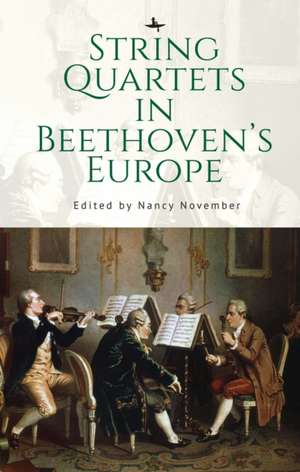

String Quartets in Beethoven’s Europe
Editat de Nancy Novemberen Limba Engleză Hardback – 19 apr 2022
String Quartets in Beethoven’s Europe is the first detailed study of string quartets in late-eighteenth- and early-nineteenth-century Europe. It brings together the work of nine scholars who explore little-studied aspects of this multi-faceted genre. Together, this book’s chapters deal with compositional responses to Beethoven’s string quartets and the prestige of the genre; varied compositional practices in string quartet writing, with a particular emphasis on texture and performance elements; and the reception of Beethoven’s string quartets ca. 1800. They include discussions of quartets composed for the amateur and connoisseur markets in Beethoven’s Europe; virtuosity, the French Violin School, and the quatuor brillant; the relationship between quartet composers and their audiences during Beethoven’s era; and the cross-pollination of quartet styles in Europe’s musical centers such as Vienna, Paris, and St. Petersburg.
Preț: 593.77 lei
Preț vechi: 800.42 lei
-26%
Puncte Express: 891
Carte disponibilă
Livrare economică 09-23 noiembrie
Livrare express 23-29 octombrie pentru 100.71 lei
Livrare prin curier în România Termenul estimat este afișat lângă disponibilitate.
Transport gratuit pentru acest produs Plată online sau ramburs, în funcție de opțiunile comenzii.
Retur gratuit în 14 zile Comandă securizată și suport în română.
Specificații
ISBN-13: 9781644697870
ISBN-10: 1644697874
Pagini: 276
Dimensiuni: 156 x 234 x 17 mm
Greutate: 0.04 kg
Editura: Academic Studies Press
Colecția Academic Studies Press
Locul publicării:Boston, MA, United States
ISBN-10: 1644697874
Pagini: 276
Dimensiuni: 156 x 234 x 17 mm
Greutate: 0.04 kg
Editura: Academic Studies Press
Colecția Academic Studies Press
Locul publicării:Boston, MA, United States
Cuprins
Acknowledgments
Introduction
1. His Master’s Voice? Ries, Reputation, and the String Quartet
Allan Badley
2. The “Middle Period” String Quartets of Spohr and Beethoven
Nancy November
3. Counterpoint without Anxiety? Andreas Romberg’s String Quartets Op. 2, Dedicated to Haydn
W. Dean Sutcliffe
4. On the Fugues in Anton Reicha’s Quatuor Scientifique: Between Tradition and Innovation
Mai Koshikakezawa
5. The Other “Razumovsky” Quartets: Franz Weiss’s Op. 8 and the Formation of Vienna’s Kennerpublikum
Mark Ferraguto
6. Hyacinthe Jadin and the Sound of Revolution: Recovering French String Quartet Aesthetics in 1790s Paris
Callum Blackmore
7. “One for the Rode”: The Contribution of Pierre Rode and the Quatuor Brillant to the Early Nineteenth-Century String Quartet
Sam Girling
8. A Surprise to the Ears, an Amusement for the Eyes: Compositional Strategy and Audience Response to String Quartets ca. 1800
Yoko Maruyama
9. The Canonization of Beethoven’s String Quartets in the Musikalisches Taschenbuch auf das Jahr 1803
Christian Speck
Epilogue
Authors’ Biographies
Index
Introduction
1. His Master’s Voice? Ries, Reputation, and the String Quartet
Allan Badley
2. The “Middle Period” String Quartets of Spohr and Beethoven
Nancy November
3. Counterpoint without Anxiety? Andreas Romberg’s String Quartets Op. 2, Dedicated to Haydn
W. Dean Sutcliffe
4. On the Fugues in Anton Reicha’s Quatuor Scientifique: Between Tradition and Innovation
Mai Koshikakezawa
5. The Other “Razumovsky” Quartets: Franz Weiss’s Op. 8 and the Formation of Vienna’s Kennerpublikum
Mark Ferraguto
6. Hyacinthe Jadin and the Sound of Revolution: Recovering French String Quartet Aesthetics in 1790s Paris
Callum Blackmore
7. “One for the Rode”: The Contribution of Pierre Rode and the Quatuor Brillant to the Early Nineteenth-Century String Quartet
Sam Girling
8. A Surprise to the Ears, an Amusement for the Eyes: Compositional Strategy and Audience Response to String Quartets ca. 1800
Yoko Maruyama
9. The Canonization of Beethoven’s String Quartets in the Musikalisches Taschenbuch auf das Jahr 1803
Christian Speck
Epilogue
Authors’ Biographies
Index
Recenzii
“Studies of string quartet compositions have long been skewed toward works by the triumvirate: Haydn, Mozart, and Beethoven. This collection of essays fills in some of the gaps by broadening that scope to consider other leading composers of their time, including members of Beethoven’s circle (Ferdinand Ries, Louis Spohr, Anton Reicha, Andreas Romberg, Franz Weiss), and the Frenchmen Pierre Rode and Hyacinthe Jadin.”
— The Beethoven Newsletter (Winter 2023)
“The nine essays November… has collected provide a broad view of the string quartet in Viennese musical life around 1800. This topic has been insufficiently studied, and the book helps remedy that. … Expanding the lens through which to view the period, analyses are in depth and detailed and comprehensive bibliographies and useful footnotes are included. … Recommended.”
— M. N.-H. Cheng, Colgate University, CHOICE (April 2023: Vol. 60 No. 8)
“String Quartets in Beethoven’s Europe seeks to expand the available information about, and intellectual approaches to, chamber music around the turn of the nineteenth century, moving the discourse beyond a focus on Vienna and its most famous triumvirate, Haydn, Mozart, and Beethoven. As an introduction to string quartets by a number of mostly overlooked composers contemporaneous with Beethoven, the book is a success… [T]he book suggests many avenues for future research and opens opportunities for scholars and students to explore music that has until now received less than its due attention, especially in English-language scholarship.”
— Marie Sumner Lott, Music & Letters
— The Beethoven Newsletter (Winter 2023)
“The nine essays November… has collected provide a broad view of the string quartet in Viennese musical life around 1800. This topic has been insufficiently studied, and the book helps remedy that. … Expanding the lens through which to view the period, analyses are in depth and detailed and comprehensive bibliographies and useful footnotes are included. … Recommended.”
— M. N.-H. Cheng, Colgate University, CHOICE (April 2023: Vol. 60 No. 8)
“String Quartets in Beethoven’s Europe seeks to expand the available information about, and intellectual approaches to, chamber music around the turn of the nineteenth century, moving the discourse beyond a focus on Vienna and its most famous triumvirate, Haydn, Mozart, and Beethoven. As an introduction to string quartets by a number of mostly overlooked composers contemporaneous with Beethoven, the book is a success… [T]he book suggests many avenues for future research and opens opportunities for scholars and students to explore music that has until now received less than its due attention, especially in English-language scholarship.”
— Marie Sumner Lott, Music & Letters