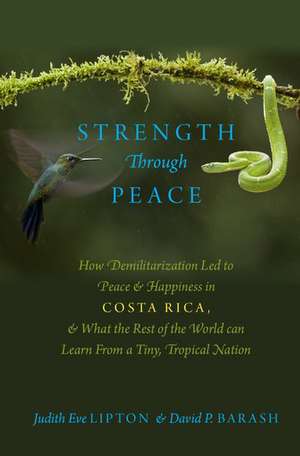
Strength Through Peace: How Demilitarization Led to Peace and Happiness in Costa Rica, and What the Rest of the World can Learn From a Tiny, Tropical Nation
Autor Judith Eve Lipton, David P. Barashen Limba Engleză Hardback – 12 iun 2026
Preț: 257.66 lei
Preț vechi: 293.50 lei
-12%
Puncte Express: 386
Carte tipărită la comandă
Livrare economică 03-08 decembrie
Livrare prin curier în România Termenul estimat este afișat lângă disponibilitate.
Transport gratuit de la 400.00 lei Plată online sau ramburs, în funcție de opțiunile comenzii.
Retur gratuit în 14 zile Comandă securizată și suport în română.
Specificații
ISBN-13: 9780199924974
ISBN-10: 019992497X
Pagini: 272
Dimensiuni: 157 x 236 x 23 mm
Greutate: 0.48 kg
Editura: Oxford University Press
Colecția OUP USA
Locul publicării:New York, United States
ISBN-10: 019992497X
Pagini: 272
Dimensiuni: 157 x 236 x 23 mm
Greutate: 0.48 kg
Editura: Oxford University Press
Colecția OUP USA
Locul publicării:New York, United States
Recenzii
"A timely book! Overall, the book is theoretically well developed, with a wealth of information on this understudied topic, and represents an original and innovative piece of scholarship which adds to the literature. Moreover, it's well-written and lucid which should appeal to generalists seeking a better contextualization of Costa Rica and the region."
Costa Rica is a wonderful enigma
Strength Through Peace is an engaging book about Costa Rica, a small country in a dangerous part of the world that abolished its military in 1948 and has tried to meet the needs of its people instead. Costa Rica's bold step continues to provide an important lesson for the world: If you want peace, prepare for peace."
No book could be more relevant and appropriate to our time than Strength Through Peace. It is imperative that all who care about the sanctity of evolution must read this book and then lead a revolution to preserve all life on earth."
Here is a story worth celebrating: Costa Rica's unwavering pursuit of social progress via demilitarization. You will experience renewed hope, and want to share it with all of your friends and loved ones!"
Most people think war is ineradicable, because it's part of human nature, but they're wrong. In Strength Through Peace, Lipton and Barash argue that Costa Rica, which abolished its army in 1948, offers hope that the US and other nations can kick the habit of militarism. I hope lots of people read this fascinating, uplifting book, because the first step toward ending war is to believe we can do it."
Costa Rica is a wonderful enigma
Strength Through Peace is an engaging book about Costa Rica, a small country in a dangerous part of the world that abolished its military in 1948 and has tried to meet the needs of its people instead. Costa Rica's bold step continues to provide an important lesson for the world: If you want peace, prepare for peace."
No book could be more relevant and appropriate to our time than Strength Through Peace. It is imperative that all who care about the sanctity of evolution must read this book and then lead a revolution to preserve all life on earth."
Here is a story worth celebrating: Costa Rica's unwavering pursuit of social progress via demilitarization. You will experience renewed hope, and want to share it with all of your friends and loved ones!"
Most people think war is ineradicable, because it's part of human nature, but they're wrong. In Strength Through Peace, Lipton and Barash argue that Costa Rica, which abolished its army in 1948, offers hope that the US and other nations can kick the habit of militarism. I hope lots of people read this fascinating, uplifting book, because the first step toward ending war is to believe we can do it."
Notă biografică
David P. Barash is an evolutionary biologist, Professor of Psychology emeritus at the University of Washington, and author of more than 200 technical research articles, and 39 books. He is also a long-time peace activist and was named by a right-wing organization as one of the 64 most dangerous professors in the US. Judith Eve Lipton is a psychiatrist who practiced psychopharmacology and psychosomatic medicine for 30 years. She learned sociobiology from David Barash, and they went on to maximize their fitness by investing in 4 children and 7 grandchildren, so far, not to mention co-authoring 8 books, about war, sex, and human nature. She is passionate about animals, peace, and the prevention of nuclear war.