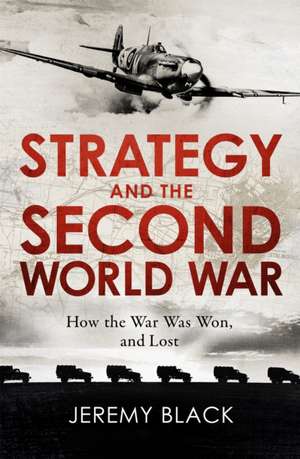
Strategy and the Second World War: How the War was Won, and Lost
Autor Jeremy Blacken Limba Engleză Paperback – iul 2021
,
Preț: 81.83 lei
Preț vechi: 109.22 lei
-25%
Carte disponibilă
Livrare economică 09-23 noiembrie
Livrare express 23-29 octombrie pentru 56.10 lei
Specificații
ISBN-10: 1472145100
Pagini: 320
Dimensiuni: 154 x 232 x 28 mm
Greutate: 0.4 kg
Editura: Little Brown
Colecția Robinson
Locul publicării:London, United Kingdom
Descriere
This concise, accessible account of strategy and the Second World War fills a gap in a way that is timely, with the eightieth anniversary of the war becoming global taking place in 2021. In 1941, Nazi Germany attacked the Soviet Union, Japan attacked Pearl Harbor and British interests in the Far East, and Germany declared war on the United States. Black not only engages explicitly with the strategic issues of the time - as they developed chronologically, and interacted - but also relates these to subsequent debates about the choices made, revealing their continued political contexts and resonances. Building on the conceptual and methodological perspectives offered in his existing work on strategy - Plotting Power: Strategy in the Eighteenth Century (2017) and Military Strategy: A Global History (2020) - Black's treatment of strategy encompasses domestic policy and economic and ideological means, as well as conflict. He shows how, for example, the Holocaust was as much part of Hitler's strategy as war against Communism. His key aim is to emphasise strategic culture and to collapse what he sees as the questionable distinction between policy and strategy, also to emphasise the dynamic impact of contexts, the continual significance of prioritisation, and the significance of the unfixed nature of alliance systems. Black begins by examining strategic engagement and planning in the run-up to the Second World War, including Appeasement and the Soviet-German pact as key strategic means. He shows how the 'long war' strategy of Britain and France was already in difficulties prior to the major German successes in early 1940 and examines the consequences of the Fall of France for the strategies of all the powers. He shows how Germany, from a position of success, but with concerns about Britain, the USA and the Soviet Union, planned a new strategy; while Japan did so in the context of stalemate in China, concern about the Soviet Union, and opportunity due to the weakness of the Western European powers in the region. He explores the nature of strategy-making and its implementation. Black shows how the Soviet Union refused to adopt a pre-emptive approach to attack by Germany, unlike the United States; also how Allied strategy-making was more effective at the Anglo-American level than with the Soviet Union, not only for ideological and political reasons, but also because the Americans and British had a better grasp of the global dimension, in part due to oceanic concerns and means. It is in this context that he discusses the Germany First, and Mediterranean and Second Front controversies. He also looks at the strategic rationale of the Combined Bomber Offensive. Black shows how German and Japanese Strategies in 1943-45 changed as the war went badly for the Axis powers, and looks at the strategic perspective offered by secondary Axis powers - Italy, Romania, Bulgaria, Hungary and Finland. He discusses the extent to which seeking to mould the post-war world becomes more important in competing Allied strategies, notably from 1943, but more particularly from 1944, and how this played out in competing views, for example, over Poland, and the direction and speed of Allied advances. He shows clearly how the strategic choices of the war - real, apparent or imagined - played a role in post-war politics, notably in the Cold War, but also in the related and changing subjects of geopolitics and international relations. Black also discusses how - before, during and after the war - counterfactual speculation about alternative outcomes - past, present and future - proved elements in the development of strategy, both private - for example, Hitler speculating about the death of Roosevelt - and public. He concludes by showing how strategy was a crucial tool not only for conducting the war, but remains one for understanding it today.,
,
Recenzii
In 1941, the Second World War became global, when Nazi Germany attacked the Soviet Union; Japan attacked the United States at Pearl Harbor; and Germany declared war on the United States.
In this timely book, which fills a real gap, Black engages with the strategic issues of the time - as they developed chronologically, and interacted - and relates these to subsequent debates about the choices made, revealing their continued political resonances.
Beginning with Appeasement and the Soviet-German pact as key strategic means, Black examines the consequences of the fall of France for the strategies of all the powers. He shows how Allied strategy-making was more effective at the Anglo-American level than with the Soviet Union, not only for ideological and political reasons, but also because the Americans and British had a better grasp of the global dimension.
He explores how German and Japanese strategies evolved as the war went badly for the Axis powers, and discusses the extent to which seeking to mould the post-war world informed Allied strategic choices from 1943 onwards, and the role these played in post-war politics, notably in the Cold War.
Strategy was a crucial tool not only for conducting the war; it remains the key to understanding it today.