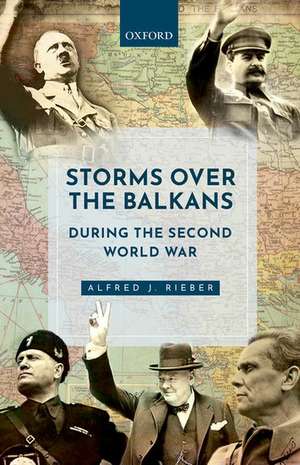
Storms over the Balkans during the Second World War
Autor Alfred J. Rieberen Limba Engleză Hardback – 22 apr 2022
Preț: 706.78 lei
Preț vechi: 1047.53 lei
-33%
Puncte Express: 1060
Carte disponibilă
Livrare economică 30 octombrie-04 noiembrie
Livrare prin curier în România Termenul estimat este afișat lângă disponibilitate.
Transport gratuit pentru acest produs Plată online sau ramburs, în funcție de opțiunile comenzii.
Retur gratuit în 14 zile Comandă securizată și suport în română.
Specificații
ISBN-13: 9780192858030
ISBN-10: 0192858033
Pagini: 306
Ilustrații: several black and white maps
Dimensiuni: 160 x 240 x 22 mm
Greutate: 0.61 kg
Editura: OUP OXFORD
Colecția OUP Oxford
Locul publicării:Oxford, United Kingdom
ISBN-10: 0192858033
Pagini: 306
Ilustrații: several black and white maps
Dimensiuni: 160 x 240 x 22 mm
Greutate: 0.61 kg
Editura: OUP OXFORD
Colecția OUP Oxford
Locul publicării:Oxford, United Kingdom
Recenzii
Alfred Rieber's insightful, panoramic, and wide-ranging new book on World War II in the Balkans combines the author's impressive expertise on the geopolitics of Eurasia with his unfailing attention to context and detail.
Storm Over the Balkans carefully and veraciously analyzes the coming of World War II to the Balkans and the eruptions of violence and fighting in the region that continued into the early Cold War period. Alfred Rieber's newest of many important contributions to the literature on Russia and international affairs is essential reading for anyone who wants to understand the fearsome conflicts that tore apart Yugoslavia in the 1990s and continue to plague the Western Balkans to this day.
In this outstanding and ground-breaking volume, Alfred J. Rieber masterfully disentangles the socio-political, cultural and military complexities of the Balkan conflagration in the first half of the 20th century, focussing on the Second World War and the immediate origins of the Cold War. He brings into sharp relief both the historical continuities and contingencies that informed the shifting strategies and tactics of the key regional protagonists - Mussolini, Hitler, Stalin, Churchill and Tito. The result is a veritable tour de force.
This is a must read for anyone wanting to make sense of the tragic, complex but little known World War Two experiences of the Balkans. The book shows that personalities matter, but the weight of history and geography as well. It is ultimately a story about the difficulties of the 'small' peoples of Europe to become masters of their own history, rather than objects of Great Power ambitions. Highly erudite, engaging, original -- and so topical given today's situation."
A masterful presentation and analysis of the events and personalities that shaped the fate of the Balkans before, during, and immediately after World War Second ... All in all -- a marvellous piece of study that sheds a fresh light on things we thought we knew.
A particular strength of the book is its all-encompassing perspective. Rather than zoom in on Yugoslavia, as do many authors ostensibly interested in "the Balkans," Rieber helpfully elucidates the roles Greece, Bulgaria, Albania, and, to a lesser degree, Romania played during those fateful years. He demonstrates nuanced and in-depth understanding of the cross-currents, linkages, and mutual influences connecting the individual countries as well as knowledge of the domestic conditions in each of them at the time.
Rieber's work is richly researched, with Russian and American archival repositories, as well as additional published primary sources, reflecting the book's focus on political and diplomatic history.
Alfred Rieber wrote a book that is valuable in different ways, especially in the countries of his "Balkans". We can only wish her as many translations into "local" languages as possible and as many productive discussions as possible.
The book is written in an academic popular style and is intended for a wide audience and relies on a scrupulous analysis of primary sources... The work of Rieber is especially valuable , in my view, as part of the growing field of research devoted to the origins of the split between Tito and Stalin.
Rieber's book is well researched, engaging, and provides an insightful history of the Second World War in the western Balkans that should appeal to generalists and specialists alike.
Storm Over the Balkans carefully and veraciously analyzes the coming of World War II to the Balkans and the eruptions of violence and fighting in the region that continued into the early Cold War period. Alfred Rieber's newest of many important contributions to the literature on Russia and international affairs is essential reading for anyone who wants to understand the fearsome conflicts that tore apart Yugoslavia in the 1990s and continue to plague the Western Balkans to this day.
In this outstanding and ground-breaking volume, Alfred J. Rieber masterfully disentangles the socio-political, cultural and military complexities of the Balkan conflagration in the first half of the 20th century, focussing on the Second World War and the immediate origins of the Cold War. He brings into sharp relief both the historical continuities and contingencies that informed the shifting strategies and tactics of the key regional protagonists - Mussolini, Hitler, Stalin, Churchill and Tito. The result is a veritable tour de force.
This is a must read for anyone wanting to make sense of the tragic, complex but little known World War Two experiences of the Balkans. The book shows that personalities matter, but the weight of history and geography as well. It is ultimately a story about the difficulties of the 'small' peoples of Europe to become masters of their own history, rather than objects of Great Power ambitions. Highly erudite, engaging, original -- and so topical given today's situation."
A masterful presentation and analysis of the events and personalities that shaped the fate of the Balkans before, during, and immediately after World War Second ... All in all -- a marvellous piece of study that sheds a fresh light on things we thought we knew.
A particular strength of the book is its all-encompassing perspective. Rather than zoom in on Yugoslavia, as do many authors ostensibly interested in "the Balkans," Rieber helpfully elucidates the roles Greece, Bulgaria, Albania, and, to a lesser degree, Romania played during those fateful years. He demonstrates nuanced and in-depth understanding of the cross-currents, linkages, and mutual influences connecting the individual countries as well as knowledge of the domestic conditions in each of them at the time.
Rieber's work is richly researched, with Russian and American archival repositories, as well as additional published primary sources, reflecting the book's focus on political and diplomatic history.
Alfred Rieber wrote a book that is valuable in different ways, especially in the countries of his "Balkans". We can only wish her as many translations into "local" languages as possible and as many productive discussions as possible.
The book is written in an academic popular style and is intended for a wide audience and relies on a scrupulous analysis of primary sources... The work of Rieber is especially valuable , in my view, as part of the growing field of research devoted to the origins of the split between Tito and Stalin.
Rieber's book is well researched, engaging, and provides an insightful history of the Second World War in the western Balkans that should appeal to generalists and specialists alike.
Notă biografică
Alfred J. Rieber is University Professor Emeritus at the Central European University, where he was Chair of History from 1996 to 2000. He previously taught at Northwestern University and the University of Pennsylvania, and is the author of many books, including Struggle for the Eurasian Borderlands. From the Early Modern Empires to the End of the First World War (2014), which won the 2015 World History Association Bentley Prize, and Stalin and the Struggle for Supremacy in Eurasia (2015), which was shortlisted for the Pushkin Prize in Russian History in 2016.