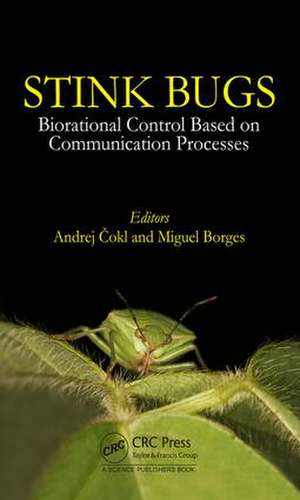
Stinkbugs: Biorational Control Based on Communication Processes
Editat de Andrej Cokl, Miguel Borgesen Limba Engleză Hardback – 28 mar 2017
Preț: 1283.57 lei
Preț vechi: 1565.33 lei
-18%
Puncte Express: 1925
Preț estimativ în valută:
227.31€ • 265.48$ • 197.47£
227.31€ • 265.48$ • 197.47£
Carte tipărită la comandă
Livrare economică 21 februarie-07 martie
Preluare comenzi: 021 569.72.76
Specificații
ISBN-13: 9781498732802
ISBN-10: 1498732801
Pagini: 276
Ilustrații: 22
Dimensiuni: 156 x 234 x 18 mm
Greutate: 0.7 kg
Ediția:1
Editura: CRC Press
Colecția CRC Press
Locul publicării:Boca Raton, United States
ISBN-10: 1498732801
Pagini: 276
Ilustrații: 22
Dimensiuni: 156 x 234 x 18 mm
Greutate: 0.7 kg
Ediția:1
Editura: CRC Press
Colecția CRC Press
Locul publicării:Boca Raton, United States
V-ar putea interesa
-
 Fishing the Great Lakes: An Environmental History, 1783–1933Margaret Beattie BoguePreț: 188.62 lei
 -
 Mountain Nature: A Seasonal Natural History of the Southern AppalachiansJennifer Frick-RuppertPreț: 168.69 lei
 -
 Preț: 115.50 lei
 -
 Preț: 343.01 lei
 -
 Coral Reef Restoration HandbookWilliam F. Precht-18%Preț: 1288.95 lei1571.89 lei
 -
 Handbook of Ecological Models used in Ecosystem and Environmental ManagementSven Erik Jorgensen-18%Preț: 1137.32 lei1386.98 lei
 -
 Nonlinear Physics of EcosystemsEhud Meron-18%Preț: 1286.52 lei1568.93 lei
 -
 Genetic DiversityConner L. Mahoney-30%Preț: 992.67 lei1427.04 lei
 -
 Effects of Climate Change on Aquatic Invasive SpeciesSofia A. Contreras-31%Preț: 1757.20 lei2541.60 lei
 -
 Holy ShoreGideon "Chonla" ShmueliPreț: 515.91 lei
Cuprins
Stinkbug Classification, Phylogeny, Biology and Reproductive Behavior. Host Plant-Stinkbug (Pentatomidae) Relationships. Predatory Stink Bugs (Asopinae) and the Role of Substrate-Borne Vibrational Signals in Intra- and Interspecific Interactions. Communication as the Basis for Biorational Control. The Semiochemistry of Pentatomidae. Substrate-Borne Vibratory Communication. Stink Bug Communication Network and Environment. Plant and Stink Bug Interactions at Different Trophic Levels. Use of Pheromones for Predatory Stink Bugs Management. Use of Pheromones for Monitoring Phytophagous Stink Bugs (Hemiptera: Pentatomidae). Use of Vibratory Signals for Stink Bug Monitoring and Control. Suggestions for Neotropic Stink Bug Pest Status and Control.
Descriere
This book presents an overview of the Pentatomidae species, covering their biology, phylogeny and reproductive behavior, main plants used in their diet and their nutritional exigencies, predatory stinkbugs, interactions between herbivores-plants and natural enemies, use of pheromone for monitoring phytophagous populations, and chemical and vibrational communication signals. It also presents possible technologies to be applied in field crops for pest management that could be developed as the basis of the interplay of stink bug communication signals.