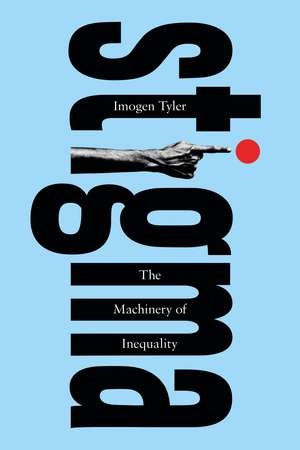
Stigma: The Machinery of Inequality
Autor Imogen Tyleren Limba Engleză Paperback – 10 noi 2022
In this radical reconceptualisation Tyler precisely and passionately outlines the political function of stigma as an instrument of state coercion. Through an original social and economic reframing of the history of stigma, Tyler reveals stigma as a political practice, illuminating previously forgotten histories of resistance against stigmatization, boldly arguing that these histories provide invaluable insights for understanding the rise of authoritarian forms of government today.
Preț: 75.24 lei
Preț vechi: 121.74 lei
-38%
Puncte Express: 113
Preț estimativ în valută:
13.32€ • 15.56$ • 11.56£
13.32€ • 15.56$ • 11.56£
Carte disponibilă
Livrare economică 29 ianuarie-12 februarie
Livrare express 14-20 ianuarie pentru 82.35 lei
Preluare comenzi: 021 569.72.76
Specificații
ISBN-13: 9781350379275
ISBN-10: 1350379271
Pagini: 384
Dimensiuni: 154 x 232 x 22 mm
Greutate: 0.58 kg
Editura: Bloomsbury Publishing
Colecția Bloomsbury Academic
Locul publicării:London, United Kingdom
ISBN-10: 1350379271
Pagini: 384
Dimensiuni: 154 x 232 x 22 mm
Greutate: 0.58 kg
Editura: Bloomsbury Publishing
Colecția Bloomsbury Academic
Locul publicării:London, United Kingdom
Cuprins
Introduction: Stigma, the Machinery of Inequality
1. The Penal Tattoo
2. From Stigma Power to Black Power
3. The Stigma Machine of the Border
4. The Stigma Machine of Austerity
5. Shame Lives on the Eyelids
6. Conclusion: Rage Against the Stigma Machines
1. The Penal Tattoo
2. From Stigma Power to Black Power
3. The Stigma Machine of the Border
4. The Stigma Machine of Austerity
5. Shame Lives on the Eyelids
6. Conclusion: Rage Against the Stigma Machines
Recenzii
Historically, when people were physically branded and maimed, it was clear who was creating stigma and why. While such practices are rare today, Tyler (Lancaster Univ., UK) argues that powerful, hidden processes in developed modern societies still create stigma . Chapters include an analysis of race and Black power in the US, the European refugee crisis, poverty within austerity Britain (based partly on her work with a local Poverty Truth Commission), and autobiographical insights from her working-class upbringing . [The] analysis of oppression in other places can provide a more acceptable way to explore dynamics that also apply to the US. Summing Up: Recommended. Lower-division undergraduates through faculty.
A profoundly original and innovating book. By giving voice to the dehumanised, Tyler's book powerfully bears witness to the suffering and tragedy unfolding in our age. Historically attentive and theoretically sophisticated. intellectually rich and elegantly written.
A devastating and brilliant book that reconceptualises stigma for the Twenty-First Century. Tyler skewers austerity and border regimes, laying out their human costs with clear-eyed, thoughtful analysis. Stigma is essential reading for these times.
If you think you know what stigma is, think again. This book is essential reading for anyone hoping to understand the roots of stigma in our society and how it is leveraged to embed inequities.
Imogen Tyler's passionate book brings out the enduring power of stigma to mark inequality on the body in profound, searing ways. This will be a vital contribution to recognising the lived experience of inequality across history.
A profoundly original and innovating book. By giving voice to the dehumanised, Tyler's book powerfully bears witness to the suffering and tragedy unfolding in our age. Historically attentive and theoretically sophisticated. intellectually rich and elegantly written.
A devastating and brilliant book that reconceptualises stigma for the Twenty-First Century. Tyler skewers austerity and border regimes, laying out their human costs with clear-eyed, thoughtful analysis. Stigma is essential reading for these times.
If you think you know what stigma is, think again. This book is essential reading for anyone hoping to understand the roots of stigma in our society and how it is leveraged to embed inequities.
Imogen Tyler's passionate book brings out the enduring power of stigma to mark inequality on the body in profound, searing ways. This will be a vital contribution to recognising the lived experience of inequality across history.