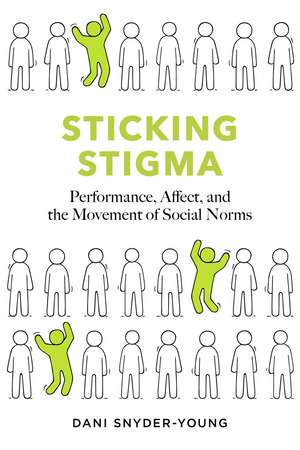
Sticking Stigma: Performance, Affect, and the Movement of Social Norms
Autor Dani Snyder-Youngen Limba Engleză Paperback – 15 feb 2026
Applied theater projects have been used to reduce the stigma related to many health conditions including bipolar disorder, HIV, suicide bereavement, mental illness, autism, and substance use disorder. Beyond this applied theater tradition, theater and performance studies tend not to use the framework or language of stigma very often. Stigma is a more commonly used framework in social science fields such as health and sociology. However, theater and performance regularly attends to the material and affective violence of stigma power: oppression, dispossession, abjection, objectification, expulsion. Snyder-Young examines a set of activist performance projects attempting to use the force of stigma to redistribute and recenter social power.
Preț: 202.82 lei
Puncte Express: 304
Carte tipărită la comandă
Livrare economică 01-15 decembrie
Livrare prin curier în România Termenul estimat este afișat lângă disponibilitate.
Transport gratuit de la 400.00 lei Plată online sau ramburs, în funcție de opțiunile comenzii.
Retur gratuit în 14 zile Comandă securizată și suport în română.
Specificații
ISBN-13: 9780826508478
ISBN-10: 0826508472
Pagini: 260
Ilustrații: 12 b&w images, 5 tables
Dimensiuni: 152 x 229 mm
Greutate: 0.39 kg
Editura: Vanderbilt University Press
Colecția Vanderbilt University Press
ISBN-10: 0826508472
Pagini: 260
Ilustrații: 12 b&w images, 5 tables
Dimensiuni: 152 x 229 mm
Greutate: 0.39 kg
Editura: Vanderbilt University Press
Colecția Vanderbilt University Press
V-ar putea interesa
-
 The Presentation of Self in Everyday LifeErving Goffman-31%Preț: 63.73 lei92.78 lei
 -
 StigmaErving Goffman-32%Preț: 62.36 lei91.96 lei
 -
 A Boal Companion: Dialogues on Theatre and Cultural PoliticsJan Cohen-Cruz-5%Preț: 444.56 lei467.95 lei
 -
 Stigma RevisitedStacey HannemPreț: 232.26 lei
 -
 Disidentifications: Queers of Color And The Performance of PoliticsJosé Esteban MuñozPreț: 194.98 lei
 -
 Staging Change: Toward a Theatrical Theory of Activist PerformanceDr Victoria L. Scrimer-25%Preț: 210.98 lei283.05 lei
 -
 Performing PowerMarcus MorganPreț: 157.34 lei
 -
 Empathy and ResistanceKristina LunzPreț: 109.62 lei
 -
 Place-Keepers: Latina/x Art, Performance, and Organizing in the Twin CitiesJessica Lopez LymanPreț: 136.27 lei
 -
 Oppression and the BodyChristine CaldwellPreț: 127.22 lei
 -
 Southern Stages - Space and Memory in US PerformanceChandra Owenby Hopkins-8%Preț: 597.81 lei649.79 lei
 -
 Preț: 248.31 lei
 -
 Socially Engaged Creative PracticeJess Moriarty-23%Preț: 774.45 lei1005.78 lei
 -
 The PerformerRichard SennettPreț: 92.52 lei
 -
 -19%Preț: 603.42 lei744.97 lei
 -
 -25%Preț: 193.82 lei259.90 lei
 -
 Preț: 70.13 lei
 -
 The Stigma of AddictionJonathan D. Avery-5%Preț: 512.73 lei539.72 lei
 -
 -18%Preț: 309.95 lei380.00 lei
Recenzii
“An exceptional book about an urgent topic. Dani Snyder-Young makes a powerful case for the need to understand how stigma gets attached to varying bodies and identities, and how live performance—of all kinds—can help stigma get unstuck.”
—Kirsty Sedgman, author of On Being Unreasonable: Why Being Bad Can Be a Force for Good
—Kirsty Sedgman, author of On Being Unreasonable: Why Being Bad Can Be a Force for Good
Notă biografică
Dani Snyder-Young is an associate professor of theater at Northeastern University. She is the author of Privileged Spectatorship: Theatrical Interventions in White Supremacy.
Cuprins
Introduction: Manipulating Stigma
Part 1: Reducing Stigma
Chapter 1: Reducing Internalized Stigma: Embodied Worldmaking and Participatory Storytelling
Chapter 2: Instrumentalizing Utopian Performativity: Spectatorial Affective Contact and Stigma Reduction
Chapter 3: Aesthetic Distance and Absent Contact: Little Amal Amidst a ‘Migrant Crisis’
Part 2: Stigmatizing for Social Justice
Chapter 4: Killjoy Hegemony and Counterpublic Stigma Power: Public Accountability, Networked Harassment, and Stigmatainment
Chapter 5: Stigmatizing Performative Activism
Chapter 6: White Women’s Tears: Stigmatizing White Supremacy Culture through Critical Bouffon
Methodological Appendices
Appendix A: Interview and Survey Study of Recovery Storytelling Participants
Appendix B: Audience Survey for This Is Treatment
Appendix C: This is Treatment Survey Participant Demographics
Part 1: Reducing Stigma
Chapter 1: Reducing Internalized Stigma: Embodied Worldmaking and Participatory Storytelling
Chapter 2: Instrumentalizing Utopian Performativity: Spectatorial Affective Contact and Stigma Reduction
Chapter 3: Aesthetic Distance and Absent Contact: Little Amal Amidst a ‘Migrant Crisis’
Part 2: Stigmatizing for Social Justice
Chapter 4: Killjoy Hegemony and Counterpublic Stigma Power: Public Accountability, Networked Harassment, and Stigmatainment
Chapter 5: Stigmatizing Performative Activism
Chapter 6: White Women’s Tears: Stigmatizing White Supremacy Culture through Critical Bouffon
Methodological Appendices
Appendix A: Interview and Survey Study of Recovery Storytelling Participants
Appendix B: Audience Survey for This Is Treatment
Appendix C: This is Treatment Survey Participant Demographics
Descriere
An examination of the manipulation of stigma by theater artists and cultural producers to shift social norms in ways that alleviate inequalities