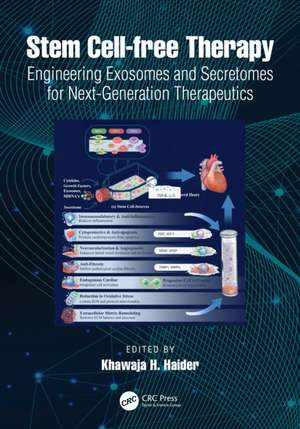
Stem Cell-Free Therapy: Engineering Exosomes and Secretomes for Next-Generation Therapeutics
Editat de Khawaja H. Haideren Limba Engleză Hardback – 21 sep 2026
Key Features:
- Explores the biomedical applications of MSC-derived secretome and EVs across different diseases.
- Discusses the biological and therapeutic potential of exosome-based treatments for neurodegenerative, cardiovascular, ophthalmological, and metabolic diseases.
- Examines innovations in extracellular vesicle-based cell-free therapies for targeted tissue repair and disease intervention.
- Reviews the challenges of translating EV-based therapeutics into clinical practice, including regulatory and manufacturing considerations.
- Highlights cutting-edge applications of EVs in oncology, infectious diseases, and theranostics.
Preț: 936.01 lei
Preț vechi: 1141.47 lei
-18% Nou
Puncte Express: 1404
Carte tipărită la comandă
Livrare economică 27 noiembrie-11 decembrie
Livrare prin curier în România Termenul estimat este afișat lângă disponibilitate.
Transport gratuit pentru acest produs Plată online sau ramburs, în funcție de opțiunile comenzii.
Retur gratuit în 14 zile Comandă securizată și suport în română.
Specificații
ISBN-13: 9781041101000
ISBN-10: 1041101007
Pagini: 700
Ilustrații: 114
Dimensiuni: 178 x 254 mm
Greutate: 1.46 kg
Ediția:1
Editura: CRC Press
Colecția CRC Press
ISBN-10: 1041101007
Pagini: 700
Ilustrații: 114
Dimensiuni: 178 x 254 mm
Greutate: 1.46 kg
Ediția:1
Editura: CRC Press
Colecția CRC Press
Public țintă
Professional ReferenceNotă biografică
Khawaja H. Haider is a Professor of Cellular and Molecular Pharmacology (Stem Cell and Gene Therapy) and Chairman of the Basic Sciences Department (Medical Program) at Sulaiman AlRajhi University, Saudi Arabia. Before his current assignment, he served in several prestigious institutions in various parts of the world. He has also served as Principal Investigator (PI) and Co-PI on multiple National Institute of Health (NIH) funded stem cell research projects. He has been on the editorial boards and invited reviewer panels for several respected international journals. His research focuses on using, either alone or in combination, DNA, miRNAs, and stem cells as “drugs,” a topic that has gained popularity in regenerative medicine. He has extensively published on cellular and sub-cellular preconditioning of stem cells and using their conditioned media for cell-free therapy. He has published nearly 350 book chapters, abstracts, and research papers in various books and leading research journals, including Circulation, Circulation Research, Cardiovascular Research, JCMM, the Journal of Biological Chemistry, Cell Cycle, Basic Research in Cardiology, and Antioxidant Redox Signaling. He has also given numerous presentations and edited ten books covering various facets of stem cells and their applications from drug to drug development.
Cuprins
Chapter 1: Living Biodrugs MSCs-Derived Exosomes and Secretome as Advanced Therapeutic Products for the Treatment of COVID-19 Chapter 2: Paracrining the Heart with Stem Cell Secretome: Mechanism of Action, Ethical Considerations, and Regulatory Framework for Development as Advanced Treatment Medicinal Products Chapter 3: Cell-Free Therapy: Next Step in Regenerative Medicine Chapter 4: Harnessing the Secretome to Repair Electrical Conductivity in the Heart Chapter 5: The MSC-Derived Secretome-Based Therapy for Neuroinflammation in Traumatic Brain Injury Chapter 6: Therapeutic Potential of Secretome in Ophthalmic Disorders Chapter 7: The Potential of Extracellular Vesicles in Regenerative Medicine Chapter 8: Vesicle-Based Cell-Free Therapy in Liver Diseases: A Promising Therapeutic Frontier Chapter 9: Potential Therapies Using Engineered Mesenchymal Stem Cell-derived Exosomes in Gastrointestinal Diseases Chapter 10: Stem Cell Exosomes: Nature’s Nanoparticles for Respiratory Disorders Chapter 11: The Role of Exosomes in Primary Sjögren’s Syndrome: Pathogenesis, Diagnostics, and Therapeutics Chapter 12: MSC-Derived Exosomes for the Therapy of Diabetes Mellitus and Associated Complications Chapter 13: The Use of Mesenchymal Stem Cell-Sourced Exosomes in the Treatment of Neurocognitive Disease: From Bench to Bedside Chapter 14: The Utilization of Exosome-Derived Secretome in Cardiac Repair in Heart Failure Chapter 15: Living Biodrugs and Their Derived Advanced Therapy Medicinal Products to Treat Autoimmune Pathologies Chapter 16: Mesenchymal Stem Cells in Knee Osteoarthritis: Mechanisms, Evidence, and Future Directions Chapter 17: Stem Cells Extracellular Vesicles and Autoimmune Disease Chapter 18: Theragnostic Uses of Exosomes Chapter 19: Exosome Engineering for Enhanced Therapeutic Activity Chapter 20: Osteoimmunology and Intercellular Communication: The Role of The Secretome and Extracellular Vesicles in Bone Regeneration Chapter 21: Advancing Regenerative Medicine: The Role of Secretome and Extracellular Vesicles in Bone and Cartilage Disorders Chapter 22: Mesenchymal Stem Cell-Derived Secretome and Extracellular Vesicles: Therapeutic Innovations for Nervous System Disorders Chapter 23: Exosomes and Secretome in Urogenital Medicine: Beyond Cellular Therapies Chapter 24: Advances in Cell-Derived Exosomes and Secretomes from Bench to Bedside in Oncology Chapter 25: Exosome-Based Therapy: Therapeutic Potential and Limitations Chapter 26: The Use of Secretome and Extracellular Vesicles in Regenerative Medicine Chapter 27 Diabetes Mellitus: Treatment with MSCs and their Secretome
Descriere
This book provides a comprehensive review of the advancements in cell-free therapeutic applications, focusing on the biological and biomedical potential of mesenchymal stem cell (MSC)-derived secretome and extracellular vesicles (EVs) in disease treatment and tissue repair.