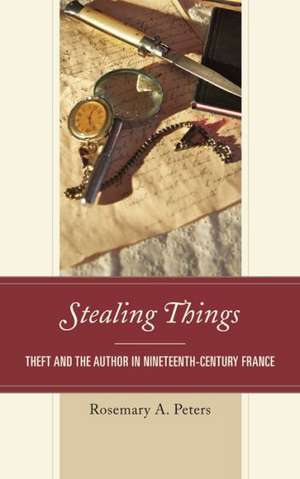
Stealing Things: Theft and the Author in Nineteenth-Century France
Autor Rosemary A. Petersen Limba Engleză Paperback – 30 mar 2015
Preț: 345.19 lei
Preț vechi: 483.79 lei
-29%
Puncte Express: 518
Carte tipărită la comandă
Livrare economică 24 noiembrie-08 decembrie
Livrare prin curier în România Termenul estimat este afișat lângă disponibilitate.
Transport gratuit de la 400.00 lei Plată online sau ramburs, în funcție de opțiunile comenzii.
Retur gratuit în 14 zile Comandă securizată și suport în română.
Specificații
ISBN-13: 9781498516457
ISBN-10: 1498516459
Pagini: 276
Ilustrații: 10 BW Photos
Dimensiuni: 148 x 226 x 16 mm
Greutate: 0.41 kg
Editura: Bloomsbury Publishing
Colecția Lexington Books
Locul publicării:New York, United States
ISBN-10: 1498516459
Pagini: 276
Ilustrații: 10 BW Photos
Dimensiuni: 148 x 226 x 16 mm
Greutate: 0.41 kg
Editura: Bloomsbury Publishing
Colecția Lexington Books
Locul publicării:New York, United States
Cuprins
Acknowledgments
Introduction
1. Codes for Honest People
2. Objects of Fiction, Affairs of State
3. Time Bandits: Purloining the Pocket Watch
4. Identify Theft in the Second Empire
5. Out of the Shadows, Into the Shops: Theft, Gender, and Object Relations
Conclusion
Bibliography
Index
About the Author
Introduction
1. Codes for Honest People
2. Objects of Fiction, Affairs of State
3. Time Bandits: Purloining the Pocket Watch
4. Identify Theft in the Second Empire
5. Out of the Shadows, Into the Shops: Theft, Gender, and Object Relations
Conclusion
Bibliography
Index
About the Author
Recenzii
Provocative and fresh, this wide-ranging study offers a unique perspective on the anxieties and pressures of an increasingly commercial 19th-century French culture. Juxtaposing memoirs, moral codes, specialized dictionaries, and a children's novel with more conventional newspapers, literary texts, and theories, Peters (Louisiana State Univ.) explores a weary and suspicious century caught up in the throes of exchange and reinvention. Thoughtful and diverse early chapters on Balzac's Code des gens honnêtes, Vidocq's contemporaneous Mémoirs and Les voleurs, and Ségur's Les Malheurs de Sophie give way to an analysis of pocket watches-symbol of the emergence of a new social order and the upheaval of commodification-in Zola and Balzac. Final chapters on urban spaces and socioeconomic transformation detail questions of intellectual property theft and the tensions of literary kleptomania. The thoroughness and originality of the introduction alone, with its presentation of the philosophical, legal, and literary conditions of the late 18th century, truly distinguish this volume. Summing Up: Highly recommended. Upper-division undergraduates through faculty.
Stealing Things constitutes a fine performance and will be of interest to students of crime fiction and the nineteenth century.
While cultural studies of crime in nineteenth-century France have generally focused on lurid murders, Stealing Things thoughtfully redirects our attention to theft-a crime that Peters reveals as definitive of the key social issues at stake in an age of industrialization and commodification. This book deftly weaves readings of memoirs, sociological treatises, penal codes, copyright law, and literature for adults and children into a sustained reflection on the era's shifting attitudes toward property-both material and conceptual. Ribbons, pocket watches, and poems, purloined, make their appearance (and disappearance) in this lively account.
This new volume traces the evolving notions of property, ownership, and theft from pre-revolutionary France to the early 20thcentury by expertly exploring the vicissitudes and ramifications of this cultural nexus in fiction and nonfiction. Peters' thoughtful and probing consideration takes in and even focuses on the rarely explored yet crucial areas of authorial plagiarism and, most significantly, the phenomenon of increased feminine involvement in theft by the end of the 19th century.
Original and insightful, this book provides a complex view of the nature of crime and the criminal in nineteenth-century French literature and society. Socio-political discourse and peculiarly literary issues interact seamlessly in a well thought-out analysis of the works of some of the century's most central authors (Balzac and Zola first of all) within the background the birth of contemporary material culture. There is stimulating reading material here for both the specialist and the curious generalist reader.
Stealing Things constitutes a fine performance and will be of interest to students of crime fiction and the nineteenth century.
While cultural studies of crime in nineteenth-century France have generally focused on lurid murders, Stealing Things thoughtfully redirects our attention to theft-a crime that Peters reveals as definitive of the key social issues at stake in an age of industrialization and commodification. This book deftly weaves readings of memoirs, sociological treatises, penal codes, copyright law, and literature for adults and children into a sustained reflection on the era's shifting attitudes toward property-both material and conceptual. Ribbons, pocket watches, and poems, purloined, make their appearance (and disappearance) in this lively account.
This new volume traces the evolving notions of property, ownership, and theft from pre-revolutionary France to the early 20thcentury by expertly exploring the vicissitudes and ramifications of this cultural nexus in fiction and nonfiction. Peters' thoughtful and probing consideration takes in and even focuses on the rarely explored yet crucial areas of authorial plagiarism and, most significantly, the phenomenon of increased feminine involvement in theft by the end of the 19th century.
Original and insightful, this book provides a complex view of the nature of crime and the criminal in nineteenth-century French literature and society. Socio-political discourse and peculiarly literary issues interact seamlessly in a well thought-out analysis of the works of some of the century's most central authors (Balzac and Zola first of all) within the background the birth of contemporary material culture. There is stimulating reading material here for both the specialist and the curious generalist reader.