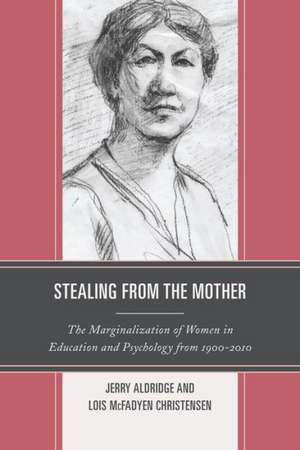
Stealing from the Mother: The Marginalization of Women in Education and Psychology from 1900-2010
Autor Jerry Aldridge, Lois McFadyen Christensenen Limba Engleză Hardback – 11 aug 2013
Preț: 413.25 lei
Preț vechi: 579.18 lei
-29%
Puncte Express: 620
Carte tipărită la comandă
Livrare economică 06-20 iunie
Specificații
ISBN-13: 9781475801583
ISBN-10: 1475801580
Pagini: 180
Ilustrații: 2 BW Illustrations
Dimensiuni: 160 x 236 x 19 mm
Greutate: 0.41 kg
Ediția:New.
Editura: Bloomsbury Publishing
Colecția R&L Education
Locul publicării:New York, United States
ISBN-10: 1475801580
Pagini: 180
Ilustrații: 2 BW Illustrations
Dimensiuni: 160 x 236 x 19 mm
Greutate: 0.41 kg
Ediția:New.
Editura: Bloomsbury Publishing
Colecția R&L Education
Locul publicării:New York, United States
V-ar putea interesa
-
 Preț: 264.77 lei
 -
 All the Women of the BibleHerbert LockyerPreț: 101.61 lei
 -
 Corsets To Camouflage: Women and WarKate Adie-28%Preț: 63.74 lei88.61 lei
 -
 IntercourseAndrea Dworkin-28%Preț: 84.25 lei116.43 lei
 -
 Preț: 201.48 lei
 -
 -23%Preț: 487.19 lei632.71 lei
 -
 Preț: 123.38 lei
 -
 Daughters Of ArabiaJean Sasson-27%Preț: 49.87 lei68.68 lei
 -
 Women, Family, and WorkKarine Moe-8%Preț: 447.54 lei486.46 lei
 -
 The Will to ChangeBell Hooks-11%Preț: 89.67 lei101.28 lei
 -
 Female MasculinityJack HalberstamPreț: 158.49 lei
 -
 Nasa/TrekConstance PenleyPreț: 130.13 lei
 -
 Preț: 195.30 lei
 -
 The Tattooed LadyAmelia Klem OsterudPreț: 119.49 lei
 -
 -20%Preț: 162.07 lei203.05 lei
Cuprins
Stealing from the Mother:
The Marginalization of Women in Education and Psychology from 1900-2010
TABLE OF CONTENTS
Preface
PART ONE:THE PROGRESSIVE PERIOD(1900-1950)
Women from the Northeast
Chapter OneLucy Sprague Mitchell
Chapter TwoCaroline Pratt
Chapter ThreePatty Smith Hill
Chapter FourJosephine Yates Lois M. Christensen and Ebtesam Rababah
Women from the Midwest
Chapter FiveElla Flagg Young
Chapter SixJane Addams
Chapter SevenAlice Chipman Dewey
Chapter EightAnna Bryan
Chapter NineSusan Blow
Chapter TenAnna Julia Cooper
Women from the Southeast
Chapter ElevenMarietta Johnson
Chapter TwelveJulia Tutwiler
Chapter ThirteenMary Jane Patterson
Chapter FourteenMary Church TerrellVernessa E. Curry
Chapter FifteenCharlotte Hawkins Brown
PART TWO:THE PSYCHOLOGICAL PERIOD(1951-2000)
Chapter SixteenSabina Spielrein
Chapter Seventeen Anna Freud
Chapter EighteenMamie Phipps Clark
Chapter NineteenMary Ainsworth
Chapter TwentyMilly Cowles
Chapter Twenty-OneCarol Gilligan
PART THREE:THE POLITICAL PERIOD(2001-2010)
Chapter Twenty-Two Eliminating Gender Inequity in Early Childhood Education
Chapter Twenty-ThreeThe Marginalization of Women Under No Child Left
Behind
Jerry Aldridge, Jennifer L. Kilgo, and Kay Emfinger
PART FOUR:RETURNING THE MOTHER TO HER RIGHTFUL PLACE
Chapter Twenty-FourWomen in Higher Education
Chapter Twenty-Five Rethinking Teacher Education
Jennifer L. Kilgo and Maxie P. Kohler
The Marginalization of Women in Education and Psychology from 1900-2010
TABLE OF CONTENTS
Preface
PART ONE:THE PROGRESSIVE PERIOD(1900-1950)
Women from the Northeast
Chapter OneLucy Sprague Mitchell
Chapter TwoCaroline Pratt
Chapter ThreePatty Smith Hill
Chapter FourJosephine Yates Lois M. Christensen and Ebtesam Rababah
Women from the Midwest
Chapter FiveElla Flagg Young
Chapter SixJane Addams
Chapter SevenAlice Chipman Dewey
Chapter EightAnna Bryan
Chapter NineSusan Blow
Chapter TenAnna Julia Cooper
Women from the Southeast
Chapter ElevenMarietta Johnson
Chapter TwelveJulia Tutwiler
Chapter ThirteenMary Jane Patterson
Chapter FourteenMary Church TerrellVernessa E. Curry
Chapter FifteenCharlotte Hawkins Brown
PART TWO:THE PSYCHOLOGICAL PERIOD(1951-2000)
Chapter SixteenSabina Spielrein
Chapter Seventeen Anna Freud
Chapter EighteenMamie Phipps Clark
Chapter NineteenMary Ainsworth
Chapter TwentyMilly Cowles
Chapter Twenty-OneCarol Gilligan
PART THREE:THE POLITICAL PERIOD(2001-2010)
Chapter Twenty-Two Eliminating Gender Inequity in Early Childhood Education
Chapter Twenty-ThreeThe Marginalization of Women Under No Child Left
Behind
Jerry Aldridge, Jennifer L. Kilgo, and Kay Emfinger
PART FOUR:RETURNING THE MOTHER TO HER RIGHTFUL PLACE
Chapter Twenty-FourWomen in Higher Education
Chapter Twenty-Five Rethinking Teacher Education
Jennifer L. Kilgo and Maxie P. Kohler
Recenzii
Stealing from the Mother: The Marginalization of Women in Education and Psychology from 1900-2010 is an insightful book that sheds light on the injustices and discrimination women have experienced, and continue to experience, in the fields of education and psychology. In this exceptional book, distinguished scholars Jerry Aldridge and Lois McFayden Christensen provide us with a historical perspective on the marginalization of women within the education system, while also offering meaningful ways in which to re-introduce and include women and their contributions in this arena. This book is unique in that it not only examines this history in terms of the progressive, psychological, and political periods of education, but it also acknowledges and addresses the influence of location and geography on the minimization of women and their ideas. Stealing from the Mother is not only an essential book for those interested in the historical foundations of education and psychology; I highly recommend this book for both students and professionals, as well as for all individuals with an interest in raising awareness of the ongoing discrimination against women, and eliminating injustice and inequality in all of its forms.
In Stealing from the Mother, Aldridge and Christensen take a fresh look at the history of education, inviting readers to see women's contributions to the field in an entirely new light. I felt like the authors were taking me by the hand and introducing me to a myriad of smart, spirited, and dedicated educational pioneers, who had all received short shrift for their work in varying ways and degrees. Accessible and inspiring, this text provides a new lens for understanding past and present happenings in education and offers support for resisting the marginalization of women in the future. This is a thought-provoking and worthy contribution to the profession.
I really love this book. From the first chapter, I was drawn to the riveting stories of these amazing and strong women. The voices of these influential women are captured within the pages of this long needed book. Throughout each chapter, I took inspiration and I gained knowledge in the courage, intellect, creativity, and persistence of these women who overcame societal hurdles for the sake of education and for children. This book is noteworthy for all generations and across many disciplines, but I especially think this book is important for entering professionals who are often naive to the incredible journey of our educational foremothers and their positive, infinite impacts.
This timely book on a perennial topic recognizes the heretofore little known and unrecognized contributions of many woman educators, including those in early childhood. The authors have gathered published evidence describing the marginalization of women in education and psychology and have opened doors for fresh examination, discussion, and research of the now-visible issues. It places information about 21 remarkable women who have lived in three centuries in historical and political contexts that also achieve a geographical distribution. Readers will discover books and articles the women have published, the organizations and institutions they have established, the students and colleagues they have influenced, and the biographies they have inspired. Some are still professionally active, still prompting the end-of-chapter questions requiring reader reflection and deeper research. Taking seriously the political and institutional aspects of the field of education, the authors strive to inform the reader about specific ways to take action and to make a difference in their world.
Stealing from the Mother: The Marginalization of Women in Education is an amazing book that appealed to me as a scholar, teacher, administrator, and most importantly as a mother. I found the historical information between the progressive, psychological, and political periods intriguing. I loved reading about the brave women leaders in education highlighted throughout the book. The book concludes with an captivating section titled, Returning the Mother to her Rightful Place, which presents the current climate of higher education for women under a primary male model in academia; yet, provides ways to rethink teacher education, considering how the environment in higher education can be improved. Despite legislation put into place to provide equity for women, there is still much more work to be done to create a supportive climate in academia for women. In all, the authors provide a well-organized, fascinating examination of the history of women within the field of education.
This book is a tribute to the women who innovated, with passion and determination, the educational system in spite of the marginalization and lack of recognition of their professionalism. Their life experiences, told with extreme simplicity and directness, draw not only the history of education, but of an entire era. Each of these women has a peculiar history, but the same dreams to achieve and the same struggles to fight, of which the reader, chapter after chapter, becomes a witness. The many insights, the numerous questions asked so often in a provocative way, become an opportunity to reflect upon the women's marginalization. A book, therefore, in some way universal, dedicated not only to those who work in the educational sector, but to everyone wishing to correct the inequity of our societies.
The Year of the Woman provides the perfect backdrop to recognize, reaffirm and celebrate the selfless journeys our educational foremothers took so that more of us could realize our rights and fulfill our dreams. The stories encouraged me to embrace the "feminization" of education, as it was this qualitative factor that led to the incorporation of social justice, experiential learning, holistic programming and an understanding of the "Other" within our schools. Reading Stealing from the Mother generated an excitement and pride in my chosen profession. The text begins the documentation and discussion of the legacy of those who paved our way, of those who worked tirelessly for the love of children and learning, and of those who truly understood that all children have the right to an inclusive education long before it became fashionable or legislated. The authors have managed to put a new twist on NCLB. Upon reflection, I realized that what was really being asked of the reader was to make sure that No Woman was Left Behind. In doing so, the book empowers and inspires the reader to continue to share the truth of our past so that "her" stories are not lynched by the current white, western, paternalistic dogma.
In Stealing from the Mother, Aldridge and Christensen take a fresh look at the history of education, inviting readers to see women's contributions to the field in an entirely new light. I felt like the authors were taking me by the hand and introducing me to a myriad of smart, spirited, and dedicated educational pioneers, who had all received short shrift for their work in varying ways and degrees. Accessible and inspiring, this text provides a new lens for understanding past and present happenings in education and offers support for resisting the marginalization of women in the future. This is a thought-provoking and worthy contribution to the profession.
I really love this book. From the first chapter, I was drawn to the riveting stories of these amazing and strong women. The voices of these influential women are captured within the pages of this long needed book. Throughout each chapter, I took inspiration and I gained knowledge in the courage, intellect, creativity, and persistence of these women who overcame societal hurdles for the sake of education and for children. This book is noteworthy for all generations and across many disciplines, but I especially think this book is important for entering professionals who are often naive to the incredible journey of our educational foremothers and their positive, infinite impacts.
This timely book on a perennial topic recognizes the heretofore little known and unrecognized contributions of many woman educators, including those in early childhood. The authors have gathered published evidence describing the marginalization of women in education and psychology and have opened doors for fresh examination, discussion, and research of the now-visible issues. It places information about 21 remarkable women who have lived in three centuries in historical and political contexts that also achieve a geographical distribution. Readers will discover books and articles the women have published, the organizations and institutions they have established, the students and colleagues they have influenced, and the biographies they have inspired. Some are still professionally active, still prompting the end-of-chapter questions requiring reader reflection and deeper research. Taking seriously the political and institutional aspects of the field of education, the authors strive to inform the reader about specific ways to take action and to make a difference in their world.
Stealing from the Mother: The Marginalization of Women in Education is an amazing book that appealed to me as a scholar, teacher, administrator, and most importantly as a mother. I found the historical information between the progressive, psychological, and political periods intriguing. I loved reading about the brave women leaders in education highlighted throughout the book. The book concludes with an captivating section titled, Returning the Mother to her Rightful Place, which presents the current climate of higher education for women under a primary male model in academia; yet, provides ways to rethink teacher education, considering how the environment in higher education can be improved. Despite legislation put into place to provide equity for women, there is still much more work to be done to create a supportive climate in academia for women. In all, the authors provide a well-organized, fascinating examination of the history of women within the field of education.
This book is a tribute to the women who innovated, with passion and determination, the educational system in spite of the marginalization and lack of recognition of their professionalism. Their life experiences, told with extreme simplicity and directness, draw not only the history of education, but of an entire era. Each of these women has a peculiar history, but the same dreams to achieve and the same struggles to fight, of which the reader, chapter after chapter, becomes a witness. The many insights, the numerous questions asked so often in a provocative way, become an opportunity to reflect upon the women's marginalization. A book, therefore, in some way universal, dedicated not only to those who work in the educational sector, but to everyone wishing to correct the inequity of our societies.
The Year of the Woman provides the perfect backdrop to recognize, reaffirm and celebrate the selfless journeys our educational foremothers took so that more of us could realize our rights and fulfill our dreams. The stories encouraged me to embrace the "feminization" of education, as it was this qualitative factor that led to the incorporation of social justice, experiential learning, holistic programming and an understanding of the "Other" within our schools. Reading Stealing from the Mother generated an excitement and pride in my chosen profession. The text begins the documentation and discussion of the legacy of those who paved our way, of those who worked tirelessly for the love of children and learning, and of those who truly understood that all children have the right to an inclusive education long before it became fashionable or legislated. The authors have managed to put a new twist on NCLB. Upon reflection, I realized that what was really being asked of the reader was to make sure that No Woman was Left Behind. In doing so, the book empowers and inspires the reader to continue to share the truth of our past so that "her" stories are not lynched by the current white, western, paternalistic dogma.