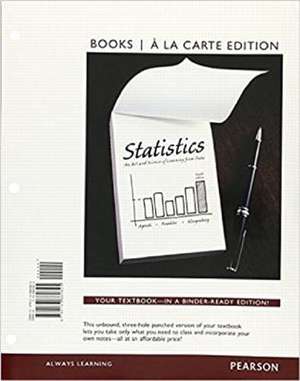
Statistics
Autor Alan Agresti, Christine A. Franklin, Bernhard Klingenbergen Limba Engleză Foi volante
În contextul programelor universitare de introducere în statistică, Statistics: The Art and Science of Learning from Data, Global Edition se poziționează ca o resursă fundamentală care transformă disciplina dintr-un set de formule rigide într-o știință centrală a vieții moderne. Recomandăm acest manual pentru cursurile de licență unde accentul cade pe alfabetizarea statistică și pe capacitatea de a extrage sens din volume mari de date. Ediția a cincea aduce îmbunătățiri tehnologice semnificative, integrând noi aplicații web și resurse video care facilitează învățarea activă.
Subliniem faptul că, spre deosebire de manualele tradiționale, structura propusă de Alan Agresti, Christine A. Franklin și Bernhard Klingenberg inversează ordinea clasică: conceptele sunt introduse mai întâi prin prisma datelor categorice și a proporțiilor, facilitând o înțelegere intuitivă înainte de trecerea la datele cantitative. Această metodologie reflectă expertiza vastă a lui Agresti, vizibilă și în lucrările sale anterioare precum An Introduction to Categorical Data Analysis sau Statistical Methods for the Social Sciences, Global Edition, unde rigoarea academică este dublată de accesibilitate.
Ca o alternativă la Sullivan, M: Statistics: Informed Decisions Using Data, Glob pentru cursurile de statistică introductivă, acest titlu oferă avantajul unei integrări mai profunde a noilor direcții din Data Science încă din primele capitole. Organizarea cărții ghidează studentul de la colectarea și explorarea datelor (grafice, regresie liniară, variabilitate) către analize complexe, utilizând exemple din lumea reală care mențin un nivel ridicat de implicare. Reținem că această ediție Global Edition de la Pearson este calibrată pentru a răspunde nevoilor curriculare internaționale, oferind un echilibru între teorie și aplicații practice.
Preț: 1016.18 lei
Preț vechi: 1319.72 lei
-23%
Carte indisponibilă temporar
Specificații
De ce să citești această carte
Această lucrare se adresează studenților care doresc să înțeleagă logica din spatele cifrelor, nu doar să aplice algoritmi. Prin parcurgerea ei, cititorul câștigă abilitatea de a pune întrebările potrivite în fața unui set de date și de a evita capcanele interpretărilor grafice eronate. Este o resursă esențială pentru viitorii specialiști care au nevoie de o bază solidă în statistica aplicată, susținută de instrumente digitale moderne.
Despre autor
Alan Agresti este profesor emerit în cadrul Departamentului de Statistică al Universității din Florida, unde a predat timp de 35 de ani. Este un expert recunoscut la nivel mondial în analiza datelor categorice, domeniu în care a publicat peste 100 de articole și texte de referință. Printre lucrările sale fundamentale se numără „Categorical Data Analysis” și „Statistical Methods for the Social Sciences”. Pentru contribuțiile sale remarcabile în educația statistică și cercetare, Agresti este membru ales al American Statistical Association, experiența sa didactică fiind pilonul pe care este construită abordarea conceptuală a acestui manual.
Descriere scurtă
Cuprins
1. Statistics: The Art and Science of Learning From Data
1.1 Using Datato Answer Statistical Questions
1.2 SampleVersus Population
1.3 OrganizingData, Statistical Software, and the New Field of Data Science
ChapterSummary
ChapterExercises
2. Exploring Data With Graphs and Numerical Summaries
2.1 DifferentTypes of Data
2.2 GraphicalSummaries of Data
2.3 Measuringthe Center of Quantitative Data
2.4 Measuringthe Variability of Quantitative Data
2.5 UsingMeasures of Position to Describe Variability
2.6 LinearTransformations and Standardizing
2.7Recognizing and Avoiding Misuses of Graphical Summaries
ChapterSummary
ChapterExercises
3. Exploring Relationships Between Two Variables
3.1 TheAssociation Between Two Categorical Variables
3.2 TheRelationship Between Two Quantitative Variables
3.3 LinearRegression: Predicting the Outcome of a Variable
3.4 Cautionsin Analyzing Associations
ChapterSummary
ChapterExercises
4. Gathering Data
4.1Experimental and Observational Studies
4.2 Good andPoor Ways to Sample
4.3 Good andPoor Ways to Experiment
4.4 Other Waysto Conduct Experimental and Nonexperimental Studies
ChapterSummary
ChapterExercises
II: PROBABILITY, PROBABILITY DISTRIBUTIONS, AND SAMPLINGDISTRIBUTIONS
5. Probability in Our Daily Lives
5.1 HowProbability Quantifies Randomness
5.2 FindingProbabilities
5.3Conditional Probability
5.4 Applyingthe Probability Rules
ChapterSummary
ChapterExercises
6. Random Variables and Probability Distributions
6.1Summarizing Possible Outcomes and Their Probabilities
6.2Probabilities for Bell-Shaped Distributions
6.3Probabilities When Each Observation Has Two Possible Outcomes
ChapterSummary
ChapterExercises
7. Sampling Distributions
7.1 How SampleProportions Vary Around the Population Proportion
7.2 How SampleMeans Vary Around the Population Mean
7.3 Using theBootstrap to Find Sampling Distributions
ChapterSummary
Chapter Exercises
III: INFERENTIAL STATISTICS
8. Statistical Inference: Confidence Intervals
8.1 Point andInterval Estimates of Population Parameters
8.2 ConfidenceInterval for a Population Proportion
8.3 ConfidenceInterval for a Population Mean
8.4 BootstrapConfidence Intervals
ChapterSummary
ChapterExercises
9. Statistical Inference: Significance Tests AboutHypotheses
9.1 Steps forPerforming a Significance Test
9.2Significance Tests About Proportions
9.3Significance Tests About a Mean
9.4 Decisionsand Types of Errors in Significance Tests
9.5Limitations of Significance Tests
9.6 TheLikelihood of a Type II Error
ChapterSummary
ChapterExercises
10. Comparing Two Groups
10.1Categorical Response: Comparing Two Proportions
10.2 QuantitativeResponse: Comparing Two Means
10.3 ComparingTwo Groups with Bootstrap or Permutation Resampling
10.4 AnalyzingDependent Samples
10.5 Adjustingfor the Effects of Other Variables
ChapterSummary
ChapterExercises
IV: ANALYZING ASSOCIATION AND EXTENDED STATISTICALMETHODS
11. Analyzing the Association Between CategoricalVariables
11.1Independence and Dependence (Association)
11.2 TestingCategorical Variables for Independence
11.3Determining the Strength of the Association
11.4 Using Residualsto Reveal the Pattern of Association
11.5 FishersExact and Permutation Tests
ChapterSummary
ChapterExercises
12. Analyzing the Association Between QuantitativeVariables: Regression Analysis
12.1 ModelingHow Two Variables Are Related
12.2 InferenceAbout Model Parameters and the Association
12.3Describing the Strength of Association
12.4 How theData Vary Around the Regression Line
12.5Exponential Regression: A Model for Nonlinearity
ChapterSummary
ChapterExercises
13. Multiple Regression
13.1 UsingSeveral Variables to Predict a Response
13.2 Extendingthe Correlation and R2 for Multiple Regression
13.3 UsingMultiple Regression to Make Inferences
13.4 Checkinga Regression Model Using Residual Plots
13.5Regression and Categorical Predictors
13.6 Modelinga Categorical Response
ChapterSummary
ChapterExercises
14. Comparing Groups: Analysis of Variance Methods
14.1 One-WayANOVA: Comparing Several Means
14.2Estimating Differences in Groups for a Single Factor
14.3 Two-WayANOVA
ChapterSummary
ChapterExercises
15. Nonparametric Statistics
15.1 CompareTwo Groups by Ranking
15.2Nonparametric Methods for Several Groups and for Matched Pairs
ChapterSummary
ChapterExercises
Appendix
Answers
Index
Index of Applications
Credits
Notă biografică
He is the author of more than 100 refereed articles and six texts, including Statistical Methods for the Social Sciences (Pearson, 5th edition, 2018) and An Introduction to Categorical Data Analysis (Wiley, 3rd edition, 2019). Alan has also received teaching awards from the University of Florida and an Excellence in Writing award from John Wiley & Sons.
Christine Franklin is the K-12 Statistics Ambassador for the American Statistical Association and elected ASA Fellow. She has retired from the University of Georgia as the Lothar Tresp Honoratus Honors Professor and Senior Lecturer Emerita in Statistics.
She is the co-author of two textbooks and has published more than 60 journal articles and book chapters. Chris was the lead writer for the American Statistical Association Pre-K-12 Guidelines for the Assessment and Instruction in Statistics Education (GAISE) Framework document, co-chair for the updated Pre-K-12 GAISE II, and chair of the ASA Statistical Education of Teachers (SET) report.
Bernhard Klingenberg is a Professor of Statistics in the Department of Mathematics & Statistics at Williams College, where he has been teaching introductory and advanced statistics classes since 2004. He teaches statistical inference and modelling as well as data visualisation at the Graduate Data Science Program at New College of Florida.
Prof. Klingenberg is responsible for the development of the web apps, which he programs using the R package Shiny. A native of Austria, he frequently returns there to hold visiting positions at universities and gives short courses on categorical data analysis in Europe and the United States. He also enjoys photography, with some of his pictures appearing in this book.