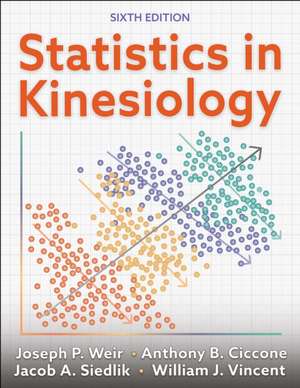
Statistics in Kinesiology
Autor Anthony B. Ciccone, Jacob A. Siedlik, Joseph P. Weir, William J. Vincenten Limba Engleză Paperback – 30 sep 2026
Preț: 543.28 lei
Preț vechi: 590.52 lei
-8% Precomandă
Puncte Express: 815
Carte nepublicată încă
Livrare prin curier în România Precomanda se expediază când titlul devine disponibil.
Transport gratuit pentru acest produs Plată online sau ramburs, în funcție de opțiunile comenzii.
Retur gratuit în 14 zile Comandă securizată și suport în română.
Doresc să fiu notificat când acest titlu va fi disponibil:
Se trimite...
Specificații
ISBN-13: 9781718227675
ISBN-10: 1718227671
Pagini: 376
Dimensiuni: 216 x 279 mm
Ediția:Sixth Edition
Editura: HUMAN KINETICS
ISBN-10: 1718227671
Pagini: 376
Dimensiuni: 216 x 279 mm
Ediția:Sixth Edition
Editura: HUMAN KINETICS
Notă biografică
Joseph P. Weir, PhD, is a professor in the department of health, sport, and exercise sciences at the University of Kansas and was department chair from 2012 to 2022. From 1995 to 2012 he was a professor in the physical therapy doctoral program at Des Moines University in Iowa. He earned his doctorate in exercise physiology from the University of Nebraska at Lincoln.
Dr. Weir is a fellow of both the American College of Sports Medicine (ACSM) and the National Strength and Conditioning Association (NSCA). He was given the NSCA President's Award in 2007 and its William J. Kraemer Outstanding Sport Scientist Award in 2006. He served as president of the National Strength and Conditioning Association Foundation from 2006 to 2009, and he was cochair of the ACSM's Biostatistics Interest Group from 2001 to 2003.
Dr. Weir's research interests primarily focus on muscle fatigue, muscle strength, the cardiovascular autonomic nervous system, and spinal cord injury. He is a senior associate editor of Journal of Strength and Conditioning Research and serves on the manuscript clarification committee of the journal. He is coauthor of Laboratory Manual for Exercise Physiology, Exercise Testing, and Physical Fitness and has contributed chapters to multiple books.
Anthony B. Ciccone, PhD, is an associate professor in the department of exercise science and outdoor recreation at Utah Valley University. He earned his doctorate in exercise physiology from the University of Kansas. Dr. Ciccone is an active member of the National Strength and Conditioning Association (NSCA) and has served on the NSCA Foundation's scholarship committee.
Dr. Ciccone mentors undergraduate research projects addressing neuromuscular fatigue and sport performance. His work has been published in numerous peer-reviewed journals, including Muscle & Nerve and Journal of Strength and Conditioning Research. He is a contributing author of Conditioning for Strength and Human Performance.
Jacob A. Siedlik, PhD, is an associate professor in the department of exercise science and pre-health professions at Creighton University and a research scientist at the Florida Institute for Human and Machine Cognition. He earned his doctorate in exercise physiology from the University of Kansas.
Dr. Siedlik is a member of the American College of Sports Medicine, the National Strength and Conditioning Association, and the American Medical Informatics Association. He is the author of 40 peer-reviewed publications, and his research focuses on leveraging biological and clinical data to advance human health, resilience, and performance. Dr. Siedlik serves as a reviewer for Journal of Strength and Conditioning Research and International Journal of Environmental Research and Public Health.
William J. Vincent, EdD, is a retired adjunct professor and former director of the general education wellness program in the department of exercise sciences at Brigham Young University in Provo, Utah. He is an emeritus professor and the former chair of the department of kinesiology at California State University at Northridge (CSUN). He was employed at CSUN for 40 years and taught statistics and measurement theory for 35 of those years. In 1995 he received the university's Distinguished Teaching Award.
Dr. Vincent has been a member of the American Alliance for Health, Physical Education, Recreation and Dance (AAHPERD), now SHAPE America, since 1964. In 2007, he received the AAHPERD National Honor Award for distinguished service to the profession. He has served as the president of the Southwest District of AAHPERD and was a member of the AAHPERD board of governors from 1993 to 1995. In 1988 he was named the Southwest District Scholar and delivered the keynote address, titled "From Means to MANOVA," at the 1989 convention.
Dr. Vincent is the author or coauthor of four books and more than 70 professional articles. Fifty-one of those articles appeared in refereed journals, including Research Quarterly for Exercise and Sport, International Journal of Sports Medicine, and Journal of Athletic Training. He has a bachelor's degree in physical education (pedagogy), a master's degree in physical education (exercise physiology), and a doctorate in educational psychology (perception and learning), all from the University of California at Los Angeles.
Dr. Vincent lives in Lindon, Utah. He and his late wife, Diana, raised six children, and he has 24 grandchildren and nine great-grandchildren. In his free time, he enjoys camping, snow skiing and water skiing, conducting genealogical research, and reading.
Dr. Weir is a fellow of both the American College of Sports Medicine (ACSM) and the National Strength and Conditioning Association (NSCA). He was given the NSCA President's Award in 2007 and its William J. Kraemer Outstanding Sport Scientist Award in 2006. He served as president of the National Strength and Conditioning Association Foundation from 2006 to 2009, and he was cochair of the ACSM's Biostatistics Interest Group from 2001 to 2003.
Dr. Weir's research interests primarily focus on muscle fatigue, muscle strength, the cardiovascular autonomic nervous system, and spinal cord injury. He is a senior associate editor of Journal of Strength and Conditioning Research and serves on the manuscript clarification committee of the journal. He is coauthor of Laboratory Manual for Exercise Physiology, Exercise Testing, and Physical Fitness and has contributed chapters to multiple books.
Anthony B. Ciccone, PhD, is an associate professor in the department of exercise science and outdoor recreation at Utah Valley University. He earned his doctorate in exercise physiology from the University of Kansas. Dr. Ciccone is an active member of the National Strength and Conditioning Association (NSCA) and has served on the NSCA Foundation's scholarship committee.
Dr. Ciccone mentors undergraduate research projects addressing neuromuscular fatigue and sport performance. His work has been published in numerous peer-reviewed journals, including Muscle & Nerve and Journal of Strength and Conditioning Research. He is a contributing author of Conditioning for Strength and Human Performance.
Jacob A. Siedlik, PhD, is an associate professor in the department of exercise science and pre-health professions at Creighton University and a research scientist at the Florida Institute for Human and Machine Cognition. He earned his doctorate in exercise physiology from the University of Kansas.
Dr. Siedlik is a member of the American College of Sports Medicine, the National Strength and Conditioning Association, and the American Medical Informatics Association. He is the author of 40 peer-reviewed publications, and his research focuses on leveraging biological and clinical data to advance human health, resilience, and performance. Dr. Siedlik serves as a reviewer for Journal of Strength and Conditioning Research and International Journal of Environmental Research and Public Health.
William J. Vincent, EdD, is a retired adjunct professor and former director of the general education wellness program in the department of exercise sciences at Brigham Young University in Provo, Utah. He is an emeritus professor and the former chair of the department of kinesiology at California State University at Northridge (CSUN). He was employed at CSUN for 40 years and taught statistics and measurement theory for 35 of those years. In 1995 he received the university's Distinguished Teaching Award.
Dr. Vincent has been a member of the American Alliance for Health, Physical Education, Recreation and Dance (AAHPERD), now SHAPE America, since 1964. In 2007, he received the AAHPERD National Honor Award for distinguished service to the profession. He has served as the president of the Southwest District of AAHPERD and was a member of the AAHPERD board of governors from 1993 to 1995. In 1988 he was named the Southwest District Scholar and delivered the keynote address, titled "From Means to MANOVA," at the 1989 convention.
Dr. Vincent is the author or coauthor of four books and more than 70 professional articles. Fifty-one of those articles appeared in refereed journals, including Research Quarterly for Exercise and Sport, International Journal of Sports Medicine, and Journal of Athletic Training. He has a bachelor's degree in physical education (pedagogy), a master's degree in physical education (exercise physiology), and a doctorate in educational psychology (perception and learning), all from the University of California at Los Angeles.
Dr. Vincent lives in Lindon, Utah. He and his late wife, Diana, raised six children, and he has 24 grandchildren and nine great-grandchildren. In his free time, he enjoys camping, snow skiing and water skiing, conducting genealogical research, and reading.
Cuprins
Preface
Acknowledgments
List of Key Symbols
Chapter 1. Measurement, Statistics, and Research
What Is Measurement?
Process of Measurement
Variables and Constants
Research Design and Statistical Analysis
Statistical Inference
Summary
Chapter 2. Organizing and Displaying Data
Organizing Data
Displaying Data
Summary
Chapter 3. Percentiles
Common Percentile Divisions
Calculations Using Percentiles
Summary
Chapter 4. Measures of Central Tendency
Mode
Median
Mean
Relationships Between the Mode, Median, and Mean
Logarithmic Transformations and the Geometric Mean
Summary
Chapter 5. Measures of Variability
Range
Interquartile Range
Variance
Standard Deviation
Definition Method of Hand Calculations
Calculating Standard Deviation for a Sample
Coefficient of Variation
Standard Deviation and Normal Distribution
Graphical Depiction of the Standard Deviation
Summary
Chapter 6. The Normal Curve
Z Scores
Standard Scores
Probability and Odds
Calculating Skewness and Kurtosis
Summary
Chapter 7. Fundamentals of Statistical Inference
Predicting Population Parameters Using Statistical Inference
Estimating Sampling Error
Levels of Confidence, Confidence Intervals, and Probability of Error
An Example Using Statistical Inference
Statistical Hypothesis Testing
Type I and Type II Error
Degrees of Freedom
Living With Uncertainty
Two- and One-Tailed Tests
Applying Confidence Intervals
Frequentist Versus Bayesian Inference
Equivalence Testing
Summary
Chapter 8. Correlation and Bivariate Regression
Correlation
Calculating the Correlation Coefficient
Bivariate Regression
Homoscedasticity
Range Restriction
Summary
Chapter 9. Multiple Correlation and Multiple Regression
Multiple Correlation
Semipartial Correlation
Multiple Regression
Summary
Chapter 10. The t Test: Comparing Means From Two Sets of Data
The t Tests
Types of t Tests
Magnitude of the Difference (Size of Effect)
Determining Power and Sample Size
The t Test for Proportions
Summary
Chapter 11. Simple Analysis of Variance: Comparing the Means of Three or More Sets of Data
Assumptions in ANOVA
Sources of Variance
Calculating F: The Definition Method
Determining the Significance of F
Post Hoc Tests
Magnitude of the Treatment (Size of Effect)
Summary
Chapter 12. Analysis of Variance With Repeated Measures
Assumptions in Repeated Measures ANOVA
Calculating Repeated Measures ANOVA
Correcting for Violations of the Assumption of Sphericity
Post Hoc Tests
Confidence Intervals and Effect Sizes
Interpreting the Results
Summary
Chapter 13. Quantifying Reliability
Intraclass Correlation Coefficient
Standard Error of Measurement
Summary
Chapter 14. Factorial Analysis of Variance
A Between–Between Example
A Between–Within Example
A Within–Within Example
Summary
Chapter 15. Analysis of Covariance
Relationship Between ANOVA and Regression
ANCOVA and Statistical Power
Assumptions in ANCOVA
The Pretest–Posttest Control Group Design
Pairwise Comparisons
Summary
Chapter 16. Analysis of Nonparametric Data
Chi-Square (Single Classification)
Chi-Square (Two or More Classifications)
Rank Order Correlation
Mann-Whitney U Test
Kruskal-Wallis ANOVA for Ranked Data
Friedman's Two-Way ANOVA by Ranks
Cliff's Delta
Bootstrap
Summary
Chapter 17. Clinical Measures of Association
Relative Risk
Odds Ratio
Diagnostic Testing
Logistic Regression
Receiver Operator Characteristic (ROC) Curves
Summary
Chapter 18. Advanced Statistical Procedures
Multilevel Modeling
Meta-Analysis
Multiple Analysis of Variance
Factor Analysis
Discriminant Analysis
Summary
Chapter 19. Statistical Issues in Kinesiology
Regression to the Mean
Differences in Nominal Significance (DINS) Error
Issue With Ratios
Post Hoc Power Analyses
Outliers
Responders Versus Nonresponders
Summary
Appendix. Statistical Tables
Glossary
References
Index
About the Authors
Acknowledgments
List of Key Symbols
Chapter 1. Measurement, Statistics, and Research
What Is Measurement?
Process of Measurement
Variables and Constants
Research Design and Statistical Analysis
Statistical Inference
Summary
Chapter 2. Organizing and Displaying Data
Organizing Data
Displaying Data
Summary
Chapter 3. Percentiles
Common Percentile Divisions
Calculations Using Percentiles
Summary
Chapter 4. Measures of Central Tendency
Mode
Median
Mean
Relationships Between the Mode, Median, and Mean
Logarithmic Transformations and the Geometric Mean
Summary
Chapter 5. Measures of Variability
Range
Interquartile Range
Variance
Standard Deviation
Definition Method of Hand Calculations
Calculating Standard Deviation for a Sample
Coefficient of Variation
Standard Deviation and Normal Distribution
Graphical Depiction of the Standard Deviation
Summary
Chapter 6. The Normal Curve
Z Scores
Standard Scores
Probability and Odds
Calculating Skewness and Kurtosis
Summary
Chapter 7. Fundamentals of Statistical Inference
Predicting Population Parameters Using Statistical Inference
Estimating Sampling Error
Levels of Confidence, Confidence Intervals, and Probability of Error
An Example Using Statistical Inference
Statistical Hypothesis Testing
Type I and Type II Error
Degrees of Freedom
Living With Uncertainty
Two- and One-Tailed Tests
Applying Confidence Intervals
Frequentist Versus Bayesian Inference
Equivalence Testing
Summary
Chapter 8. Correlation and Bivariate Regression
Correlation
Calculating the Correlation Coefficient
Bivariate Regression
Homoscedasticity
Range Restriction
Summary
Chapter 9. Multiple Correlation and Multiple Regression
Multiple Correlation
Semipartial Correlation
Multiple Regression
Summary
Chapter 10. The t Test: Comparing Means From Two Sets of Data
The t Tests
Types of t Tests
Magnitude of the Difference (Size of Effect)
Determining Power and Sample Size
The t Test for Proportions
Summary
Chapter 11. Simple Analysis of Variance: Comparing the Means of Three or More Sets of Data
Assumptions in ANOVA
Sources of Variance
Calculating F: The Definition Method
Determining the Significance of F
Post Hoc Tests
Magnitude of the Treatment (Size of Effect)
Summary
Chapter 12. Analysis of Variance With Repeated Measures
Assumptions in Repeated Measures ANOVA
Calculating Repeated Measures ANOVA
Correcting for Violations of the Assumption of Sphericity
Post Hoc Tests
Confidence Intervals and Effect Sizes
Interpreting the Results
Summary
Chapter 13. Quantifying Reliability
Intraclass Correlation Coefficient
Standard Error of Measurement
Summary
Chapter 14. Factorial Analysis of Variance
A Between–Between Example
A Between–Within Example
A Within–Within Example
Summary
Chapter 15. Analysis of Covariance
Relationship Between ANOVA and Regression
ANCOVA and Statistical Power
Assumptions in ANCOVA
The Pretest–Posttest Control Group Design
Pairwise Comparisons
Summary
Chapter 16. Analysis of Nonparametric Data
Chi-Square (Single Classification)
Chi-Square (Two or More Classifications)
Rank Order Correlation
Mann-Whitney U Test
Kruskal-Wallis ANOVA for Ranked Data
Friedman's Two-Way ANOVA by Ranks
Cliff's Delta
Bootstrap
Summary
Chapter 17. Clinical Measures of Association
Relative Risk
Odds Ratio
Diagnostic Testing
Logistic Regression
Receiver Operator Characteristic (ROC) Curves
Summary
Chapter 18. Advanced Statistical Procedures
Multilevel Modeling
Meta-Analysis
Multiple Analysis of Variance
Factor Analysis
Discriminant Analysis
Summary
Chapter 19. Statistical Issues in Kinesiology
Regression to the Mean
Differences in Nominal Significance (DINS) Error
Issue With Ratios
Post Hoc Power Analyses
Outliers
Responders Versus Nonresponders
Summary
Appendix. Statistical Tables
Glossary
References
Index
About the Authors