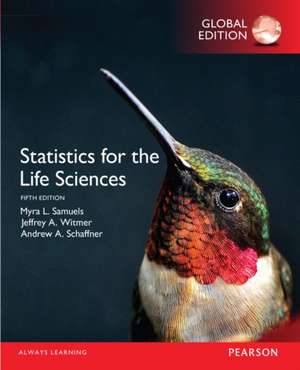
Statistics for the Life Sciences, Global Edition
Autor Myra Samuels, Myra L. Samuels, Jeffrey A. Witmer, Andrew Schaffneren Limba Engleză Paperback – 26 aug 2015
Destinat studenților de la licență și masterat, cercetătorilor și practicienilor din diverse ramuri ale științelor vieții, volumul Schaffner, A: Statistics for the Life Sciences, Global Editi oferă un cadru aplicat pentru interpretarea datelor fără a necesita un bagaj matematic avansat. Remarcăm efortul autorului Andrew Schaffner de a ancora fiecare concept teoretic în realitatea practică, utilizând studii de caz din medicină, zoologie, silvicultură și nutriție. Această abordare transformă statistica dintr-o disciplină abstractă într-un instrument esențial pentru viitoarea carieră a studentului. Subliniem faptul că această a cincea ediție aduce o schimbare metodologică importantă: testele de randomizare sunt prezentate timpuriu pentru a clarifica logica inferenței statistice înainte de a trece la metodele parametrice. Structura cursului, publicat de Pearson Education, urmează o progresie logică. Prima unitate se concentrează pe colectarea și descrierea datelor, acoperind tipurile de dovezi și eșantionarea aleatorie, în timp ce capitolele ulterioare introduc distribuția binomială și normală sub aspectul relevanței lor biologice. Cititorii familiarizați cu The Practice of Statistics in the Life Sciences de Brigitte Baldi vor aprecia în acest volum o focalizare similară pe date reale, însă Schaffner, A: Statistics for the Life Sciences, Global Editi se distinge prin modul în care integrează transformarea variabilelor și evaluarea normalității ca pași critici în analiza eșantioanelor. Spre deosebire de manualele care se bazează pe memorarea formulelor, textul de față prioritizează intuiția statistică și capacitatea de a interpreta rezultatele în context științific.
Preț: 659.03 lei
Preț vechi: 775.32 lei
-15%
Carte disponibilă
Livrare economică 12-26 noiembrie
Livrare express 29 octombrie-04 noiembrie pentru 65.38 lei
Specificații
ISBN-10: 1292101814
Pagini: 656
Dimensiuni: 203 x 254 x 36 mm
Greutate: 1.38 kg
Ediția:5. Auflage
Editura: Pearson
De ce să citești această carte
Recomandăm această ediție globală studenților care au nevoie de o introducere clară și aplicată în biostatistică. Câștigați o înțelegere profundă a modului în care datele dictează concluziile științifice, fără a fi blocați în demonstrații matematice aride. Este resursa ideală pentru cei care doresc să aplice corect testele statistice în proiecte de cercetare din biologie, medicină sau agronomie, având la bază doar noțiuni de algebră elementară.
Descriere scurtă
Bringing Statistics to Life
The Fifth Edition of Statistics for the Life Sciences uses authentic examples and exercises from a wide variety of life science domains to give statistical concepts personal relevance, enabling students to connect concepts with situations they will encounter outside the classroom. The emphasis on understanding ideas rather than memorizing formulas makes the text ideal for students studying a variety of scientific fields: animal science, agronomy, biology, forestry, health, medicine, nutrition, pharmacy, physical education, zoology and more. In the fifth edition, randomization tests have been moved to the fore to motivate the inference procedures introduced in the text. There are no prerequisites for the text except elementary algebra.
Cuprins
1. Introduction
1.1 Statistics and the Life Sciences
1.2 Types of Evidence
1.3 Random Sampling
2. Description of Samples and Populations
2.1 Introduction
2.2 Frequency Distributions
2.3 Descriptive Statistics: Measures of Center
2.4 Boxplots
2.5 Relationships Between Variables
2.6 Measures of Dispersion
2.7 Effect of Transformation of Variables
2.8 Statistical Inference
2.9 Perspective
3. Probability and the Binomial Distribution
3.1 Probability and the Life Sciences
3.2 Introduction to Probability
3.3 Probability Rules (Optional)
3.4 Density Curves
3.5 Random Variables
3.6 The Binomial Distribution
3.7 Fitting a Binomial Distribution to Data (Optional)
4. The Normal Distribution
4.1 Introduction
4.2 The Normal Curves
4.3 Areas under a Normal Curve
4.4 Assessing Normality
4.5 Perspective
5. Sampling Distributions
5.1 Basic Ideas
5.2 The Sample Mean
5.3 Illustration of the Central Limit Theorem
5.4 The Normal Approximation to the Binomial Distribution
5.5 Perspective
Unit I Highlights and Study
UNIT II: INFERENCE FOR MEANS
6. Confidence Intervals
6.1 Statistical Estimation
6.2 Standard Error of the Mean
6.3 Confidence Interval for μ
6.4 Planning a Study to Estimate μ
6.5 Conditions for Validity of Estimation Methods
6.6 Comparing Two Means
6.7 Confidence Interval for (μ1 - μ2)
6.8 Perspective and Summary
7. Comparison of Two Independent Samples
7.1 Hypothesis Testing: The Randomization Test
7.2 Hypothesis Testing: The t Test
7.3 Further Discussion of the t Test
7.4 Association and Causation
7.5 One-Tailed t Tests
7.6 More on Interpretation of Statistical Significance
7.7 Planning for Adequate Power
7.8 Student's t: Conditions and Summary
7.9 More on Principles of Testing Hypotheses
7.10 The Wilcoxon-Mann-Whitney Test
8. Comparison of Paired Samples
8.1 Introduction
8.2 The Paired-Sample t Test and Confidence Interval
8.3 The Paired Design
8.4 The Sign Test
8.5 The Wilcoxon Signed-Rank Test
8.6 Perspective
Unit II Highlights and Study
UNIT III: INFERENCE FOR CATEGORICAL DATA
9. Categorical Data: One-Sample Distributions
9.1 Dichotomous Observations
9.2 Confidence Interval for a Population Proportion
9.3 Other Confidence Levels (Optional)
9.4 Inference for Proportions: The Chi-Square Goodness-of-Fit Test
9.5 Perspective and Summary
10. Categorical Data: Relationships
10.1 Introduction
10.2 The Chi-Square Test for the 2 × 2 Contingency Table
10.3 Independence and Association in the 2 × 2 Contingency Table
10.4 Fisher's Exact Test
10.5 The r × k Contingency Table
10.6 Applicability of Methods
10.7 Confidence Interval for Difference Between Probabilities
10.8 Paired Data and 2 × 2 Tables
10.9 Relative Risk and the Odds Ratio
10.10 Summary of Chi-Square Test
Unit III Highlights and Study
UNIT IV: MODELING RELATIONSHIPS
11. Comparing the Means of Many Independent Samples
11.1 Introduction
11.2 The Basic One-Way Analysis of Variance
11.3 The Analysis of Variance Model
11.4 The Global F Test
11.5 Applicability of Methods
11.