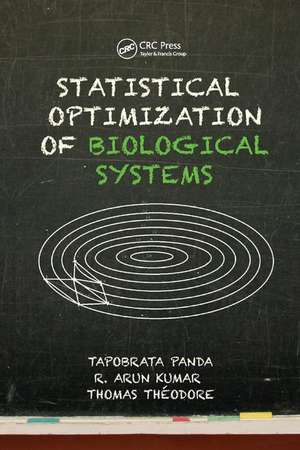
Statistical Optimization of Biological Systems
Autor Tapobrata Panda, Thomas Theodore, R. Arun Kumaren Limba Engleză Paperback – 26 iul 2017
Preț: 524.56 lei
Preț vechi: 693.67 lei
-24%
Puncte Express: 787
Carte indisponibilă temporar
Doresc să fiu notificat când acest titlu va fi disponibil:
Se trimite...
Specificații
ISBN-13: 9781138893139
ISBN-10: 1138893137
Pagini: 296
Dimensiuni: 156 x 234 mm
Greutate: 0.43 kg
Ediția:1
Editura: CRC Press
Colecția CRC Press
ISBN-10: 1138893137
Pagini: 296
Dimensiuni: 156 x 234 mm
Greutate: 0.43 kg
Ediția:1
Editura: CRC Press
Colecția CRC Press
V-ar putea interesa
-
 -25%Preț: 999.31 lei1338.33 lei
 -
 BiodesignPaul G. Yock-8%Preț: 652.70 lei709.46 lei
 -
 The Medical Device R&D HandbookTheodore R. Kucklick-18%Preț: 1484.41 lei1810.27 lei
 -
 Biofluid Mechanics: The Human Circulation, Second EditionKrishnan B. Chandran-5%Preț: 1317.76 lei1387.11 lei
 -
 OMICS: Biomedical Perspectives and ApplicationsDebmalya Barh-18%Preț: 1034.90 lei1262.07 lei
 -
 A Laboratory Course in Tissue EngineeringMelissa Kurtis Micou-15%Preț: 606.52 lei713.54 lei
 -
 Reliable Design of Medical DevicesRichard C. Fries-18%Preț: 2106.47 lei2568.86 lei
 -
 Physical Chemistry for Engineering and Applied SciencesFrank R. Foulkes-18%Preț: 905.88 lei1104.74 lei
 -
 Handbook of ElectroporationDamijan Miklavčič-5%Preț: 12356.00 lei13006.31 lei
 -
 Modeling Cellular SystemsFrederik Graw-15%Preț: 643.07 lei756.55 lei
 -
 -5%Preț: 683.87 lei719.87 lei
 -
 Bone AdaptationYoshitaka Kameo-15%Preț: 647.09 lei761.27 lei
 -
 Shedding the Polarized Light on CancerTatiana NovikovaPreț: 379.78 lei
 -
 Computational Methods in Molecular Imaging TechnologiesVinit Kumar GunjanPreț: 378.80 lei
 -
 Advances in Animal Biotechnology and its ApplicationsSuresh Kumar Gahlawat-5%Preț: 1342.26 lei1412.90 lei
 -
 -20%Preț: 2755.16 lei3456.68 lei
Cuprins
Introduction. Non-Statistical Experimental Design. Response Surface Experimental Designs. Statistical Analysis of Experimental Designs and Optimization of Process Variables. Evolutionary Operation Programmes. Taguchi’s Design. Hybrid Experimental Design Based on a Genetic Algorithm.
Notă biografică
Tapobrata Panda is a Professor at the Indian Institute of Technology Madras, Chennai, India. He received a BSc (honors) in Chemistry from the University of Calcutta, Kolkata, India; a BTech and MTech in Food Technology and Biochemical Engineering from Jadavpur University, Kolkata, India; and a PhD in Biochemical Engineering from the Indian Institute of Technology Delhi, New Delhi. Professor Panda is widely published and a member of several journals’ editorial boards. His papers have an ‘h’-index (Google Scholar) of 30 and ‘i-10’ value of 64. His areas of interest include hybrid experimental design, bio-MEMS, biological synthesis of nanoparticles, and design of therapeutic molecules and enzymes.
R. Arun Kumar is currently working with an oil and gas super major in liquefied natural gas business as a Process Engineer. Previously, he worked for an international oil and gas service company. He received a BTech in Chemical Engineering from the Indian Institute of Technology Madras, Chennai, India; and was in the top 1% of the National Astronomy and Physics Olympiad. His areas of interest include biochemical engineering, genetic algorithms applied to biological systems, and design of experiments.
Thomas Théodore is an Associate Professor of Chemical Engineering at the Siddaganga Institute of Technology, Tumkur, India. He received Chemical Engineering degrees from Annamalai University, Chidambaram, India, and Alagappa College of Technology, Chennai, India; an MS in Bioengineering from the École Supérieure de Physique et de Chimie Industrielles de la Ville de Paris, France; an MEngSc in Biopharmaceutical Engineering from University College Dublin, Ireland; and a PhD in Biochemical Engineering from the Indian Institute of Technology Madras, Chennai, India. His areas of interest include therapeutic proteins and biodegradable polymers.
R. Arun Kumar is currently working with an oil and gas super major in liquefied natural gas business as a Process Engineer. Previously, he worked for an international oil and gas service company. He received a BTech in Chemical Engineering from the Indian Institute of Technology Madras, Chennai, India; and was in the top 1% of the National Astronomy and Physics Olympiad. His areas of interest include biochemical engineering, genetic algorithms applied to biological systems, and design of experiments.
Thomas Théodore is an Associate Professor of Chemical Engineering at the Siddaganga Institute of Technology, Tumkur, India. He received Chemical Engineering degrees from Annamalai University, Chidambaram, India, and Alagappa College of Technology, Chennai, India; an MS in Bioengineering from the École Supérieure de Physique et de Chimie Industrielles de la Ville de Paris, France; an MEngSc in Biopharmaceutical Engineering from University College Dublin, Ireland; and a PhD in Biochemical Engineering from the Indian Institute of Technology Madras, Chennai, India. His areas of interest include therapeutic proteins and biodegradable polymers.
Descriere
This book explains how to apply non-statistical and statistical techniques to the optimization of biological systems. Employing real-life bioprocess optimization problems and their solutions as examples, the text describes experimental design from identifying process variables to selecting a screening design, applying response surface methodology, and conducting regression modeling. It demonstrates the statistical analysis and optimization of different experimental designs, details the optimization techniques employed to determine optimum levels of the process variables for both single- and multiple-response systems, and discusses important experimental designs.