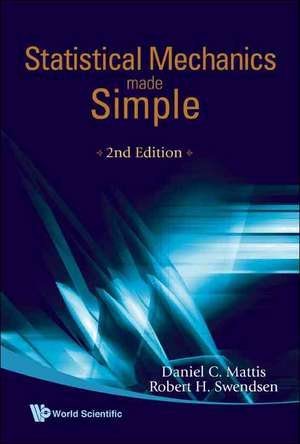
Statistical Mechanics Made Simple
Autor Daniel C. Mattis, Robert Swendsenen Limba Engleză Paperback – 4 mar 2008
În cadrul programelor de studiu pentru licență avansată și masterat în fizică teoretică, mecanica statistică reprezintă puntea fundamentală între legile microscopice și comportamentul macroscopic al materiei. Statistical Mechanics Made Simple, aflat la a doua ediție, se poziționează ca un instrument pedagogic esențial care extinde principiile fizicii newtoniene și cuantice către realitatea complexă a fluctuațiilor termice. Găsim în acest volum o tranziție fluidă de la conceptele de bază ale termodinamicii către aplicații moderne, beneficiind de expertiza noului co-autor, Robert Swendsen, care introduce secțiuni riguroase despre grupul de renormalizare și metodele Monte-Carlo.
Descoperim o structură revizuită ce pune accent pe coerența imaginii de ansamblu a fizicii termice. Față de prima ediție, autorii au integrat elemente de teoria multor corpuri și o analiză detaliată a tranzițiilor de fază, elemente care lipsesc adesea din manualele introductive. Comparabil cu Statistical Mechanics de James H. Luscombe în rigurozitate, volumul de față se distinge prin abordarea mai aplicată, fiind actualizat pentru a include metodologii numerice contemporane și un set extins de probleme rezolvate pas cu pas în noul Appendix.
Această lucrare continuă direcția de cercetare și claritate conceptuală stabilită de Daniel C. Mattis în lucrările sale de referință, The Theory of Magnetism I și II. Dacă în acele volume autorul se concentra pe magnetism ca fenomen specific, aici extinde logica statistică la o scară universală, de la propagarea sunetului până la natura cvasiparticulelor în lichide cuantice. Este o resursă versatilă care permite instructorilor să își adapteze cursurile pe o plajă largă de teme, de la matrici de transfer la exponenți critici.
Preț: 351.45 lei
Carte tipărită la comandă
Livrare economică 29 septembrie-13 octombrie
Specificații
ISBN-10: 9812779094
Pagini: 335
Ilustrații: illustrations
Dimensiuni: 164 x 247 x 19 mm
Greutate: 0.62 kg
Ediția:2 Rev ed.
Editura: WORLD SCIENTIFIC
V-ar putea interesa
-
 -22%Preț: 357.56 lei458.89 lei
 -
 Advanced Solid State PhysicsPhilip Phillips-19%Preț: 683.34 lei843.62 lei
 -
 Fundamentals of Condensed Matter PhysicsMarvin L. Cohen-8%Preț: 551.98 lei599.98 lei
 -
 Quantum Field Theory and Condensed MatterRamamurti Shankar-11%Preț: 559.02 lei628.12 lei
 -
 Nonequilibrium Many-Body Theory of Quantum Systems: A Modern IntroductionGianluca Stefanucci-14%Preț: 701.83 lei816.08 lei
 -
 Statistical Physics of ParticlesMehran Kardar-8%Preț: 465.28 lei505.74 lei
 -
 Quantum Field Theory Approach to Condensed Matter PhysicsEduardo C. Marino-11%Preț: 642.67 lei722.10 lei
 -
 Universal Themes of Bose-Einstein CondensationNick P. Proukakis-11%Preț: 725.97 lei815.71 lei
 -
 Solid State PhysicsDavid W. Snoke-19%Preț: 609.33 lei752.26 lei
 -
 The Physics of GrapheneMikhail I. Katsnelson-11%Preț: 608.27 lei683.45 lei
 -
 Advanced Quantum Condensed Matter PhysicsMichael El-Batanouny-11%Preț: 663.92 lei745.99 lei
 -
 Phase Transitions in MaterialsBrent Fultz-11%Preț: 627.36 lei704.89 lei
 -
 Many-Body Theory of Condensed Matter SystemsMichael G. Cottam-11%Preț: 438.69 lei492.92 lei
 -
 TRANSPORT MULTILAY NANO (2ND ED)Freericks James K-18%Preț: 884.35 lei1078.48 lei
 -
 -15%Preț: 516.34 lei607.46 lei
 -
 Collective Effects in Condensed Matter PhysicsVladimir V. Kiselev-23%Preț: 953.81 lei1238.72 lei
 -
 Quantum Theory of Many-Body SystemsAlexandre Zagoskin-19%Preț: 405.89 lei501.10 lei
 -
 Statistical PhysicsRoberto PiazzaPreț: 386.79 lei
 -
 Skyrmions in Condensed MatterJung Hoon Han-18%Preț: 1107.29 lei1350.36 lei
 -
 Preț: 396.47 lei
 -
 DIAGRAMMATICS (2ND ED)Michael V Sadovskii-15%Preț: 697.09 lei820.10 lei
 -
 Statistical MechanicsPeter S Riseborough-15%Preț: 535.82 lei630.37 lei
 -
 -15%Preț: 515.88 lei606.93 lei
 -
 Introduction To Statistical Mechanics: Solutions To ProblemsJohn Dirk WaleckaPreț: 205.78 lei
 -
 MODERN COURSE IN QUANTUM THEORY OF SOLIDHan Fuxiang-18%Preț: 1470.86 lei1793.74 lei
De ce să citești această carte
Recomandăm această ediție studenților la fizică și chimie care doresc să stăpânească mecanica statistică dincolo de idealizările teoretice. Cititorul câștigă o înțelegere profundă a tranzițiilor de fază și a tehnicilor numerice moderne (Monte-Carlo). Prezența soluțiilor detaliate transformă o disciplină adesea intimidantă într-una accesibilă, oferind instrumentele matematice necesare pentru cercetarea contemporană în fizica stării solide și teoria câmpurilor.
Descriere
This second edition extends and improves on the first, already an acclaimed and original treatment of statistical concepts insofar as they impact theoretical physics and form the basis of modern thermodynamics. This book illustrates through myriad examples the principles and logic used in extending the simple laws of idealized Newtonian physics and quantum physics into the real world of noise and thermal fluctuations. In response to the many helpful comments by users of the first edition, important features have been added in this second, new and revised edition. These additions allow a more coherent picture of thermal physics to emerge. Benefiting from the expertise of the new co-author, the present edition includes a detailed exposition - occupying two separate chapters - of the renormalization group and Monte-Carlo numerical techniques, and of their applications to the study of phase transitions. Additional figures have been included throughout, as have new problems. A new Appendix presents fully worked-out solutions to representative problems; these illustrate various methodologies that are peculiar to physics at finite temperatures, that is, to statistical physics. This new edition incorporates important aspects of many-body theory and of phase transitions. It should better serve the contemporary student, while offering to the instructor a wider selection of topics from which to craft lectures on topics ranging from thermodynamics and random matrices to thermodynamic Green functions and critical exponents, from the propagation of sound in solids and fluids to the nature of quasiparticles in quantum liquids and in transfer matrices.