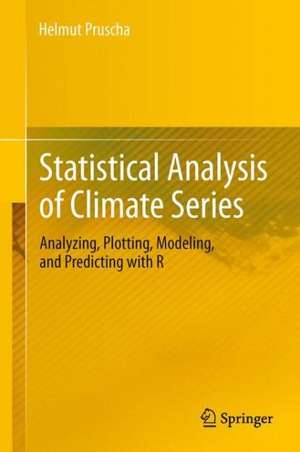
Statistical Analysis of Climate Series
Autor Helmut Pruschaen Limba Engleză Paperback – 9 noi 2014
The methodical tools are taken from time series analysis, from periodogram and wavelet analysis, from correlation and principal component analysis, and from categorical data and event-time analysis.
The applied models are - among others - the ARIMA and GARCH model, and inhomogeneous Poisson processes.
Further, we deal with a number of special statistical topics, e.g. the problem of trend-, season- and autocorrelation-adjustment, and with simultaneous statistical inference.
Programs in R and data sets on climate series, provided at the author’s homepage, enable readers (statisticians, meteorologists, other natural scientists) to perform their own exercises and discover their own applications.
Preț: 453.73 lei
Preț vechi: 493.20 lei
-8%
Puncte Express: 681
Carte indisponibilă temporar
Livrare prin curier în România Termenul estimat este afișat lângă disponibilitate.
Transport gratuit pentru acest produs Plată online sau ramburs, în funcție de opțiunile comenzii.
Retur gratuit în 14 zile Comandă securizată și suport în română.
Specificații
ISBN-13: 9783642430879
ISBN-10: 3642430872
Pagini: 184
Ilustrații: VIII, 176 p.
Dimensiuni: 155 x 235 x 11 mm
Greutate: 0.29 kg
Ediția:2013
Editura: Springer
Locul publicării:Berlin, Heidelberg, Germany
ISBN-10: 3642430872
Pagini: 184
Ilustrații: VIII, 176 p.
Dimensiuni: 155 x 235 x 11 mm
Greutate: 0.29 kg
Ediția:2013
Editura: Springer
Locul publicării:Berlin, Heidelberg, Germany
V-ar putea interesa
-
 R and Data Mining: Examples and Case StudiesYanchang Zhao-25%Preț: 377.79 lei505.25 lei
 -
 Preț: 117.58 lei
 -
 Spatial Statistics and ModelingCarlo Gaetan-18%Preț: 1119.01 lei1364.66 lei
 -
 Probability and Stochastic ProcessesIonut Florescu-27%Preț: 853.28 lei1168.87 lei
 -
 Basic and Advanced Bayesian Structural Equation ModelingXin-Yuan Song-8%Preț: 637.61 lei693.05 lei
 -
 Willful IgnoranceHerbert I WeisbergPreț: 225.84 lei
 -
 Business SurveysSnijkers-8%Preț: 594.59 lei646.30 lei
 -
 Confidence Intervals for Proportions and Related Measures of Effect SizeRobert Gordon Newcombe-18%Preț: 950.86 lei1159.58 lei
 -
 Modern Applied Statistics with SW. N. Venables-18%Preț: 1123.42 lei1370.02 lei
 -
 Biostatistics with RBabak Shahbaba-5%Preț: 597.09 lei628.52 lei
 -
 The Signal and the NoiseNate SilverPreț: 219.25 lei
 -
 -18%Preț: 788.11 lei961.10 lei
 -
 Laws of Small Numbers: Extremes and Rare EventsMichael Falk-18%Preț: 799.54 lei975.06 lei
 -
 -18%Preț: 820.55 lei1000.67 lei
Public țintă
ResearchCuprins
Climate series.- Trend and Season.- Correlation: From Yearly to Daily Data.- Model and Prediction: Yearly Data.- Model and Prediction: Monthly Data.- Analysis of Daily Data.- Spectral Analysis.- Complements.- Appendices: A: Excerpt from Climate Data Sets.- B: Some Aspects of Time Series.- C:Categorical Data Analysis- References.- Index.
Notă biografică
Helmut Pruscha, Professor for Mathematics, has served as Academic Director at the University of Munich’s Institute of Mathematics. Before doing so, he had worked for many years as a statistician at a Max-Planck-Institute for neurobiology. His research interests include topics concerning applied statistics and mathematical statistics, especially categorical time series and point processes. He has published several textbooks in German.
Textul de pe ultima copertă
The book presents the application of statistical methods to climatological data on temperature and precipitation. It provides specific techniques for treating series of yearly, monthly and daily records. The results’ potential relevance in the climate context is discussed.
The methodical tools are taken from time series analysis, from periodogram and wavelet analysis, from correlation and principal component analysis, and from categorical data and event-time analysis.
The applied models are - among others - the ARIMA and GARCH model, and inhomogeneous Poisson processes.
Further, we deal with a number of special statistical topics, e.g. the problem of trend-, season- and autocorrelation-adjustment, and with simultaneous statistical inference.
Programs in R and data sets on climate series, provided at the author’s homepage, enable readers (statisticians, meteorologists, other natural scientists) to perform their own exercises and discover their own applications.
The methodical tools are taken from time series analysis, from periodogram and wavelet analysis, from correlation and principal component analysis, and from categorical data and event-time analysis.
The applied models are - among others - the ARIMA and GARCH model, and inhomogeneous Poisson processes.
Further, we deal with a number of special statistical topics, e.g. the problem of trend-, season- and autocorrelation-adjustment, and with simultaneous statistical inference.
Programs in R and data sets on climate series, provided at the author’s homepage, enable readers (statisticians, meteorologists, other natural scientists) to perform their own exercises and discover their own applications.
Caracteristici
Within the context of the general climate discussion, the evaluation of climate series gains growing importance ? Provides application of statistical methods to climatological data Techniques for treating series records Applying among others ARIMA and GARCH model Programs in R and data sets on climate series are provided at the author's homepage Includes supplementary material: sn.pub/extras