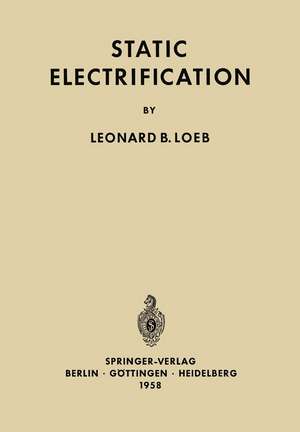
Static Electrification
Autor L. B. Loeben Limba Engleză Paperback – 29 apr 2012
Preț: 376.11 lei
Puncte Express: 564
Carte tipărită la comandă
Livrare economică 24 noiembrie-08 decembrie
Livrare prin curier în România Termenul estimat este afișat lângă disponibilitate.
Transport gratuit de la 400.00 lei Plată online sau ramburs, în funcție de opțiunile comenzii.
Retur gratuit în 14 zile Comandă securizată și suport în română.
Specificații
ISBN-13: 9783642882456
ISBN-10: 3642882455
Pagini: 256
Ilustrații: XII, 240 p. 20 illus.
Dimensiuni: 170 x 244 x 15 mm
Greutate: 0.45 kg
Ediția:Softcover reprint of the original 1st ed. 1958
Editura: Springer
Locul publicării:Berlin, Heidelberg, Germany
ISBN-10: 3642882455
Pagini: 256
Ilustrații: XII, 240 p. 20 illus.
Dimensiuni: 170 x 244 x 15 mm
Greutate: 0.45 kg
Ediția:Softcover reprint of the original 1st ed. 1958
Editura: Springer
Locul publicării:Berlin, Heidelberg, Germany
V-ar putea interesa
-
 Non-Linear Pulses in Integrated and Waveguide OpticsA. B. Shvartsburg-32%Preț: 558.27 lei826.31 lei
 -
 Quantum Optics: An IntroductionMark Fox-10%Preț: 346.40 lei383.01 lei
 -
 Phase Space Methods for Degenerate Quantum GasesBryan J. Dalton-31%Preț: 874.13 lei1270.55 lei
 -
 Light: A Very Short IntroductionIan A. Walmsley-20%Preț: 55.78 lei70.14 lei
 -
 -14%Preț: 1177.45 lei1369.13 lei
 -
 Quantum OpticsGirish S. Agarwal-8%Preț: 585.61 lei636.54 lei
 -
 Spectrograph Design FundamentalsJohn JamesPreț: 335.42 lei
 -
 Photonics 1Andrews-23%Preț: 884.06 lei1148.13 lei
 -
 The Physics of InvisibilityMartin BeechPreț: 186.25 lei
 -
 -27%Preț: 1519.30 lei2073.27 lei
Public țintă
ResearchCuprins
I. Static electrification by electrolytic process.- A. Basic principles in terms of galvanic action from metal surfaces.- B. Nature of systems leading to charge separation and their limitations.- C. Do adequate aqueous surface films exist for electrolytic charging ?.- D. Past evidence of electrolytic charging.- E. Electrical endosmosis, streaming potentials, and cataphoresis (Verified aspects of electrolytic charging).- F. The more accurate calculation of the double layer characteristics including ions of both signs.- G. The Workman-Reynolds freezing potential.- H. Summary and conclusions.- II. The contact potential difference or volta potential.- A. Introduction.- B. The metallic state energy bands, the Fermi law and basic principles.- C. Surface structure and the work function in relation to the Fermi level.- D. Influences modifying the work function.- E. The contact potential difference.- F. The measurement of contact potential and/or work function.- G. Discussion and conclusion.- III. Static charging by spray electrification.- A. Introduction.- B. The Existence of an electrical double layer at gas-liquid interfaces.- C. Relative potentials in double layers of water in relation to surface tension, for salt, acid and organic solutes.- D. The spray electrification phenomena.- E. Spray electrification of water in relation to thunderstorm electrification.- F. Homogeneous or symmetrical charging of liquid droplets on dispersion.- G. Asymmetric charge distribution of droplets of micron size from bursting of small air bubbles in concentrated solutions.- H. Conclusions.- IV. Mechanisms of electrification on solid-solid contact.- A. Introduction.- B. Quantitative measuring techniques and the influence of electrical fields.- C. Initial investigation of controlled contact electrification of metal-inorganic insulator systems.- D. Electrification of dusts on dispersion and impact on surfaces.- E. The contact charging by rolling of inorganic insulator spheres on metal surfaces.- F. Extension of Peterson’s investigations by Wagner.- G. Contact charging of ice on ice.- H. Other possible charge transfer mechanisms.- V. The generation of static charges by processes involving ionization of gases and miscellaneous other matters.- A. Introduction.- B. Various gaseous electronic mechanisms.- C. Static elimination.- D. Thunderstorm electrification.- E. Protection against lightning stroke.- Author Index.