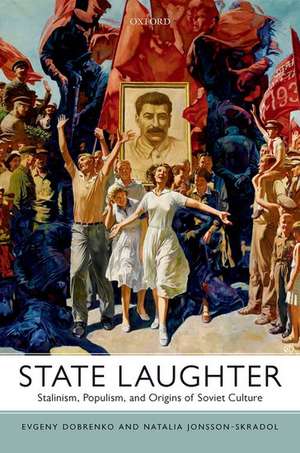
State Laughter: Stalinism, Populism, and Origins of Soviet Culture
Autor Evgeny Dobrenko, Natalia Jonsson-Skradolen Limba Engleză Hardback – 3 feb 2022
Preț: 730.96 lei
Preț vechi: 1080.56 lei
-32%
Puncte Express: 1096
Carte disponibilă
Livrare economică 06-11 noiembrie
Livrare prin curier în România Termenul estimat este afișat lângă disponibilitate.
Transport gratuit pentru acest produs Plată online sau ramburs, în funcție de opțiunile comenzii.
Retur gratuit în 14 zile Comandă securizată și suport în română.
Specificații
ISBN-13: 9780198840411
ISBN-10: 0198840411
Pagini: 436
Ilustrații: 16 black and white figures/illustrations
Dimensiuni: 165 x 240 x 33 mm
Greutate: 0.81 kg
Editura: OUP OXFORD
Colecția OUP Oxford
Locul publicării:Oxford, United Kingdom
ISBN-10: 0198840411
Pagini: 436
Ilustrații: 16 black and white figures/illustrations
Dimensiuni: 165 x 240 x 33 mm
Greutate: 0.81 kg
Editura: OUP OXFORD
Colecția OUP Oxford
Locul publicării:Oxford, United Kingdom
Recenzii
Broadly interdisciplinary and replete with nuanced insights into Stalin-era comedic practices, discourses, and genres, Dobrenko and Jonsson-Skradol's gripping volume offers new perspectives on humor under totalitarianism. This empirically-rich, theoretically-informed, and carefully documented study is bound to appeal to a wide range of scholars and students of Soviet history, literature, and culture.
This book opens up new ways of examining Soviet culture by moving away from reductive narratives in which Soviet jokes always belonged to dissidents' efforts to resist Stalinist totalitarianism. The emphasis on state-sanctioned laughter in Stalinist culture contributes not only to cultural studies of laughter in general but also benefits the understanding of Soviet culture and Soviet subjectivity in general. Most importantly, the methodology developed in this book could further inspire scholars studying cultures and politics of other communist states to explore the formation and transformation of the comic in official narratives.
This new volume is the first to offer a comprehensive exploration of how Stalin's regime understood, attempted to control, and ultimately wielded humour as a (usually blunt-force) tool to engineer utopia. The authors (Dobrenko,Skradol) place their study in direct opposition to the two principal claims that long permeated both émigré accounts and the historiography.
State Laughter should be considered a must-read for anyone interested in Soviet mass culture under Stalin.
This rich volume is certain to be of interest to students and scholars of Stalinist culture and its chronological successors, as well as more broadly to those with an interest in satire and other varieties of the comic in authoritarian states.
This book opens up new ways of examining Soviet culture by moving away from reductive narratives in which Soviet jokes always belonged to dissidents' efforts to resist Stalinist totalitarianism. The emphasis on state-sanctioned laughter in Stalinist culture contributes not only to cultural studies of laughter in general but also benefits the understanding of Soviet culture and Soviet subjectivity in general. Most importantly, the methodology developed in this book could further inspire scholars studying cultures and politics of other communist states to explore the formation and transformation of the comic in official narratives.
This new volume is the first to offer a comprehensive exploration of how Stalin's regime understood, attempted to control, and ultimately wielded humour as a (usually blunt-force) tool to engineer utopia. The authors (Dobrenko,Skradol) place their study in direct opposition to the two principal claims that long permeated both émigré accounts and the historiography.
State Laughter should be considered a must-read for anyone interested in Soviet mass culture under Stalin.
This rich volume is certain to be of interest to students and scholars of Stalinist culture and its chronological successors, as well as more broadly to those with an interest in satire and other varieties of the comic in authoritarian states.
Notă biografică
Evgeny Dobrenko is Professor of Russian Studies at Ca' Foscari University. He has previously held posts across the, then, Soviet Union, the USA, and the UK, including, among others, the Moscow and Odessa State Universities, Stanford, Amherst, and the University of California. Over his career he has authored, edited and co-edited some 20 books and more than 250 articles and essays on Soviet and post-Soviet literature and culture, Stalinism, Socialist Realism, Soviet national literatures, Russian and Soviet film, critical theory, and Soviet cultural history.Natalia Jonsson-Skradol has published over 20 articles on functions and uses of language in oppressive regimes. Her work has appeared in Slavic Review, Utopian Studies, Slavonic and East European Review, German Quarterly and in other academic publications. She has lived and worked in Israel, Germany, Austria, and the UK.