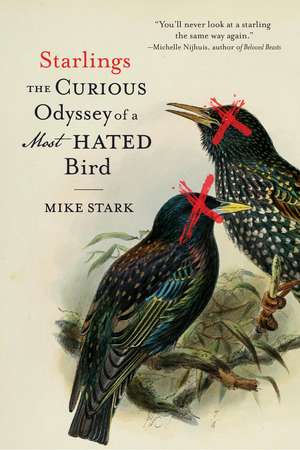
Starlings: The Curious Odyssey of a Most Hated Bird
Autor Mike Starken Limba Engleză Paperback – mar 2025
Fourth Place for the Arizona Authors Association Literary Award
Has there ever been a more hated bird than the European starling? Let loose in New York City’s Central Park by a misguided aristocrat, the starlings were supposed to help curb insect outbreaks and add to the tuneful choir of other songbirds. Rather than staying put, the dark and speckled starlings marched across the continent like a conquering army. In less than sixty years, they were in every state in the contiguous United States and their numbers topped two hundred million. Cities came under siege; crops buckled beneath their weight. Public sentiment quickly soured.
A bitter, baffling, and sometimes comical war on starlings ensued. Weapons included dynamite, guns, bounties, fake owls, real owls, rubber snakes, balloons, itching powder, and greased building ledges. Still, artists and scientists marveled at their undulating aerial formations, which seemed equal parts poetry and mathematics. Keen listeners recognized the starling as one of the world’s great vocal mimics, imitating everything from fellow birds and cell phones to barking dogs, car alarms, and TV commercials. And then there were their undeniable skills of adaptation and survival. What if there was more to these stubborn villains than once thought?
Mike Stark’s Starlings is a first-of-its-kind history of starlings in America, an oddball, love-hate story at the intersection of human folly, ornithology, and one bird’s tenacious will to endure.
Preț: 141.56 lei
Puncte Express: 212
Carte disponibilă
Livrare economică 06-20 noiembrie
Livrare express 23-29 octombrie pentru 44.79 lei
Livrare prin curier în România Termenul estimat este afișat lângă disponibilitate.
Transport gratuit de la 400.00 lei Plată online sau ramburs, în funcție de opțiunile comenzii.
Retur gratuit în 14 zile Comandă securizată și suport în română.
Specificații
ISBN-13: 9781496242020
ISBN-10: 1496242025
Pagini: 272
Ilustrații: 11 photographs, 7 illustrations
Dimensiuni: 152 x 229 x 20 mm
Greutate: 0.4 kg
Editura: BISON BOOKS
Colecția Bison Books
Locul publicării:United States
ISBN-10: 1496242025
Pagini: 272
Ilustrații: 11 photographs, 7 illustrations
Dimensiuni: 152 x 229 x 20 mm
Greutate: 0.4 kg
Editura: BISON BOOKS
Colecția Bison Books
Locul publicării:United States
V-ar putea interesa
-
 Preț: 85.95 lei
 -
 -12%Preț: 138.12 lei156.42 lei
 -
 Preț: 85.23 lei
 -
 We Are StarlingsRobert Furrow-17%Preț: 96.89 lei117.02 lei
 -
 City BirdAngela Harrison VinetPreț: 72.51 lei
 -
 The Social Lives of Birds: a must-read for bird and nature loversJoan E. StrassmannPreț: 120.62 lei
 -
 Birds Aren't RealPeter McIndoePreț: 153.34 lei
 -
 Preț: 63.36 lei
 -
 Mozart's StarlingLyanda Lynn Haupt-27%Preț: 68.39 lei93.16 lei
 -
 The StarlingStephen MossPreț: 109.56 lei
 -
 The Starling's SongOctavie WoltersPreț: 80.73 lei
 -
 Nature Needs YouHannah Bourne-TaylorPreț: 123.00 lei
 -
 Living with BirdsLen HowardPreț: 120.28 lei
 -
 Q-BirdsFrederick A. JohnsenPreț: 276.01 lei
 -
 Whistling in the DarkRichard Mabey-20%Preț: 74.01 lei92.47 lei
 -
 Carter, P: ParrotPaul Carter-5%Preț: 92.42 lei96.83 lei
 -
 SparrowKim Todd-10%Preț: 97.56 lei107.83 lei
 -
 Søren Solkær: Black SunSoren SolkaerPreț: 447.53 lei
 -
 Birds SwarmHeather Rook BylengaPreț: 65.63 lei
Notă biografică
Mike Stark is a longtime journalist and author. His previous nonfiction books include the award-winning Chasing the Ghost Bear: On the Trail of America’s Lost Super Beast (Bison Books, 2022) and Wrecked in Yellowstone: Greed, Obsession, and the Untold Story of Yellowstone’s Most Infamous Shipwreck. His first novel, The Derelict Light (Bison Books), was published in 2023. He is the creative director for the Center for Biological Diversity and lives in Tucson, Arizona.
Extras
1
The Bird Man Cometh
Hope rode into Mount Vernon, New York, in the humid
summer of 1959 with the arrival of the Bird Man. After a long train
trip from Kansas, he checked into the $7-a-night Hartley Hotel
downtown and unpacked the tools of his trade, among them some
aluminum paddles, a noisy chime worn around his neck, and a
gray double-padlocked metal box about two feet long. No one but
the Bird Man was allowed to look inside the box, lest anyone spy
the secret to completing the job he’d been hired to do: drive away
the ten thousand or so European starlings infesting the city’s trees,
parks, and neighborhoods.
The birds, with their din and copious droppings fouling side-
walks and houses, had troubled the city for five decades, especially
in the summer, and the city fathers had had enough. Five years
earlier, desperate crews had mounted a loudspeaker in town that
blasted the recorded shrieks of an injured starling. The noise drove
the starlings away but not for long. In August 1959 the city signed a
contract to pay the Bird Man $4,000 to send the starlings on their
way for good. He claimed he’d done it in Louisville, Indianapolis,
Wichita, and back home in Great Bend, Kansas. Where others had
found only failure and disappointment shooing starlings around
the country, it seemed the Bird Man had somehow found a way.
“I do it with a secret method that I ain’t going to talk about,” he
told curious reporters in his high-pitched twang after arriving in
Mount Vernon.
People ask me to chase birds and I chase ’em, but I didn’t come
2,000 miles to tell you how it’s done. You don’t think a man who’s
as old as I am and has a secret worth half a million is going to
blab it all away, do you? No, sir, not The Bird Man. I don’t hurt
them, but when I chase starlings, they stay chased. I can drive
’em out of one tree and into another if I want to. I can drive ’em
out of Cleveland and into Cincinnati if I want to. I can do anything
with ’em because I know all about ’em, that’s my secret.
The enigmatic hero, described by one reporter as a “vigorous,
wizened little man,” was Otto D. Standke. He was seventy-one,
bespectacled, and fond of having a cigar in his mouth. Before he
got into bird chasing, he’d sold phonographs for Columbia and
worked as a salesman and furniture buyer for Montgomery Ward.
In Mount Vernon, he wore a pin on his lapel claiming that he’d
made more than $1 million in sales during his career. On his tie
was an engraved silver clip that read “The Bird Man.”
Standke had stumbled onto his latest enterprise a decade earlier.
Every summer thousands of starlings roosted in the elms of
a city park in Great Bend. The birds had taken over—even
band
concerts were canceled. City officials had tried to scare them away
by planting aluminum owls in the park. “The starlings liked ’em so
much they took to roosting on their heads,” Standke said. Frustrated
that the city had spent $1,500 on the failing fake owls, Standke had
taken matters into his own hands. One night he sneaked down
to the park’s bandstand with a flashlight and caught twenty-four
starlings by hand, according to the story he told. He spirited them
back to his pheasant and turkey farm and released them into a
barn. He spent the next two months studying their every move,
eschewing “tomfool books” and learning firsthand how starlings
worked, he said. The next summer, he went to the park and cleared
out the birds using his own still-confidential method for chasing
them away. “They haven’t been back since,” he bragged in Mount
Vernon.
The Bird Man couldn’t get to work soon enough, as far as the
Mount Vernon locals were concerned. The starlings had been a terrible
fixture for far too long. Thirty years earlier, just after dawn on
an October morning in 1929, thousands of starlings and blackbirds
had descended on the city, hungry and obnoxious. Most ate their
fill and moved on; hundreds more died on the spot, exhausted.
“Patrolman Charles Schulz said that while walking along one
of the business streets, the skies seemed to rain birds upon him
and he took shelter in a doorway,” one news account said. Decades
later a local recalled when the starlings moved into a quiet, sweet-
smelling neighborhood: “Gone suddenly were the peaceful evenings
in that New York City suburb, where previously only sweet birdsong
and the sound of children at play broke the silence; instead the air
was filled with shrill screeches that resembled nothing so much
as fingernail scratchings on a blackboard. On any fine evening
during the starling invasion, sensible pedestrians carried open
umbrellas and stepped cautiously.”
The situation was no better a few miles away in the heart of New
York City. Starlings once famously roosted by the thousands at the
Metropolitan Museum of Art. But by the spring of 1959 the biggest
flocks—enormous, twisting sheets of birds in the sky numbering
fifty thousand to a hundred thousand—had taken up residence
on the steel girders supporting the Riverside Drive Viaduct. They
arrived in the evening in dark clouds of wings and feathers, pro-
duced an all-night racket in the neighborhood, and slipped away
at dawn. They had a reputation as being noisy, filthy, and utterly
unlovable, occasionally causing a stir when they collided with the
girders and suddenly, surreally, fell dead from the sky.
Whether the people of Mount Vernon and New York City knew
it or not, they were living a shared experience with people across
the continent, urban and rural alike. After European starlings were
introduced just a few miles away in Central Park in the late 1800s,
they had marched across America like a conquering army. They
were ravenous, loud, tenacious, and quick to breed. Hundreds
became thousands became millions and, in time, hundreds of
millions. In the air, great flocks swirled in mesmerizing clouds
like giant ribbons of black smoke writhing above the horizon in a
rhythm only they seemed to understand. On the ground, the effect
was much more sobering. Starlings could descend on a crop and
eat a year’s worth of effort in a day or two. City trees swayed under
the smothering weight of roosting starlings, and buildings and
sidewalks were coated with excrement. Sometimes they stayed
for weeks or months or even longer. They seemed as fickle as they
were fearless. A nuisance at best, they bordered on apocalyptic
when viewed through the darkest lens.
The Bird Man Cometh
Hope rode into Mount Vernon, New York, in the humid
summer of 1959 with the arrival of the Bird Man. After a long train
trip from Kansas, he checked into the $7-a-night Hartley Hotel
downtown and unpacked the tools of his trade, among them some
aluminum paddles, a noisy chime worn around his neck, and a
gray double-padlocked metal box about two feet long. No one but
the Bird Man was allowed to look inside the box, lest anyone spy
the secret to completing the job he’d been hired to do: drive away
the ten thousand or so European starlings infesting the city’s trees,
parks, and neighborhoods.
The birds, with their din and copious droppings fouling side-
walks and houses, had troubled the city for five decades, especially
in the summer, and the city fathers had had enough. Five years
earlier, desperate crews had mounted a loudspeaker in town that
blasted the recorded shrieks of an injured starling. The noise drove
the starlings away but not for long. In August 1959 the city signed a
contract to pay the Bird Man $4,000 to send the starlings on their
way for good. He claimed he’d done it in Louisville, Indianapolis,
Wichita, and back home in Great Bend, Kansas. Where others had
found only failure and disappointment shooing starlings around
the country, it seemed the Bird Man had somehow found a way.
“I do it with a secret method that I ain’t going to talk about,” he
told curious reporters in his high-pitched twang after arriving in
Mount Vernon.
People ask me to chase birds and I chase ’em, but I didn’t come
2,000 miles to tell you how it’s done. You don’t think a man who’s
as old as I am and has a secret worth half a million is going to
blab it all away, do you? No, sir, not The Bird Man. I don’t hurt
them, but when I chase starlings, they stay chased. I can drive
’em out of one tree and into another if I want to. I can drive ’em
out of Cleveland and into Cincinnati if I want to. I can do anything
with ’em because I know all about ’em, that’s my secret.
The enigmatic hero, described by one reporter as a “vigorous,
wizened little man,” was Otto D. Standke. He was seventy-one,
bespectacled, and fond of having a cigar in his mouth. Before he
got into bird chasing, he’d sold phonographs for Columbia and
worked as a salesman and furniture buyer for Montgomery Ward.
In Mount Vernon, he wore a pin on his lapel claiming that he’d
made more than $1 million in sales during his career. On his tie
was an engraved silver clip that read “The Bird Man.”
Standke had stumbled onto his latest enterprise a decade earlier.
Every summer thousands of starlings roosted in the elms of
a city park in Great Bend. The birds had taken over—even
band
concerts were canceled. City officials had tried to scare them away
by planting aluminum owls in the park. “The starlings liked ’em so
much they took to roosting on their heads,” Standke said. Frustrated
that the city had spent $1,500 on the failing fake owls, Standke had
taken matters into his own hands. One night he sneaked down
to the park’s bandstand with a flashlight and caught twenty-four
starlings by hand, according to the story he told. He spirited them
back to his pheasant and turkey farm and released them into a
barn. He spent the next two months studying their every move,
eschewing “tomfool books” and learning firsthand how starlings
worked, he said. The next summer, he went to the park and cleared
out the birds using his own still-confidential method for chasing
them away. “They haven’t been back since,” he bragged in Mount
Vernon.
The Bird Man couldn’t get to work soon enough, as far as the
Mount Vernon locals were concerned. The starlings had been a terrible
fixture for far too long. Thirty years earlier, just after dawn on
an October morning in 1929, thousands of starlings and blackbirds
had descended on the city, hungry and obnoxious. Most ate their
fill and moved on; hundreds more died on the spot, exhausted.
“Patrolman Charles Schulz said that while walking along one
of the business streets, the skies seemed to rain birds upon him
and he took shelter in a doorway,” one news account said. Decades
later a local recalled when the starlings moved into a quiet, sweet-
smelling neighborhood: “Gone suddenly were the peaceful evenings
in that New York City suburb, where previously only sweet birdsong
and the sound of children at play broke the silence; instead the air
was filled with shrill screeches that resembled nothing so much
as fingernail scratchings on a blackboard. On any fine evening
during the starling invasion, sensible pedestrians carried open
umbrellas and stepped cautiously.”
The situation was no better a few miles away in the heart of New
York City. Starlings once famously roosted by the thousands at the
Metropolitan Museum of Art. But by the spring of 1959 the biggest
flocks—enormous, twisting sheets of birds in the sky numbering
fifty thousand to a hundred thousand—had taken up residence
on the steel girders supporting the Riverside Drive Viaduct. They
arrived in the evening in dark clouds of wings and feathers, pro-
duced an all-night racket in the neighborhood, and slipped away
at dawn. They had a reputation as being noisy, filthy, and utterly
unlovable, occasionally causing a stir when they collided with the
girders and suddenly, surreally, fell dead from the sky.
Whether the people of Mount Vernon and New York City knew
it or not, they were living a shared experience with people across
the continent, urban and rural alike. After European starlings were
introduced just a few miles away in Central Park in the late 1800s,
they had marched across America like a conquering army. They
were ravenous, loud, tenacious, and quick to breed. Hundreds
became thousands became millions and, in time, hundreds of
millions. In the air, great flocks swirled in mesmerizing clouds
like giant ribbons of black smoke writhing above the horizon in a
rhythm only they seemed to understand. On the ground, the effect
was much more sobering. Starlings could descend on a crop and
eat a year’s worth of effort in a day or two. City trees swayed under
the smothering weight of roosting starlings, and buildings and
sidewalks were coated with excrement. Sometimes they stayed
for weeks or months or even longer. They seemed as fickle as they
were fearless. A nuisance at best, they bordered on apocalyptic
when viewed through the darkest lens.
Cuprins
List of Illustrations
1. The Bird Man Cometh
2. Mr. Schieffelin’s Birds
3. A Frenzy of Introductions
4. The Sparrows
5. Across the Sea in Cages
6. Lessons from Down Under
7. Occupation
8. European Origins
9. The Skies Transformed
10. Appetites
11. Sing a Song of Starlings
12. Under Siege
13. In Defense of Starlings
14. How to Kill a Starling
15. Blast ’Em with Starling Calls
16. Darkness in the Golden State
17. Rise of the Bird Men
18. Death from Above
19. Can’t Beat ’Em? Eat ’Em
20. Mapping the Travelers
21. Poison Years
22. A Forever War
23. Spellbound
24. Built for Survival
Epilogue
Acknowledgments
Notes
1. The Bird Man Cometh
2. Mr. Schieffelin’s Birds
3. A Frenzy of Introductions
4. The Sparrows
5. Across the Sea in Cages
6. Lessons from Down Under
7. Occupation
8. European Origins
9. The Skies Transformed
10. Appetites
11. Sing a Song of Starlings
12. Under Siege
13. In Defense of Starlings
14. How to Kill a Starling
15. Blast ’Em with Starling Calls
16. Darkness in the Golden State
17. Rise of the Bird Men
18. Death from Above
19. Can’t Beat ’Em? Eat ’Em
20. Mapping the Travelers
21. Poison Years
22. A Forever War
23. Spellbound
24. Built for Survival
Epilogue
Acknowledgments
Notes
Recenzii
“A meticulously researched account of the collision of starlings and humans, starting with the species’ deliberate 1877 introduction to New York City by a wealthy “man of leisure” named Eugene Schieffelin. . . . [Mike Stark] writes in lavish detail of the ecological train wreck that swiftly followed as Schieffelin kept importing crates of starlings, as well as house sparrows, skylarks, nightingales and bullfinches.”—Julie Zickefoose, Wall Street Journal
“A lively revelation of starling behavior, evolution, history, and relentless persecution for the crime of being prolific and adaptable. . . . Passages on the diverse, often pecuniary, and sometimes absurd motivations of movement adherents are among the book’s most amusing and provocative. . . . The perils starlings face and the wonders they inspire earn them their role as epic heroes in Stark’s thought-provoking tale. Balanced and reflective, Starlings calls on readers to challenge their prejudices and misconceptions of one noisy three-ounce blackbird, a vital step in our own journey to recast the meaning of belonging on a chaotic and increasingly violent Earth.”—Julie Dunlap, Washington Independent Review of Books
"Stark recounts tales of ingenious (noisemakers, fireworks) and not so ingenious (tying teddy bears to roost trees) ways that people tried to stop the inexorable march of the starlings from their eastern origin, but he also cites those who enjoyed and respected the bird's abilities at mimicry as well as their murmurations of hundreds of birds. This combination of human and natural history is a captivating read."—Nancy Bent, Booklist
"Starlings is both highly readable and deeply entertaining, tracing how starlings went from a solution to a problem. Stark's book dips and weaves like a starling murmuration from theme to theme, following how Americans have thought about and dealt with their feathered immigrant neighbors."—Catherine McNeur, H-Environment
“This is a book for anyone willing to spend a little time considering a species that birders and non-birders alike have conditioned themselves to ignore, and the tenderness with which Stark narrates both their faults and their ruggedness deserves praise. . . . Starlings is an important work for the present day. It shows how intertwined the story of humanity is with the damages associated with the spread of exotic starlings, and that for all the troubles these birds cause, they are more scapegoats than culprits.”—Samuel Schurkamp, Ornithological Applications
“Rarely will you find a book so meticulously researched in such a variety of fields from Mozart to chemical warfare. It turns out that there is an awful lot to learn about Common Starling. . . . This book from Mike Stark is a powerful story of the perils of messing with the ecosystem, however small and well-intentioned the original action might be.”—Rob Hume, birdguides.com
"Starlings is at once one of the most entertaining, readable, and profound bird books I have ever read. It is clearly from a writer of many gifts."—Rachel Carson Council
"Starlings is a book that pushes back against that sleepwalking approach to life and which shows us ways in which we can increase our understanding and wonder with the plants and animals we already have around us."—Elizabeth Stice, orangeblossomordinary.com
“Starlings is a smart, entertaining parable about human foolishness, avian ingenuity, and the unintended consequences of ecological meddling. With wit and verve, Mike Stark tells the epic story of the plucky starling—a bird that enchanted Mozart, exasperated farmers, and ultimately conquered America.”—Ben Goldfarb, author of Crossings and Eager
“Americans have been bewitched, befuddled, and enraged by European starlings for more than a century, and the country’s least-loved nonnative bird couldn’t ask for a better chronicler than Mike Stark. Balanced, whimsical, and deeply researched, Starlings tells the story of how they became the bird we love to hate, and in doing so illuminates our own contradictory human nature.”—Melissa L. Sevigny, author of Brave the Wild River
Descriere
This first-of-its-kind history of starlings in America reveals an oddball, love-hate story at the intersection of human folly, ornithology, and one bird’s tenacious will to endure in hostile territory.