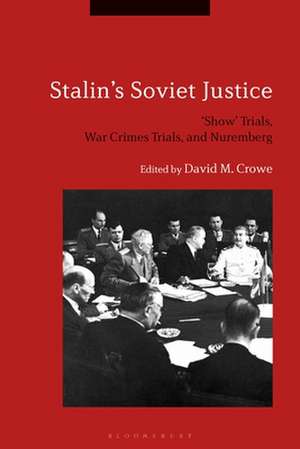
Stalin's Soviet Justice: ‘Show’ Trials, War Crimes Trials, and Nuremberg
Editat de Prof. David M. Croween Limba Engleză Paperback – 24 dec 2020
Stalin believed that an international trial for Nazi war criminals was the best way to show the world the sacrifices his country had made to defeat Hitler, and he, together with his legal mouthpiece Andrei Vyshinsky, maintained tight control over Soviet representatives during talks leading up to the creation of the Nuremberg IMT trial in 1945, and the trial itself. But Soviet prosecutors at Nuremberg were unable to deal comfortably with the complexities of an open, western-style legal proceeding, which undercut their effectiveness throughout the trial. However, they were able to present a significant body of evidence that underscored the brutal nature of Hitler's racial war in Russia from 1941-45, a theme which became central to Stalin's efforts to redefine international criminal law after the war.
Stalin's Soviet Justice provides a nuanced analysis of the Soviet justice system at a crucial turning point in European history and it will be vital reading for scholars and advanced students of the legal history of the Soviet Union, the history of war crimes and the aftermath of the Second World War.
| Toate formatele și edițiile | Preț | Express |
|---|---|---|
| Paperback (1) | 225.52 lei 6-8 săpt. | |
| Bloomsbury Publishing – 24 dec 2020 | 225.52 lei 6-8 săpt. | |
| Hardback (1) | 676.36 lei 6-8 săpt. | |
| Bloomsbury Publishing – 13 iun 2019 | 676.36 lei 6-8 săpt. |
Preț: 225.52 lei
Preț vechi: 298.38 lei
-24%
Puncte Express: 338
Preț estimativ în valută:
39.87€ • 46.39$ • 34.50£
39.87€ • 46.39$ • 34.50£
Carte tipărită la comandă
Livrare economică 23 aprilie-07 mai
Specificații
ISBN-13: 9781350196919
ISBN-10: 1350196916
Pagini: 256
Dimensiuni: 154 x 232 x 18 mm
Greutate: 0.42 kg
Editura: Bloomsbury Publishing
Colecția Bloomsbury Academic
Locul publicării:London, United Kingdom
ISBN-10: 1350196916
Pagini: 256
Dimensiuni: 154 x 232 x 18 mm
Greutate: 0.42 kg
Editura: Bloomsbury Publishing
Colecția Bloomsbury Academic
Locul publicării:London, United Kingdom
V-ar putea interesa
-
 The BridgeGeert Mak-38%Preț: 58.15 lei93.97 lei
 -
 Barbarism and Civilization: A History of Europe in our TimeBernard Wasserstein-20%Preț: 219.94 lei275.15 lei
 -
 War in European HistoryMichael Howard-22%Preț: 76.51 lei97.59 lei
 -
 Italy Today: The Sick Man of EuropeAndrea Mammone-15%Preț: 452.20 lei532.00 lei
 -
 The Fall of the Berlin WallWilliam F BuckleyPreț: 77.66 lei
 -
 The Ancient Greeks For DummiesS BatchelorPreț: 134.24 lei
 -
 Preț: 229.33 lei
 -
 The White WarMark ThompsonPreț: 103.85 lei
 -
 The Secret Life of FranceLucy WadhamPreț: 75.92 lei
 -
 The Illustrated Encyclopedia of Royal BritainCharles PhillipsPreț: 160.25 lei
 -
 A World Religions Reader 4th EditionIS MarkhamPreț: 381.22 lei
 -
 A Companion to World War IJohn HornePreț: 446.84 lei
 -
 Preț: 396.58 lei
 -
 -24%Preț: 176.85 lei232.66 lei
 -
 The Villa AriadneDilys Powell-19%Preț: 72.68 lei90.03 lei
 -
 The Putney DebatesThe LevellersPreț: 129.19 lei
 -
 Napoleon's Men: The Soldiers of the Revolution and EmpireProf Alan Forrest-39%Preț: 280.91 lei458.94 lei
 -
 UK Airfields of the Cold WarPhilip BirtlesPreț: 158.52 lei
 -
 -13%Preț: 122.58 lei140.45 lei
 -
 -42%Preț: 63.68 lei109.25 lei
 -
 Preț: 192.10 lei
Cuprins
Introduction, David M. Crowe (Elon University, USA)
1. Late Imperial and Soviet 'Show' Trials, 1878-1938, David M. Crowe (Elon University, USA)
2. Traitors or War Criminals: Collaboration on Trial in Soviet Courts in the 1940s, Alexander V. Prusin (New Mexico Institute of Mining and Technology, USA)
3. 'Nikto ne zabyt': The Politicization of Soviet War Dead, Thomas Earl Porter (North Carolina A&T State University, USA)
4. The Human Face of Soviet Justice: Aron Trainin and the Origins of the Soviet Doctrine of International Criminal Law, Valentyna Polunina (Heidelberg University, Germany)
5. 'May Justice be Done!': The Soviet Union and the London Conference (1945), Irina Schulmeister-André (Independent Scholar, Germany)
6. The Soviet Union at the Palace of Justice: Law, Intrigue, and International Rivalry in the Nuremberg Trials, Francine Hirsch (University of Wisconsin-Madison, USA)
7. Soviet Journalists at Nuremberg: Establishing the Soviet War Narrative, Jeremy Hicks (Queen Mary University of London, UK)
8. From Geneva to Nuremberg to New York: Andrei Vyshinsky, Raphaël Lemkin, and the Struggle to Outlaw Revolutionary Violence, State Terror, and Genocide, Douglas Irvin-Erickson (George Mason University, USA)
Select Bibliography
Index
1. Late Imperial and Soviet 'Show' Trials, 1878-1938, David M. Crowe (Elon University, USA)
2. Traitors or War Criminals: Collaboration on Trial in Soviet Courts in the 1940s, Alexander V. Prusin (New Mexico Institute of Mining and Technology, USA)
3. 'Nikto ne zabyt': The Politicization of Soviet War Dead, Thomas Earl Porter (North Carolina A&T State University, USA)
4. The Human Face of Soviet Justice: Aron Trainin and the Origins of the Soviet Doctrine of International Criminal Law, Valentyna Polunina (Heidelberg University, Germany)
5. 'May Justice be Done!': The Soviet Union and the London Conference (1945), Irina Schulmeister-André (Independent Scholar, Germany)
6. The Soviet Union at the Palace of Justice: Law, Intrigue, and International Rivalry in the Nuremberg Trials, Francine Hirsch (University of Wisconsin-Madison, USA)
7. Soviet Journalists at Nuremberg: Establishing the Soviet War Narrative, Jeremy Hicks (Queen Mary University of London, UK)
8. From Geneva to Nuremberg to New York: Andrei Vyshinsky, Raphaël Lemkin, and the Struggle to Outlaw Revolutionary Violence, State Terror, and Genocide, Douglas Irvin-Erickson (George Mason University, USA)
Select Bibliography
Index
Recenzii
The volume, especially the chapters by Irina Schulmeister-André/David M. Crowe, Francine Hirsch, and Jeremy Hicks excel in highlighting these complex interdependencies between power politics, legal positions, court proceedings, and official reconstructions of the past.
[It] rightfully re-orients the Soviet legal system and its leading minds into the center of the creation of post-World War II international law.
This is no dry account of disputes over points of law; here, we learn of the conflicts, disappointments, and victories of real people that takes us beyond the stereotypes of the lawyers as puppets of the Kremlin or journalists churning out propaganda. The result is an intellectually-satisfying account both of the familiar story of the failed attempt of the USSR to use the Nuremburg trials to control the narrative of its role in the Second World War and of the lasting contribution that Soviet legal scholarship made to the development of international law.
Stalin's Soviet Justice makes a significant contribution to our understanding of the theory and practice of criminal justice and political repression in the USSR, shedding valuable light on the important Soviet contributions to the development of international criminal law and legal institutions after World War II.
[It] rightfully re-orients the Soviet legal system and its leading minds into the center of the creation of post-World War II international law.
This is no dry account of disputes over points of law; here, we learn of the conflicts, disappointments, and victories of real people that takes us beyond the stereotypes of the lawyers as puppets of the Kremlin or journalists churning out propaganda. The result is an intellectually-satisfying account both of the familiar story of the failed attempt of the USSR to use the Nuremburg trials to control the narrative of its role in the Second World War and of the lasting contribution that Soviet legal scholarship made to the development of international law.
Stalin's Soviet Justice makes a significant contribution to our understanding of the theory and practice of criminal justice and political repression in the USSR, shedding valuable light on the important Soviet contributions to the development of international criminal law and legal institutions after World War II.