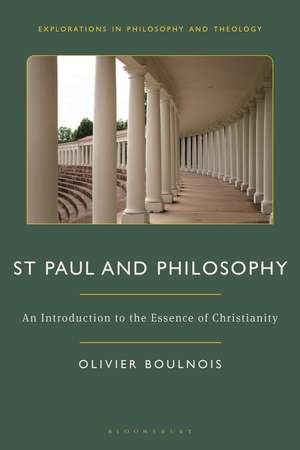
St Paul and Philosophy: An Introduction to the Essence of Christianity: Explorations in Philosophy and Theology
Autor Olivier Boulnois Traducere de Andrew Sackin-Pollen Limba Engleză Hardback – 11 dec 2025
Originally delivered as a series of lectures at Cambridge and at the Institut Catholique de Paris, St Paul and Philosophy is at once a painstaking study of Paul's own thinking and an open exploration of its continued relevance for modern and contemporary reflection on Christian religion. This book is an important demonstration that theology and philosophy are at their best when brought into dialogue with one another around perennial questions and themes.


Preț: 565.84 lei
Preț vechi: 829.64 lei
-32%
Puncte Express: 849
Carte tipărită la comandă
Livrare economică 08-22 decembrie
Livrare prin curier în România Termenul estimat este afișat lângă disponibilitate.
Transport gratuit pentru acest produs Plată online sau ramburs, în funcție de opțiunile comenzii.
Retur gratuit în 14 zile Comandă securizată și suport în română.
Specificații
ISBN-13: 9781350469976
ISBN-10: 1350469971
Pagini: 160
Dimensiuni: 164 x 238 x 16 mm
Greutate: 0.4 kg
Editura: Bloomsbury Publishing
Colecția Bloomsbury Academic
Seria Explorations in Philosophy and Theology
Locul publicării:London, United Kingdom
ISBN-10: 1350469971
Pagini: 160
Dimensiuni: 164 x 238 x 16 mm
Greutate: 0.4 kg
Editura: Bloomsbury Publishing
Colecția Bloomsbury Academic
Seria Explorations in Philosophy and Theology
Locul publicării:London, United Kingdom
Cuprins
Foreword
Introduction
1. Logos: The Wisdom of the Cross (1 Corinthians 1)
2. Cosmos: The Time of the End (1 Thessalonians)
3. Ethos (1): The Use of the World and the Suspension of Differences (1 Corinthians 7)
4. Ethos (2): Law, Powerlessness and Judaism (Romans 7)
5. Ethos (3): The Empire of Evil and the Overflow of Good (Romans 5)
6. The Messiah and the I (Galatians 2)
7. The 'Mystery of Evil' and the Secret of History (2 Thessalonians)
Conclusion
References
Index
Introduction
1. Logos: The Wisdom of the Cross (1 Corinthians 1)
2. Cosmos: The Time of the End (1 Thessalonians)
3. Ethos (1): The Use of the World and the Suspension of Differences (1 Corinthians 7)
4. Ethos (2): Law, Powerlessness and Judaism (Romans 7)
5. Ethos (3): The Empire of Evil and the Overflow of Good (Romans 5)
6. The Messiah and the I (Galatians 2)
7. The 'Mystery of Evil' and the Secret of History (2 Thessalonians)
Conclusion
References
Index
Recenzii
This is an incredibly fresh understanding of the philosophy underlying and implied in Paul's letters. By bringing the Pauline writings into dialogue with their philosophical interpreters and misinterpreters of later dates, Olivier Boulnois transposes Paul's thought into different keys and allows us to explore its profundity and resonance.
It is fascinating to see how this superb and deep, French, philosophical analysis
of Paul, which is steeped in French and German philosophy and theology, fits
with the latest developments in English-speaking scholarship on Paul within
Judaism. This is mandatory reading
This remarkable work offers a strikingly lucid, thoroughly argued intervention in the growing recent philosophical reception of St. Paul's original letters. Yet rather than belaboring once again the apostle's apparent anti-Judaic antithesis between Mosaic Law and Christian love, and instead of revisiting Paul's presumed anti-philosophical rejection of Greek Logos in almost every aspect, Olivier Boulnois phenomenologically minutely describes and genealogically meticulously reconstructs what being Jew-Greek or Greek-Jew may have actually meant for this earliest representative of genuine Christian theology. What emerges in unapologetically theoretical and practical terms is this early Christian life and thought's enduring essence, as it still speaks to us.
'There has been something of a cult of Paul and Philosophy in recent years. In this book, Olivier Boulnois contributes to the discussion a rather more sober and philologically-based assessment. For him, Paul was trying to articulate a new form of life focused around faith, hope and charity that corresponded to the unique event of the arrival of a Messiah who called into question not just the Greek naturalistic past, but also the Jewish legalistic and prophetic legacy. From henceforth, we are all to become 'messianic'. This, for Boulnois, is the phenomenological 'essence' of Christianity, with priority over both theological and ontological reflection. Such a perspective also rules out any overly political readings which would either absolutize the coercive power of the state, or condemn it as demonic. Rather, for Paul, we remain until the eschaton in an ambivalent and confused transition from law and nature to the messianic condition of charity attained through grace. Boulnois's reading is controversial and illuminating. This book will renew the debate about Paul as a decisive thinker.'
It is fascinating to see how this superb and deep, French, philosophical analysis
of Paul, which is steeped in French and German philosophy and theology, fits
with the latest developments in English-speaking scholarship on Paul within
Judaism. This is mandatory reading
This remarkable work offers a strikingly lucid, thoroughly argued intervention in the growing recent philosophical reception of St. Paul's original letters. Yet rather than belaboring once again the apostle's apparent anti-Judaic antithesis between Mosaic Law and Christian love, and instead of revisiting Paul's presumed anti-philosophical rejection of Greek Logos in almost every aspect, Olivier Boulnois phenomenologically minutely describes and genealogically meticulously reconstructs what being Jew-Greek or Greek-Jew may have actually meant for this earliest representative of genuine Christian theology. What emerges in unapologetically theoretical and practical terms is this early Christian life and thought's enduring essence, as it still speaks to us.
'There has been something of a cult of Paul and Philosophy in recent years. In this book, Olivier Boulnois contributes to the discussion a rather more sober and philologically-based assessment. For him, Paul was trying to articulate a new form of life focused around faith, hope and charity that corresponded to the unique event of the arrival of a Messiah who called into question not just the Greek naturalistic past, but also the Jewish legalistic and prophetic legacy. From henceforth, we are all to become 'messianic'. This, for Boulnois, is the phenomenological 'essence' of Christianity, with priority over both theological and ontological reflection. Such a perspective also rules out any overly political readings which would either absolutize the coercive power of the state, or condemn it as demonic. Rather, for Paul, we remain until the eschaton in an ambivalent and confused transition from law and nature to the messianic condition of charity attained through grace. Boulnois's reading is controversial and illuminating. This book will renew the debate about Paul as a decisive thinker.'