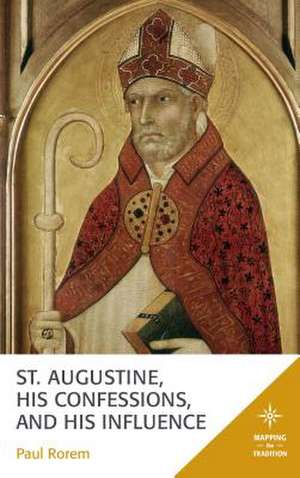
St. Augustine, His Confessions, and His Influence: Mapping the Tradition
Autor Paul Roremen Limba Engleză Hardback – 7 aug 2019


Preț: 534.93 lei
Preț vechi: 767.34 lei
-30%
Puncte Express: 802
Carte tipărită la comandă
Livrare economică 21 noiembrie-05 decembrie
Livrare prin curier în România Termenul estimat este afișat lângă disponibilitate.
Transport gratuit pentru acest produs Plată online sau ramburs, în funcție de opțiunile comenzii.
Retur gratuit în 14 zile Comandă securizată și suport în română.
Specificații
ISBN-13: 9781978702370
ISBN-10: 197870237X
Pagini: 138
Dimensiuni: 160 x 229 x 15 mm
Greutate: 0.36 kg
Editura: Bloomsbury Publishing
Colecția Fortress Academic
Seria Mapping the Tradition
Locul publicării:New York, United States
ISBN-10: 197870237X
Pagini: 138
Dimensiuni: 160 x 229 x 15 mm
Greutate: 0.36 kg
Editura: Bloomsbury Publishing
Colecția Fortress Academic
Seria Mapping the Tradition
Locul publicării:New York, United States
Cuprins
Part One: Augustine's Confessions
Part Two: Augustine's Influence
Appendix: Overview of Topics
Part Two: Augustine's Influence
Appendix: Overview of Topics
Recenzii
This fine essay may be thought of as a handbook to the Confessions. Rorem's essay is tailor-made for the classroom. It might also be useful for a Christian reading club.
Arguably no Christian writer has proven more influential than Augustine, yet the sheer range and volume of his writing - not to mention the often sharp disagreement over their proper interpretation - make the prospect of providing a short introduction of the man and his legacy daunting indeed. By using the Confessions as a lens through which to explore both the content and impact of Augustine's thought, Paul Rorem has hit upon an elegant solution to this challenge, showing how the themes that emerge from Augustine's own account of his early intellectual and spiritual struggles shape not only his own ideas, but also virtually the whole of later western thought.
Paul Rorem's book is a welcome and needed addition to studies of Augustine and his Confessions. Elegantly written, this book will hook those approaching Augustine for the first time, while enriching the understanding of those who have long been ruminating on Augustine. Taking the Confessions as a book-by-book "map", Rorem provides a richly narrated and interpreted journey through Augustine's life, friendships, ideas, writings, and controversies. Part Two traces the influence of Augustine's life and ideas along varied threads (theological, cultural, political, mystical, and others) that weave through the fabric of post-Augustinian history. The net is cast wide: Petrarch, Aquinas, just war theory, female mystics, Augustinian friars, the nature of time/eternity, Luther, the nature of the self, the Triune God, and of course predestination. Always, however, Rorem ties the discussion to key passages in the Confessions. Born out of decades of ruminating on Augustine while regularly teaching a course on the Confessions, this book has the clarity of expression one expects from Rorem, along with the virtue of being succinct without being simplistic. Along the way current scholarship is deftly brought into play with nuanced presentation.
Arguably no Christian writer has proven more influential than Augustine, yet the sheer range and volume of his writing - not to mention the often sharp disagreement over their proper interpretation - make the prospect of providing a short introduction of the man and his legacy daunting indeed. By using the Confessions as a lens through which to explore both the content and impact of Augustine's thought, Paul Rorem has hit upon an elegant solution to this challenge, showing how the themes that emerge from Augustine's own account of his early intellectual and spiritual struggles shape not only his own ideas, but also virtually the whole of later western thought.
Paul Rorem's book is a welcome and needed addition to studies of Augustine and his Confessions. Elegantly written, this book will hook those approaching Augustine for the first time, while enriching the understanding of those who have long been ruminating on Augustine. Taking the Confessions as a book-by-book "map", Rorem provides a richly narrated and interpreted journey through Augustine's life, friendships, ideas, writings, and controversies. Part Two traces the influence of Augustine's life and ideas along varied threads (theological, cultural, political, mystical, and others) that weave through the fabric of post-Augustinian history. The net is cast wide: Petrarch, Aquinas, just war theory, female mystics, Augustinian friars, the nature of time/eternity, Luther, the nature of the self, the Triune God, and of course predestination. Always, however, Rorem ties the discussion to key passages in the Confessions. Born out of decades of ruminating on Augustine while regularly teaching a course on the Confessions, this book has the clarity of expression one expects from Rorem, along with the virtue of being succinct without being simplistic. Along the way current scholarship is deftly brought into play with nuanced presentation.