
SQL Hacks
Autor Andrew Cumming, Gordon Russellen Limba Engleză Paperback – 26 dec 2006
Preț: 143.17 lei
Preț vechi: 178.95 lei
-20%
Puncte Express: 215
Carte disponibilă
Livrare economică 05-19 noiembrie
Livrare prin curier în România Termenul estimat este afișat lângă disponibilitate.
Transport gratuit de la 400.00 lei Plată online sau ramburs, în funcție de opțiunile comenzii.
Retur gratuit în 14 zile Comandă securizată și suport în română.
Specificații
ISBN-13: 9780596527990
ISBN-10: 0596527993
Pagini: 409
Dimensiuni: 154 x 228 x 32 mm
Greutate: 0.55 kg
Editura: O'Reilly
Locul publicării:United States
ISBN-10: 0596527993
Pagini: 409
Dimensiuni: 154 x 228 x 32 mm
Greutate: 0.55 kg
Editura: O'Reilly
Locul publicării:United States
V-ar putea interesa
-
 -29%Preț: 307.45 lei434.47 lei
 -
 -28%Preț: 373.16 lei521.33 lei
 -
 Data Architecture: From Zen to RealityCharles Tupper-34%Preț: 320.33 lei484.65 lei
 -
 -36%Preț: 248.12 lei388.48 lei
 -
 -30%Preț: 196.60 lei282.06 lei
 -
 -31%Preț: 224.44 lei326.96 lei
 -
 -26%Preț: 308.22 lei415.44 lei
 -
 -39%Preț: 222.78 lei367.25 lei
 -
 -20%Preț: 143.53 lei179.42 lei
 -
 -39%Preț: 133.39 lei219.59 lei
 -
 -34%Preț: 194.16 lei295.72 lei
 -
 Advances in ComputersSuyel Namasudra-44%Preț: 703.76 lei1249.07 lei
 -
 -38%Preț: 346.46 lei554.94 lei
 -
 MySQL Stored Procedure ProgrammingGuy Harrison-20%Preț: 232.59 lei290.74 lei
 -
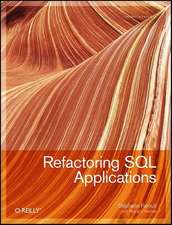 Refactoring SQL ApplicationsStephane Faroult-20%Preț: 226.46 lei283.07 lei
 -
 Head First SQLLynn Beighley-20%Preț: 319.84 lei399.79 lei
 -
 The Data Quality BlueprintJohn Parkinson-23%Preț: 1016.84 lei1320.57 lei
 -
 SQL CookbookAnthony Molinaro-20%Preț: 338.57 lei423.21 lei
 -
 SQL Server 2014 Design & ProgrammingKalman Toth-20%Preț: 263.28 lei329.10 lei
 -
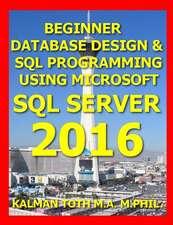 Beginner Database Design & SQL Programming Using Microsoft SQL Server 2016Kalman Toth M. a. M. Phil-20%Preț: 151.96 lei189.94 lei
 -
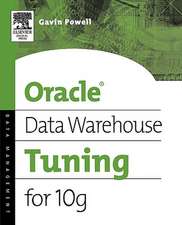 Oracle Data Warehouse Tuning for 10gGavin Powell-20%Preț: 705.66 lei882.07 lei
 -
 SQL AntipatternsBill Karwin-20%Preț: 211.67 lei264.58 lei
Cuprins
Credits;
About the Authors;
Contributors;
Acknowledgments;
Preface;
Why SQL Hacks?;
How to Use This Book;
How This Book Is Organized;
Conventions;
Using Code Examples;
How to Contact Us;
Got a Hack?;
Safari Enabled;
Chapter 1: SQL Fundamentals;
Run SQL from the Command Line;
Connect to SQL from a Program;
Perform Conditional INSERTs;
UPDATE the Database;
Solve a Crossword Puzzle Using SQL;
Don't Perform the Same Calculation Over and Over;
Chapter 2: Joins, Unions, and Views;
Modify a Schema Without Breaking Existing Queries;
Filter Rows and Columns;
Filter on Indexed Columns;
Convert Subqueries to JOINs;
Convert Aggregate Subqueries to JOINs;
Simplify Complicated Updates;
Choose the Right Join Style for Your Relationships;
Generate Combinations;
Chapter 3: Text Handling;
Search for Keywords Without LIKE;
Search for a String Across Columns;
Solve Anagrams;
Sort Your Email;
Chapter 4: Date Handling;
Convert Strings to Dates;
Uncover Trends in Your Data;
Report on Any Date Criteria;
Generate Quarterly Reports;
Second Tuesday of the Month;
Chapter 5: Number Crunching;
Multiply Across a Result Set;
Keep a Running Total;
Include the Rows Your JOIN Forgot;
Identify Overlapping Ranges;
Avoid Dividing by Zero;
Other Ways to COUNT;
Calculate the Maximum of Two Fields;
Disaggregate a COUNT;
Cope with Rounding Errors;
Get Values and Subtotals in One Shot;
Calculate the Median;
Tally Results into a Chart;
Calculate the Distance Between GPS Locations;
Reconcile Invoices and Remittances;
Find Transposition Errors;
Apply a Progressive Tax;
Calculate Rank;
Chapter 6: Online Applications;
Copy Web Pages into a Table;
Present Data Graphically Using SVG;
Add Navigation Features to Web Applications;
Tunnel into MySQL from Microsoft Access;
Process Web Server Logs;
Store Images in a Database;
Exploit an SQL Injection Vulnerability;
Prevent an SQL Injection Attack;
Chapter 7: Organizing Data;
Keep Track of Infrequently Changing Values;
Combine Tables Containing Different Data;
Display Rows As Columns;
Display Columns As Rows;
Clean Inconsistent Records;
Denormalize Your Tables;
Import Someone Else's Data;
Play Matchmaker;
Generate Unique Sequential Numbers;
Chapter 8: Storing Small Amounts of Data;
Store Parameters in the Database;
Define Personalized Parameters;
Create a List of Personalized Parameters;
Set Security Based on Rows;
Issue Queries Without Using a Table;
Generate Rows Without Tables;
Chapter 9: Locking and Performance;
Determine Your Isolation Level;
Use Pessimistic Locking;
Use Optimistic Locking;
Lock Implicitly Within Transactions;
Cope with Unexpected Redo;
Execute Functions in the Database;
Combine Your Queries;
Extract Lots of Rows;
Extract a Subset of the Results;
Mix File and Database Storage;
Compare and Synchronize Tables;
Minimize Bandwidth in One-to-Many Joins;
Compress to Avoid LOBs;
Chapter 10: Reporting;
Fill in Missing Values in a Pivot Table;
Break It Down by Range;
Identify Updates Uniquely;
Play Six Degrees of Kevin Bacon;
Build Decision Tables;
Generate Sequential or Missing Data;
Find the Top n in Each Group;
Store Comma-Delimited Lists in a Column;
Traverse a Simple Tree;
Set Up Queuing in the Database;
Generate a Calendar;
Test Two Values from a Subquery;
Choose Any Three of Five;
Chapter 11: Users and Administration;
Implement Application-Level Accounts;
Export and Import Table Definitions;
Deploy Applications;
Auto-Create Database Users;
Create Users and Administrators;
Issue Automatic Updates;
Create an Audit Trail;
Chapter 12: Wider Access;
Sharing Data Across the Internet;
Allow an Anonymous Account;
Find and Stop Long-Running Queries;
Don't Run Out of Disk Space;
Run SQL from a Web Page;
Colophon;
About the Authors;
Contributors;
Acknowledgments;
Preface;
Why SQL Hacks?;
How to Use This Book;
How This Book Is Organized;
Conventions;
Using Code Examples;
How to Contact Us;
Got a Hack?;
Safari Enabled;
Chapter 1: SQL Fundamentals;
Run SQL from the Command Line;
Connect to SQL from a Program;
Perform Conditional INSERTs;
UPDATE the Database;
Solve a Crossword Puzzle Using SQL;
Don't Perform the Same Calculation Over and Over;
Chapter 2: Joins, Unions, and Views;
Modify a Schema Without Breaking Existing Queries;
Filter Rows and Columns;
Filter on Indexed Columns;
Convert Subqueries to JOINs;
Convert Aggregate Subqueries to JOINs;
Simplify Complicated Updates;
Choose the Right Join Style for Your Relationships;
Generate Combinations;
Chapter 3: Text Handling;
Search for Keywords Without LIKE;
Search for a String Across Columns;
Solve Anagrams;
Sort Your Email;
Chapter 4: Date Handling;
Convert Strings to Dates;
Uncover Trends in Your Data;
Report on Any Date Criteria;
Generate Quarterly Reports;
Second Tuesday of the Month;
Chapter 5: Number Crunching;
Multiply Across a Result Set;
Keep a Running Total;
Include the Rows Your JOIN Forgot;
Identify Overlapping Ranges;
Avoid Dividing by Zero;
Other Ways to COUNT;
Calculate the Maximum of Two Fields;
Disaggregate a COUNT;
Cope with Rounding Errors;
Get Values and Subtotals in One Shot;
Calculate the Median;
Tally Results into a Chart;
Calculate the Distance Between GPS Locations;
Reconcile Invoices and Remittances;
Find Transposition Errors;
Apply a Progressive Tax;
Calculate Rank;
Chapter 6: Online Applications;
Copy Web Pages into a Table;
Present Data Graphically Using SVG;
Add Navigation Features to Web Applications;
Tunnel into MySQL from Microsoft Access;
Process Web Server Logs;
Store Images in a Database;
Exploit an SQL Injection Vulnerability;
Prevent an SQL Injection Attack;
Chapter 7: Organizing Data;
Keep Track of Infrequently Changing Values;
Combine Tables Containing Different Data;
Display Rows As Columns;
Display Columns As Rows;
Clean Inconsistent Records;
Denormalize Your Tables;
Import Someone Else's Data;
Play Matchmaker;
Generate Unique Sequential Numbers;
Chapter 8: Storing Small Amounts of Data;
Store Parameters in the Database;
Define Personalized Parameters;
Create a List of Personalized Parameters;
Set Security Based on Rows;
Issue Queries Without Using a Table;
Generate Rows Without Tables;
Chapter 9: Locking and Performance;
Determine Your Isolation Level;
Use Pessimistic Locking;
Use Optimistic Locking;
Lock Implicitly Within Transactions;
Cope with Unexpected Redo;
Execute Functions in the Database;
Combine Your Queries;
Extract Lots of Rows;
Extract a Subset of the Results;
Mix File and Database Storage;
Compare and Synchronize Tables;
Minimize Bandwidth in One-to-Many Joins;
Compress to Avoid LOBs;
Chapter 10: Reporting;
Fill in Missing Values in a Pivot Table;
Break It Down by Range;
Identify Updates Uniquely;
Play Six Degrees of Kevin Bacon;
Build Decision Tables;
Generate Sequential or Missing Data;
Find the Top n in Each Group;
Store Comma-Delimited Lists in a Column;
Traverse a Simple Tree;
Set Up Queuing in the Database;
Generate a Calendar;
Test Two Values from a Subquery;
Choose Any Three of Five;
Chapter 11: Users and Administration;
Implement Application-Level Accounts;
Export and Import Table Definitions;
Deploy Applications;
Auto-Create Database Users;
Create Users and Administrators;
Issue Automatic Updates;
Create an Audit Trail;
Chapter 12: Wider Access;
Sharing Data Across the Internet;
Allow an Anonymous Account;
Find and Stop Long-Running Queries;
Don't Run Out of Disk Space;
Run SQL from a Web Page;
Colophon;