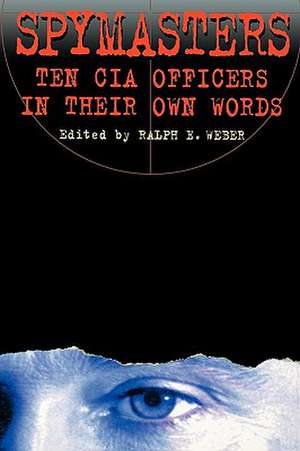
Spymasters: Ten CIA Officers in Their Own Words
Editat de Ralph Weberen Limba Engleză Paperback – 2002
President Harry S. Truman's demands for a centralized intelligence agency and the stubborn resistance of James F. Byrnes, J. Edgar Hoover, and the military services
the tumultuous early stages of the National Security Council
the failed Bay of Pigs invasion
the confusion surrounding the Kennedy assassination
Khrushchev's ousting
Operation MONGOOSE
the Gulf of Tonkin incident
The interviews are especially valuable for their portrayal of the relationships between the agency's directors and the presidents during the most anxious and threatening decades of the Cold War. The CIA's successes and failures are recounted and carefully evaluated by the men who were there, often times issuing the orders.
Preț: 281.83 lei
Preț vechi: 366.54 lei
-23%
Puncte Express: 423
Carte tipărită la comandă
Livrare economică 24 noiembrie-08 decembrie
Livrare prin curier în România Termenul estimat este afișat lângă disponibilitate.
Transport gratuit de la 400.00 lei Plată online sau ramburs, în funcție de opțiunile comenzii.
Retur gratuit în 14 zile Comandă securizată și suport în română.
Specificații
ISBN-13: 9780842027151
ISBN-10: 0842027157
Pagini: 356
Dimensiuni: 155 x 235 x 25 mm
Greutate: 0.64 kg
Ediția:New.
Editura: Bloomsbury Publishing
Colecția Rowman & Littlefield
Locul publicării:New York, United States
ISBN-10: 0842027157
Pagini: 356
Dimensiuni: 155 x 235 x 25 mm
Greutate: 0.64 kg
Ediția:New.
Editura: Bloomsbury Publishing
Colecția Rowman & Littlefield
Locul publicării:New York, United States
V-ar putea interesa
-
 Running With the FirmJames Bannon-30%Preț: 73.84 lei105.27 lei
 -
 Professional Police Practice: Scenarios and DilemmasP. A. J. Waddington-21%Preț: 345.54 lei439.15 lei
 -
 Strategic Intelligence for the 21st Century: The Mosaic MethodAlfred Rolington-14%Preț: 296.74 lei346.45 lei
 -
 -31%Preț: 532.64 lei770.96 lei
 -
 Securing Transportation SystemsSimon Hakim-8%Preț: 645.64 lei701.79 lei
 -
 The British Transport PoliceRichard Stacpoole-RydingPreț: 106.45 lei
 -
 -27%Preț: 67.51 lei91.96 lei
 -
 UndercoverPaul LewisPreț: 93.51 lei
 -
 -26%Preț: 89.87 lei121.42 lei
 -
 A Likely Tale, LadMike PannettPreț: 65.78 lei
 -
 Intelligent PolicingSimon J. GuilfoylePreț: 226.92 lei
Cuprins
Chapter 1 Sidney W. Souers
Chapter 2 Allen W. Dulles
Chapter 3 Richard Md. Bissell
Chapter 4 Samuel Halpern
Chapter 5 Lyman B. Kirkpatrick, Jr.
Chapter 6 Robert Amory, Jr.
Chapter 7 Ray S. Cline
Chapter 8 John A. McCone
Chapter 9 Richard M. Helms
Chapter 10 William E. Colby
Chapter 2 Allen W. Dulles
Chapter 3 Richard Md. Bissell
Chapter 4 Samuel Halpern
Chapter 5 Lyman B. Kirkpatrick, Jr.
Chapter 6 Robert Amory, Jr.
Chapter 7 Ray S. Cline
Chapter 8 John A. McCone
Chapter 9 Richard M. Helms
Chapter 10 William E. Colby
Recenzii
To comprehend the CIA one must understand those who made it work in its formative years. Professor Weber's singular collection of engaging, entertaining, often humorous interviews of some of its most honorable men in service during that time takes a major step toward this goal. Historians, their students, and even those with reflexive animus toward the CIA will find it of enormous value. Spymasters is a powerful oral history of the realities of Agency collection operations and their analysis.
Spymasters is a collection of fascinating and insightful interviews... Provides intriguing perspectives and information about American intelligence activities during the Cold War.
An exciting collection of fresh, stimulating, informed, and very readable conversations with top U.S. intelligence officials.
No historian understands more about the organization of American intelligence, from its beginnings during the Revolution to the present day, than Ralph E. Weber. When leading figures in the Central Intelligence Agency appraise their own work they almost necessarily throw light on dark corners. It is hardly necessary to add that during the Cold War the policy of the United States was made not merely by the Department of State but by covert CIA actions, and that any student of the years after World War II needs to know about this essential second dimension.
Ralph Weber has had the brilliant idea of finding and collecting hidden interviews with leaders of the intelligence community. He thereby renders a signal contribution to intelligence historians by making available a book not only valuable, but fascinating.
An outstanding collection of oral histories.
Spymasters is a collection of fascinating and insightful interviews... Provides intriguing perspectives and information about American intelligence activities during the Cold War.
An exciting collection of fresh, stimulating, informed, and very readable conversations with top U.S. intelligence officials.
No historian understands more about the organization of American intelligence, from its beginnings during the Revolution to the present day, than Ralph E. Weber. When leading figures in the Central Intelligence Agency appraise their own work they almost necessarily throw light on dark corners. It is hardly necessary to add that during the Cold War the policy of the United States was made not merely by the Department of State but by covert CIA actions, and that any student of the years after World War II needs to know about this essential second dimension.
Ralph Weber has had the brilliant idea of finding and collecting hidden interviews with leaders of the intelligence community. He thereby renders a signal contribution to intelligence historians by making available a book not only valuable, but fascinating.
An outstanding collection of oral histories.