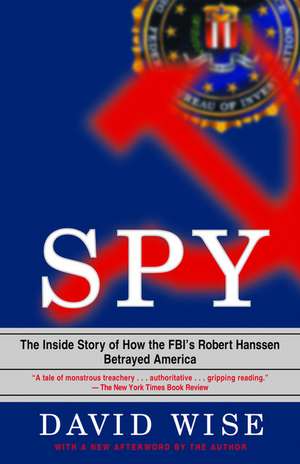
Spy
Autor David Wiseen Limba Engleză Paperback – 14 oct 2003
Imagineați-vă un om care, în timp ce își conduce copiii la biserică și pozează în apărător al valorilor conservatoare, transportă în portbagaj o mitralieră și secrete care pot îngenunchea o națiune. Într-o zi obișnuită la birou, Robert Hanssen, expert în contraspionaj, primește sarcina de a identifica o cârtiță în interiorul FBI. Paradoxul este absolut: Hanssen analizează breșele de securitate pe care el însuși le-a creat, fiind în realitate cel mai distructiv spion din istoria Statelor Unite. În Spy, observăm cum David Wise reușește să pătrundă în mintea acestui personaj contradictoriu — un amestec de fanatism religios, obsesii sexuale bizare și o loialitate vândută Moscovei pe parcursul a două decenii. Apreciem rigoarea cu care David Wise documentează acest dezastru de inteligență, dezvăluind cum FBI a plătit 7 milioane de dolari pentru un dosar extras direct din inima KGB-ului. Cine a apreciat portretul din The Bureau and the Mole de David A Vise va găsi aici aceeași profunzime biografică, dar îmbogățită de accesul exclusiv la mărturiile psihiatrului lui Hanssen. Spre deosebire de alte lucrări ale sale, precum Cassidy's Run, unde se concentra pe operațiuni tactice de lungă durată, aici autorul prioritizează dimensiunea psihologică, încercând să explice motivele unui om care și-a trădat nu doar țara, ci și familia și credința. Stilul este alert, aproape cinematic, transformând o analiză de spionaj într-o cronică a unei prăbușiri morale totale. Găsim în această carte nu doar o relatare despre spionaj, ci și o investigație despre cum o instituție de elită a putut ignora semnele evidente ale unei trădări sistemice.
Preț: 97.54 lei
Carte disponibilă
Livrare economică 13-27 noiembrie
Specificații
ISBN-10: 0375758941
Pagini: 352
Ilustrații: 16-PP PHOTO INSERT
Dimensiuni: 130 x 201 x 20 mm
Greutate: 0.3 kg
Editura: Random House
V-ar putea interesa
-
 Russians Among UsGordon CoreraPreț: 92.97 lei
 -
 The CIA Book ClubCharlie EnglishPreț: 158.61 lei
 -
 Inside the CartelMartin SuarezPreț: 192.03 lei
 -
 All His SpiesStephen AlfordPreț: 108.50 lei
 -
 The Spy and the TraitorBen Macintyre-24%Preț: 65.99 lei87.01 lei
 -
 -27%Preț: 89.52 lei122.10 lei
 -
 FBI Files: Catching a Russian SpyBryan DensonPreț: 70.32 lei
 -
 The PersianDavid McCloskeyPreț: 101.58 lei
 -
 -17%Preț: 91.61 lei109.98 leiRecomandat
 -
 -26%Preț: 90.30 lei121.47 lei
 -
 How to Catch a Russian SpyNaveed JamaliPreț: 110.19 lei
 -
 King of SpiesBlaine Harden-33%Preț: 43.82 lei65.29 lei
 -
 A Spy Among Friends: Kim Philby and the Great BetrayalBen Macintyre-26%Preț: 69.91 lei94.06 lei
 -
 -18%Preț: 86.12 lei105.42 lei
 -
 The Billion Dollar SpyDavid E. Hoffman-10%Preț: 85.35 lei94.83 lei
 -
 The Spy in Moscow StationEric HaseltinePreț: 92.96 lei
 -
 The Night AgentMatthew Quirk-24%Preț: 55.84 lei73.48 lei
 -
 -26%Preț: 79.43 lei107.20 lei
De ce să citești această carte
Recomandăm această carte cititorilor pasionați de istoria serviciilor secrete și de psihologia criminală. Spy oferă o perspectivă rară asupra modului în care Robert Hanssen a reușit să rămână nedetectat timp de 22 de ani. Este o lectură esențială pentru a înțelege vulnerabilitățile umane din spatele celor mai sofisticate sisteme de securitate, totul sub semnătura unuia dintre cei mai respectați analiști de spionaj din lume.
Despre autor
David Wise este considerat unul dintre cei mai importanți scriitori americani specializați în spionaj și securitate națională. De-a lungul carierei sale, a documentat cele mai mari scandaluri de trădare din SUA, fiind autorul unor volume de referință precum Nightmover, despre cazul Aldrich Ames, și The Invisible Government. Expertiza sa provine din accesul fără precedent la surse din interiorul comunității de informații, ceea ce îi permite să transforme fapte arhivistice în narațiuni captivante. În Spy, el își folosește vasta experiență pentru a deconstrui cazul Hanssen, consolidându-și reputația de maestru al genului politic și militar.
Descriere scurtă
David Wise, the nation’s leading espionage writer, has called on his unique knowledge and unrivaled intelligence sources to write the definitive, inside story of how Robert Hanssen betrayed his country, and why.
Spy at last reveals the mind and motives of a man who was a walking paradox: FBI counterspy, KGB mole, devout Catholic, obsessed pornographer who secretly televised himself and his wife having sex so that his best friend could watch, defender of family values, fantasy James Bond who took a stripper to Hong Kong and carried a machine gun in his car trunk.
Brimming with startling new details sure to make headlines, Spy discloses:
-the previously untold story of how the FBI got the actual file on Robert Hanssen out of KGB headquarters in Moscow for $7 million in an unprecedented operation that ended in Hanssen’s arrest.
-how for three years, the FBI pursued a CIA officer, code name gray deceiver, in the mistaken belief that he was the mole they were seeking inside U.S. intelligence. The innocent officer was accused as a spy and suspended by the CIA for nearly two years.
-why Hanssen spied, based on exclusive interviews with Dr. David L. Charney, the psychiatrist who met with Hanssen in his jail cell more than thirty times. Hanssen, in an extraordinary arrangement, authorized Charney to talk to the author.
-the full story of Robert Hanssen’s bizarre sex life, including the hidden video camera he set up in his bedroom and how he plotted to drug his wife, Bonnie, so that his best friend could father her child.
- how Hanssen and the CIA’s Aldrich Ames betrayed three Russians secretly spying for the FBI–including tophat, a Soviet general–who were then executed by Moscow.
-that after Hanssen was already working for the KGB, he directed a study of moles in the FBI when–as he alone knew–he was the mole.
Robert Hanssen betrayed the FBI. He betrayed his country. He betrayed his wife. He betrayed his children. He betrayed his best friend, offering him up to the KGB. He betrayed his God. Most of all, he betrayed himself. Only David Wise could tell the astonishing, full story, and he does so, in masterly style, in Spy.
From the Hardcover edition.
Recenzii
Molehunt
“David Wise is a master at penetrating the invisible government. We won’t read a better book about this aspect of the Cold War.” –Seymour M. Hersh
“A brilliant, fascinating account of the CIA’s greatest trauma–whether it had been penetrated by agents of the KGB. It tied the Agency into knots for two decades, but the evidence outlined by David Wise now reveals that it was only a phantom. Paranoia is sometimes said to be the prerequisite for good counterintelligence–but the CIA’s history suggests that it can become its Achilles’ heel as well.” –William E. Colby
The Spy Who Got Away
“The most important book on intelligence since The Invisible Government . . . with the suspense and tension-building that you expect in John le Carré’s fiction.” –Ronald L. Ostrow, Los Angeles Times Book Review
From the Hardcover edition.
Extras
The Mole Hunter
Disaster.
Inside the Soviet counterintelligence section at FBI headquarters in Washington, there could be no other word for what had happened: the two KGB agents who were the bureau's highly secret sources inside the Soviet embassy in Washington had somehow been discovered. Valery Martynov and Sergei Motorin had been lured back to Moscow and executed. Each was killed with a bullet in the head, the preferred method used by the KGB to dispatch traitors.
There would be no more visits to the candy store by the FBI counterintelligence agents; M&M, as the two KGB men were informally if irreverently known inside FBI headquarters, were gone, two more secret casualties of the Cold War. The year was 1986. The FBI quickly created a six-person team to try to determine what had gone wrong.
Meanwhile, the CIA, across the Potomac in Langley, Virginia, was having its own troubles. It was losing dozens of agents inside the Soviet Union, some executed, others thrown into prison. The agency formed a mole hunt group.
Two years later, in 1988, the FBI still had no answer to how Martynov, whom the bureau had given the code name pimenta, and Motorin, code name megas, had been lost. Something more had to be done, and the FBI now began thinking the unthinkable. As painful, even heretical, as it might be to consider, perhaps there was a traitor-a Russian spy-inside the FBI itself.
To find out the truth was the job of the bureau's intelligence division, which was in charge of arresting spies, penetrating foreign espionage services, and, when possible, recruiting their agents to work for the FBI. The division was divided into sections, one of which, CI-3 (the CI stood for counterintelligence), housed the Soviet analytical unit, the research arm of the bureau's spycatchers. Perhaps, the division's chiefs reasoned, something might be learned if the analysts, looking back to the beginning of the Cold War, carefully studied every report gleaned from a recruitment or a defector that hinted at possible penetrations of the FBI by Soviet intelligence. Perhaps a pattern could be seen that might point to a current penetration, if one existed.
Within the Soviet unit, two experienced analysts, Bob King and Jim Milburn, were assigned to read the debriefings of Soviet defectors and reports of Soviet intelligence sources who had, over the years, been recruited as spies by the FBI. The two shared a cubicle in Room 4835 with their supervisor.
The supervisor, a tall, forty-four-year-old, somewhat dour man, was not a popular figure among his fellow special agents, although he was respected for his wizardry with computers. He had been born in Chicago, served for a while as a police officer in that city, and joined the FBI twelve years before, in 1976. Now he was responsible for preparing and overseeing the mole study.
For the supervisor, directing the analysis to help pinpoint a possible mole inside the FBI was a task of exquisite irony. For he knew who had turned over the names of Valery Martynov and Sergei Motorin to the KGB. He knew there was in fact an active mole inside the FBI, passing the bureau's most highly classified secrets to Moscow. He knew the spy was a trusted counterintelligence agent at headquarters. He knew, in fact, that the spy was a supervisory special agent inside the Soviet analytical unit. He knew all this but could tell no one. And for good reason.
Robert Hanssen was looking for himself.
From the Hardcover edition.
Notă biografică
From the Hardcover edition.