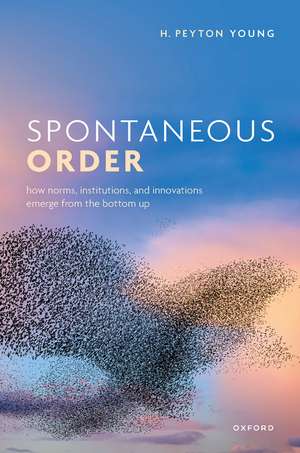
Spontaneous Order: How Norms, Institutions, and Innovations Emerge from the Bottom Up
Autor H. Peyton Youngen Limba Engleză Hardback – 10 oct 2024
Putem afirma că eroarea fundamentală a economiei clasice este presupunerea că ordinea necesită un planificator sau actori cu o raționalitate perfectă. Spontaneous Order ne provoacă să regândim acest fundament, demonstrând că cele mai robuste instituții și norme nu sunt rezultatul unui consens colectiv sau al unei viziuni de ansamblu, ci produsul secundar al unor indivizi care acționează cu informații limitate și fragmentate. Ne-a atras atenția modul în care H. Peyton Young utilizează teoria jocurilor evoluționiste pentru a explica mecanismele „bottom-up” prin care se nasc convențiile sociale.
Abordarea sa diferă de The Economic Theory of Social Institutions de Andrew Schotter prin faptul că este mai puțin axată pe analiza abstractă a jocurilor recurente și mult mai aplicabilă prin prisma sistemelor dinamice stocastice. În timp ce Schotter pune accent pe crearea tacită a instituțiilor, Young oferă un cadru riguros pentru a înțelege cum fluctuațiile și erorile individuale pot conduce, în timp, la structuri sociale stabile.
Această lucrare reprezintă o consolidare a temelor explorate anterior de autor. Dacă în Fair Representation se concentra pe mecanismele echității în alocarea locurilor parlamentare, iar în Equity – In Theory and Practice analiza distribuția resurselor publice, în Spontaneous Order el urcă la un nivel meta-teoretic. Descoperim aici o sinteză a carierei sale, integrând concepte de învățare adaptivă pe care le-a schițat în Strategic Learning and its Limits, dar aplicate acum pe o scară largă, de la biologie la inginerie. Este o analiză densă, dar esențială pentru a înțelege de ce anumite inovații tehnologice se impun, în timp ce altele, teoretic superioare, dispar.
Preț: 761.04 lei
Preț vechi: 1200.40 lei
-37%
Carte disponibilă
Livrare economică 16-21 iulie
Specificații
ISBN-10: 019889290X
Pagini: 400
Dimensiuni: 165 x 240 x 30 mm
Greutate: 0.75 kg
Editura: OUP OXFORD
Colecția OUP Oxford
Locul publicării:Oxford, United Kingdom
V-ar putea interesa
-
 The Evolution of EverythingMatt RidleyPreț: 78.37 lei
 -
 Self-Assembling Games: Language, Learning, and InquiryJeffrey A. Barrett-11%Preț: 453.06 lei509.06 lei
 -
 Game Theory: A Very Short IntroductionKen Binmore-21%Preț: 55.56 lei70.30 lei
 -
 Essentials of Econophysics ModellingFrantisek Slanina-11%Preț: 463.61 lei520.91 lei
 -
 When Everyone Knows That Everyone Knows...Steven PinkerPreț: 135.80 lei
 -
 The ScoreC. Thi NguyenPreț: 190.02 lei
 -
 The Winner's CurseRichard H. ThalerPreț: 189.81 lei
 -
 Complexity and EvolutionAlan KirmanPreț: 411.02 lei
 -
 NonlinearKevin G. BethunePreț: 142.44 lei
 -
 Shared WisdomAlex PentlandPreț: 146.02 lei
 -
 -15%Preț: 100.41 lei118.13 lei
 -
 Micromotives and MacrobehaviorThomas C. SchellingPreț: 99.99 lei
 -
 The Origin Of WealthEric Beinhocker-19%Preț: 83.64 lei103.73 lei
 -
 Primer In Game Theory, ARobert Gibbons-9%Preț: 615.43 lei676.30 lei
 -
 Economic Approaches to OrganizationsSytse Douma-15%Preț: 651.64 lei766.63 lei
 -
 The Origin of WealthEric D BeinhockerPreț: 160.95 lei
 -
 Leadership and the New Science: Discovering Order in a Chaotic WorldMargaret J. WheatleyPreț: 146.12 lei
 -
 When Everyone Knows That Everyone Knows . . .Steven PinkerPreț: 174.81 lei
 -
 Why Do We all Behave The Way We Do?S. S. O'ConnorPreț: 78.91 lei
 -
 10 to 25David YeagerPreț: 92.97 lei
De ce să citești această carte
Veți învăța cum să identificați mecanismele invizibile care guvernează succesul unei inovații sau stabilitatea unei norme într-o organizație. Cartea se adresează cercetătorilor și studenților avansați în economie sau sociologie care doresc să depășească modelele simpliste de raționalitate. Câștigați un instrumentar analitic modern, bazat pe sisteme dinamice, pentru a înțelege evoluția instituțională reală, dincolo de teorii abstracte.
Despre autor
H. Peyton Young este o figură proeminentă în economia contemporană, deținând titlul de James Meade Professor la University of Oxford și fiind profesor emerit la Johns Hopkins University. Expertiza sa este recunoscută la nivel global, fiind totodată Senior Fellow la Brookings Institution. Cariera sa este marcată de o abordare interdisciplinară, reușind să aplice teoria jocurilor în domenii diverse, de la reprezentarea politică la dinamica sistemelor economice complexe. Lucrările sale sunt fundamentale pentru înțelegerea modului în care învățarea strategică și normele de echitate modelează societatea modernă.
Descriere
Recenzii
The question of how meaningful patterns of collective behavior-in a word 'order'-emerges out of the mess of uncoordinated individual beliefs, preferences, and information, lies at the heart of social science; and nobody has thought about this question more deeply than Peyton Young. In this one volume he has distilled decades of insights, bending rigorous mathematical models with simulations, experiments, and field data. The result will challenge and inspire students and experts alike.
These essays are fundamental contributions to the theory of the dynamics underlying the emergence of Social Norms. They are essential for anyone in the field.