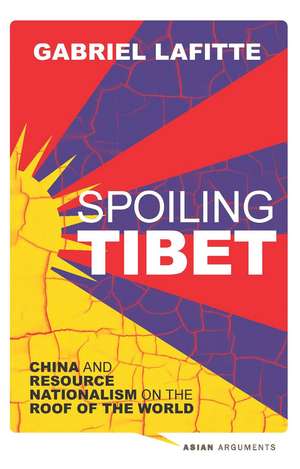
Spoiling Tibet: China and Resource Nationalism on the Roof of the World: Asian Arguments
Autor Gabriel Lafitteen Limba Engleză Paperback – 12 sep 2013
Despite great interest in Tibet worldwide, Spoiling Tibet is the first book that investigates mining at the roof of the world. A unique, authoritative guide through the torrent of online posts, official propaganda and exile speculation.
Din seria Asian Arguments
- 11%
 Preț: 155.97 lei
 - 22%
 Preț: 115.15 lei
 - 15%
 Preț: 86.92 lei
 - 44%
 Preț: 74.99 lei
 - 19%
 Preț: 128.15 lei
 - 16%
 Preț: 160.94 lei
 - 44%
 Preț: 109.61 lei
 - 16%
 Preț: 158.12 lei
 - 15%
 Preț: 134.73 lei
 - 42%
 Preț: 92.50 lei
 - 24%
 Preț: 176.52 lei
 - 43%
 Preț: 69.94 lei
 - 18%
 Preț: 155.84 lei
 - 13%
 Preț: 163.37 lei
 - 21%
 Preț: 116.32 lei
 - 16%
 Preț: 156.74 lei
 - 15%
 Preț: 156.89 lei
 - nou
 Preț: 468.90 lei
 - nou
 Preț: 161.54 lei
Preț: 159.88 lei
Preț vechi: 201.17 lei
-21%
Puncte Express: 240
Carte disponibilă
Livrare economică 16-30 noiembrie
Livrare prin curier în România Termenul estimat este afișat lângă disponibilitate.
Transport gratuit de la 400.00 lei Plată online sau ramburs, în funcție de opțiunile comenzii.
Retur gratuit în 14 zile Comandă securizată și suport în română.
Specificații
ISBN-13: 9781780324357
ISBN-10: 1780324359
Pagini: 216
Dimensiuni: 136 x 214 x 14 mm
Greutate: 0.28 kg
Editura: Bloomsbury Publishing
Colecția Zed Books
Seria Asian Arguments
Locul publicării:London, United Kingdom
ISBN-10: 1780324359
Pagini: 216
Dimensiuni: 136 x 214 x 14 mm
Greutate: 0.28 kg
Editura: Bloomsbury Publishing
Colecția Zed Books
Seria Asian Arguments
Locul publicării:London, United Kingdom
V-ar putea interesa
-
 The Elements of PowerNicolas NiarchosPreț: 125.53 lei
 -
 Preț: 107.59 lei
 -
 -31%Preț: 802.32 lei1166.47 lei
 -
 Winner Take AllDambisa Moyo-31%Preț: 64.05 lei92.84 lei
 -
 Preț: 104.91 lei
 -
 The Broken China DreamMinxin PeiPreț: 178.37 lei
 -
 -25%Preț: 91.25 lei122.32 lei
 -
 -26%Preț: 99.39 lei135.09 lei
 -
 When the Iron Bird FliesJianglin LiPreț: 283.12 lei
 -
 The Political Economy of ChinaHongying WangPreț: 180.00 lei
 -
 In Search of Green ChinaMa TianjiePreț: 159.33 lei
 -
 Eat the BuddhaBarbara DemickPreț: 78.08 lei
 -
 -18%Preț: 78.52 lei95.18 lei
 -
 The War BelowErnest Scheyder-17%Preț: 103.25 lei124.19 lei
 -
 All That GlistensMartin Thorley-23%Preț: 164.84 lei214.25 lei
 -
 The Age of ExtractionTim WuPreț: 107.73 lei
 -
 Halper, L: TibetLezlee Brown Halper-15%Preț: 138.01 lei163.17 lei
 -
 The Rare Metals WarGuillaume PitronPreț: 93.37 lei
 -
 China's Regional Development and TibetRongxing GuoPreț: 405.79 lei
 -
 Tibet, the Last CryEric MeyerPreț: 92.21 lei
Cuprins
A note on the geography of Tibet
Maps of Tibet and China
Introduction
1. Tibet in its own right
2. Gold rush in Tibet
3. Reach of the revolutionary state
4. Chromite globalization
5. Capitalizing on Tibet: privatizing the treasure house
6. Intensive exploitation
Conclusion
Notes
Further reading on Tibet
Index
Maps of Tibet and China
Introduction
1. Tibet in its own right
2. Gold rush in Tibet
3. Reach of the revolutionary state
4. Chromite globalization
5. Capitalizing on Tibet: privatizing the treasure house
6. Intensive exploitation
Conclusion
Notes
Further reading on Tibet
Index
Recenzii
Spoiling Tibet contains a fascinating wealth of information about mining in contemporary Tibet. Bringing reflections on the relationship between landscape and enlightenment together with analyses of capital flight, primitive accumulation, and the dynamics of Chinese state capitalism in an era of globalization, the book is packed full of often counter-intuitive insights. Lafitte highlights the voices of Tibetans who are excluded from decision-making and object to environmentally destructive mining, while also arguing that to date, China has not exploited Tibetan minerals as much as commonly presumed.
Gabriel Lafitte is one of the few analysts wtih a profound knowledge of the extent and impacts of mineral exploitaiton in Tibet. This book is a vital reference point for anyone inerested in the future of Tibet.
This is not just a simple book on minerals and mines in Tibet. It is the first serious study of the subject. It is also a book that tackles the issue of Tibet's sacred mountains, which are at present being badly damaged by the development of mines. At a time when Tibetans are fighting to save their physical environment as well as their religious landscape from destruction, an informative book such as this is most welcome. Written in a comprehensive and lively style, it sheds light on Chinese policies regarding Tibet's minerals resources. It is a must read for anyone interested in Tibet and in the fragility of the environment.
Gabriel Lafitte is one of the few analysts wtih a profound knowledge of the extent and impacts of mineral exploitaiton in Tibet. This book is a vital reference point for anyone inerested in the future of Tibet.
This is not just a simple book on minerals and mines in Tibet. It is the first serious study of the subject. It is also a book that tackles the issue of Tibet's sacred mountains, which are at present being badly damaged by the development of mines. At a time when Tibetans are fighting to save their physical environment as well as their religious landscape from destruction, an informative book such as this is most welcome. Written in a comprehensive and lively style, it sheds light on Chinese policies regarding Tibet's minerals resources. It is a must read for anyone interested in Tibet and in the fragility of the environment.